
What is the cloud? It is someone else’s computer that you rent over the internet, by the hour or even by the second. That old joke is true, and it is the best place to begin.
In one minute
- The cloud is computers, storage and networks owned by a provider and rented to you over the internet.
- You pay for what you use, grow when you are busy and shrink when you are quiet.
- Your data, your security settings and your costs are still your job.

How This Series Started
A few years ago I sat with the leaders of one of my largest financial technology clients. They had called me for a Comprehensive Database Performance Health Check. Very quickly the talk moved from slow queries to a bigger question: should we move to the cloud?
Everyone at the table used the word “cloud”. After ten minutes it was clear that each person meant something different. So we went back to basics, one simple question at a time. This series is my notes from those meetings, rewritten so that anyone can follow them, even if you have never touched a server.
What is the Cloud, in Plain Words
Think about how you get electricity at home. You do not build a power station in your garden. You plug in, use what you need, and pay a bill at the end of the month. The cloud works the same way for computers.
A cloud provider owns huge buildings full of computers, called data centers. You rent a small part of that power whenever you need it. You can start a server in a few minutes, use it, and switch it off. When it is off, you stop paying for it.
Providers build many data centers in many countries. A group of data centers close to each other is called a region. If one building has a power problem, the others in the region keep your system running. So when the news says “the cloud is down”, it usually means one service in one region is having a bad day, not the whole internet.
What Changes When You Use the Cloud
In that first meeting, the finance head asked the best question of the day: “Apart from the bill, what actually changes for us?” Here is what we agreed on.
- You rent instead of buy. No big hardware purchase every few years. Instead, a monthly bill that goes up and down with use.
- You grow and shrink. A report that is quiet all month and busy on the last two days can get extra power for just those two days.
- You move faster. A team can try a new idea in an afternoon instead of waiting weeks for a new server to arrive.
- You reach the world. Running your app close to customers on another continent becomes a setting, not a building project.
What Stays Your Job
This is the part many sales slides skip. Renting a flat does not mean the landlord looks after your belongings. In the same way, the provider looks after the buildings, the machines and the network. You still look after your data, who can see it, your backups and your costs. This split is called the shared responsibility model.
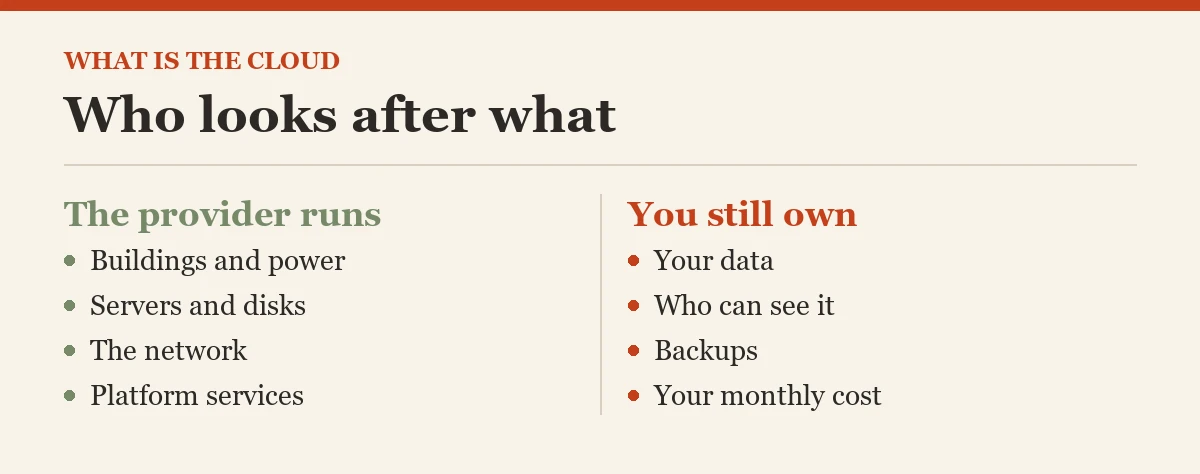
From my own work I can tell you one more thing. The cloud does not fix a slow query. It only lets you pay more to run the same slow query on a bigger machine. Good habits still matter, and in the cloud you see their value on every monthly bill.
Words to Know
- Data center: a building full of computers
- Region: a group of data centers in one area
- Provider: the company that owns and rents the computers
- Shared responsibility: the provider looks after the machines, you look after your data
Common Myths About the Cloud
- “The cloud is always cheaper.” It is cheaper for work that goes up and down. For work that runs flat out all day, it can cost more. It depends on the job.
- “The cloud is not safe.” The big providers spend more on security than most companies ever could. Most problems come from settings the customer left open.
- “We must rewrite everything first.” Many systems can move as they are and improve later. Some should stay where they are.
- “Once we move, we are done.” Moving is the start. Watching costs, security and performance continues every month.
A Quick Test: Is It Really Cloud?
I gave the team five simple questions to ask about any product sold to them as “cloud”. A real cloud service answers yes to most of them.
- Can we get it ourselves in minutes, without waiting for someone?
- Can it grow and shrink when our needs change?
- Do we pay only for what we use?
- Can our users reach it over the network from anywhere?
- Is the power shared from a big pool, so we never wait for new hardware?
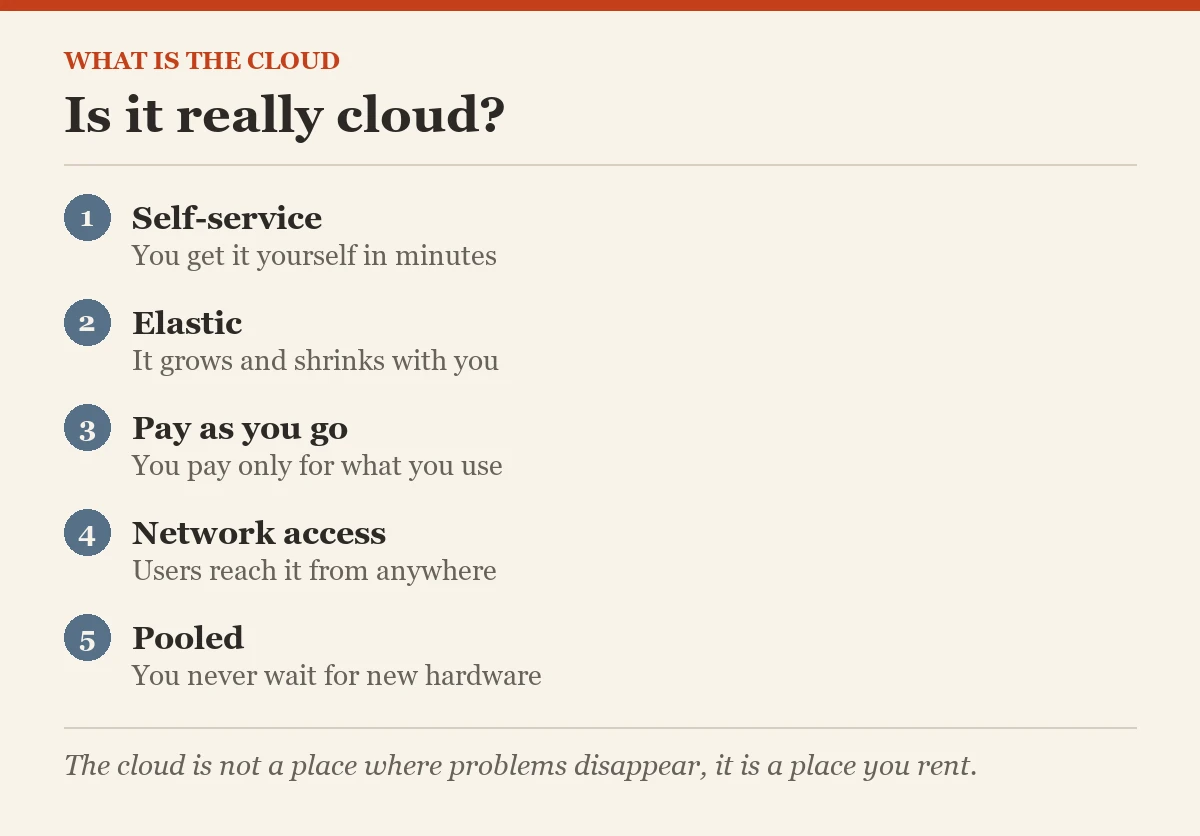
If most answers are no, it can still be a good product. It is simply old style hosting with a new name, and you should judge it that way.
What Comes Next
Now you know what the cloud is. In the next post we open the box and see how cloud computing actually works, using one simple idea that makes it all possible.
Open Source Cloud series, part 1 of 10
- What is the Cloud? (you are here)
- What is Cloud Computing?
- What are the Different Types of Cloud Deployments?
- What is Open Source?
- What is Open Source Cloud?
- Open Source Cloud: Different Options
- What are the Different Layers of Open Source Cloud?
- Checklist for the Best Open Source Cloud
- The CXO Role in Implementing Open Source Cloud
- Open Source Cloud: Final Post
Next: What is Cloud Computing?
The cloud is not a place where problems disappear, it is a place you rent where good habits pay off faster.
Published by Pinal Dave on SQLAuthority. More of my work at pinaldave.com.
Discover more from SQL Authority with Pinal Dave
Subscribe to get the latest posts sent to your email.



1 Comment. Leave new
Hi,
Thankyou for sharing the information about cloud computing and you explained very well.
I hope you will share more information about cloud.
Thankyou