
What is open source? It is software whose recipe is published for everyone to read, use, change and share. Closed source software keeps the recipe secret and sells you the finished dish.
In one minute
- Open source means the source code is public and anyone may use and change it.
- A license sets the rules for how you may use it, and licenses differ.
- Free to download does not mean free to run: people, support and skills still cost money.

Why We Paused the Cloud Talk
After we covered cloud deployments, the CTO said: “Half our vendors now say open source cloud. Before we talk about that, can we agree on what open source even means?” It was the right pause. Many expensive decisions start with a fuzzy definition.
The Recipe Comparison
Every program starts as source code, which is the human readable recipe that programmers write. The computer then turns it into something it can run.
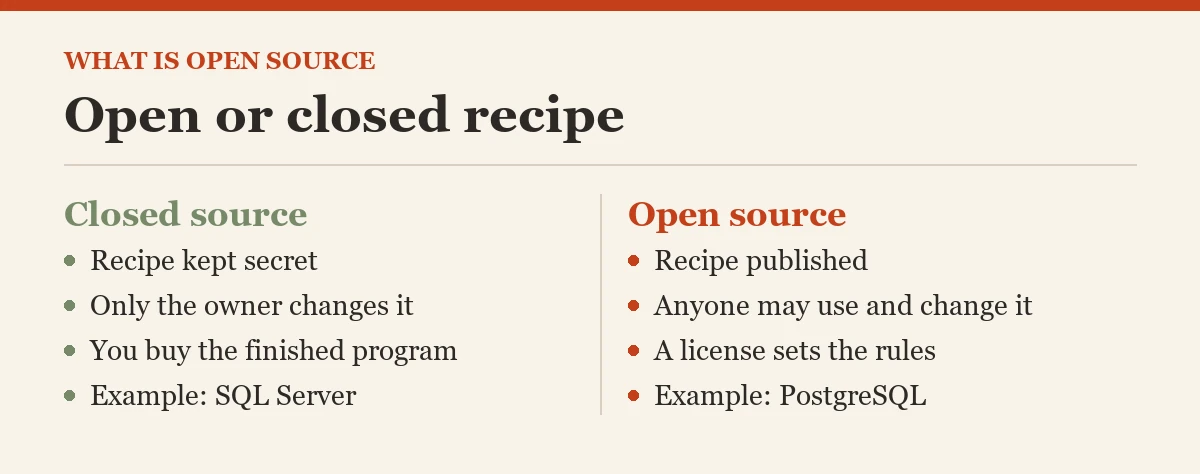
- Closed source (also called proprietary): the company keeps the recipe secret. You buy or rent the finished program, and only that company can change it.
- Open source: the recipe is published. Anyone can read it, cook it, improve it and share their version, following the rules in its license.
A few everyday examples make it clear. Microsoft Office and SQL Server are closed source. LibreOffice, MySQL, PostgreSQL and Linux are open source. Both kinds can be excellent. They simply follow different rules.
The License Is the Rulebook
Open source does not mean “no rules”. Every project has a license that says what you may do. Some licenses are very relaxed and let you do almost anything, even inside a paid product. Others ask that, if you share a changed version, you share your changes too.
This matters more today than when I first wrote this series. In recent years a few well known projects changed their license from a true open source license to a more restricted “source available” one. In some cases the community copied the last open version and carried it on under a new name. For example, when Terraform changed its license in 2023, the community started OpenTofu. The lesson for a beginner is simple: always check the license, and check it again when a new version comes out.
Why Organizations Love Open Source
- No licence fee to start. You can download and try it today.
- Freedom to look inside. Your team can read the code to understand a problem or check its security.
- A large community. Popular projects have thousands of people fixing bugs and answering questions.
- Less dependence on one vendor. If one support company disappoints you, another can support the same software.
The Honest Costs
One CFO in my meeting called open source “free as in puppy”. The puppy is free, but food, training and vet visits are not. Open source software still needs skilled people, updates, security patches and often a paid support contract. Budget for those from day one.
Words to Know
- Source code: the human readable recipe of a program
- Open source: source code anyone may use, change and share
- Closed source: source code kept private by its owner
- License: the rules for using the software
- Fork: a new project started from a copy of another
Common Mistakes Beginners Make
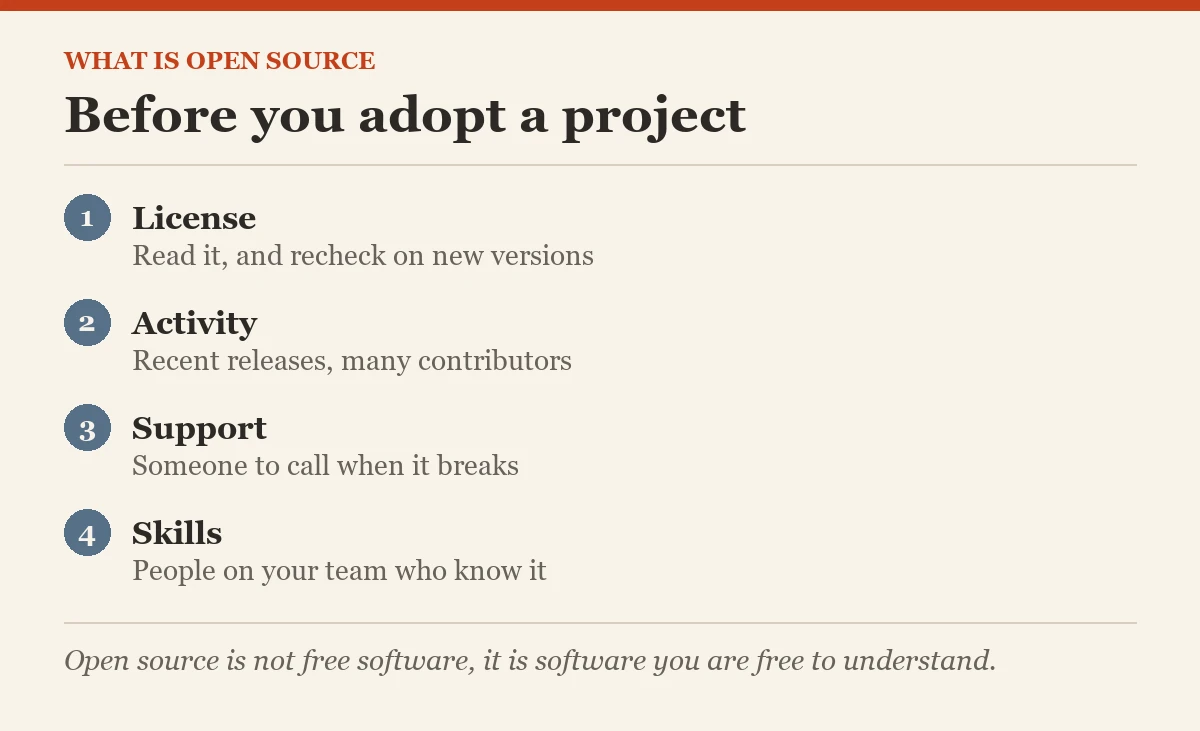
- Assuming open source means no support. Many companies sell professional support for open source products.
- Skipping the license. Legal teams should read it, especially for software you will ship to customers.
- Picking a project nobody maintains. Check how often it is updated and how many people contribute.
- Thinking open means less secure. Public code can be reviewed by many eyes. Security depends on how well it is maintained, not on who can read it.
What Comes Next
Now we have both pieces: the cloud and open source. In the next post we put them together and see what an open source cloud really is.
Open Source Cloud series, part 4 of 10
- What is the Cloud?
- What is Cloud Computing?
- What are the Different Types of Cloud Deployments?
- What is Open Source? (you are here)
- What is Open Source Cloud?
- Open Source Cloud: Different Options
- What are the Different Layers of Open Source Cloud?
- Checklist for the Best Open Source Cloud
- The CXO Role in Implementing Open Source Cloud
- Open Source Cloud: Final Post
Previous: What are the Different Types of Cloud Deployments? | Next: What is Open Source Cloud?
Open source is not free software, it is software you are free to understand.
Published by Pinal Dave on SQLAuthority. More of my work at pinaldave.com.
Discover more from SQL Authority with Pinal Dave
Subscribe to get the latest posts sent to your email.




5 Comments. Leave new
Hi Pinal Dave. Regarding your comments about open source software not being free, is it possible for a second developer to make modifications and then make the new version available to the public at a new price ? And if so would they have to reimburse the original developer a portion of the profits ?
So, some constructive criticism on your “open source” series. I think you missed probably the most important aspect…the “type” of open source license you use is CRITICAL to your business. Not all open source licenses are created equal and IMHO some of the license types can be used for nefarious purposes.
Permissive licenses like MIT, BSD, and Apache can be used by anyone and generally just require attribution. GPL and especially variants like aGPL are extremely dangerous to use, especially if you are an ISV (your business is selling software). The reason is that many gpl variants have clauses that state “if you use our software in your product you must open source YOUR code to the rest of the world”. That means your IP is at-risk. Even if you aren’t an ISV you may one day wish to merge with another ISV and any good auditor will ask for something called a “Black Duck audit” (you can google that) and if they find you are using aGPL software they may not want to merge with you.
_Some_ companies that provide gpl’d software will have a commercial license to overcome what I consider “nefarious”. What they do is threaten to sue you if you don’t open source your code or pay them. In this example gpl OSS software is definitely NOT free software. If you use OSS you need to do due diligence, especially if you are an ISV. Any company using OSS should really consider carefully researching the licensing and getting legal counsel.
Hi Dave,
Great point. I am personally not an expert on this topic so I have not much explored it.
However, I will be very interested, if you can write a guest post on this topic.
I wrote one like 6 years ago here: https://davewentzel.com/content/open-source-licensing/ . Others have also written exhaustively on the topic, the key thing to note for anyone that reads your blogs or finds them via a google search is to understand that you really should do due diligence in your choice of OSS if you are an ISV or you sell your software to others (the aGPL will require you to release your IP) or if you may be involved in M&A. Get your legal team involved. Always. These are not technology decisions solely, they are business decisions.
What is interesting in your context of “open source cloud” is how the cloud vendors are exploiting the aGPL. Not much has been written on this. For instance, AWS doesn’t really “sell” their software, it is rented, so they can do things that weren’t thought about when the aGPL was thought up. AWS has forced aGPL vendors like Confluent, Redis, and Mongo to rethink their licensing. I’m not sure I agree with what AWS did specifically to Redis but, … oh well. These are fascinating stories that should be told and understood by our industry.
And there are those proponents of the aGPL that keep saying there is nothing nefarious going on, rather they want to ensure _all_ software is free and open and the aGPL is the tool to get that leverage. I say, hogwash. You can’t force altruism and you shouldn’t try. And since it only applies to ISVs (if I use aGPL for an internal website who would ever know) this is clearly a gambit for extortion on alternative commercial licensing.
If I should jaded or overly passionate about this it is because my company was involved in a lawsuit over this. I worked a lot of late nights and weekends rewriting our code to migrate OFF aGPL software.
Thank you – great write up.