
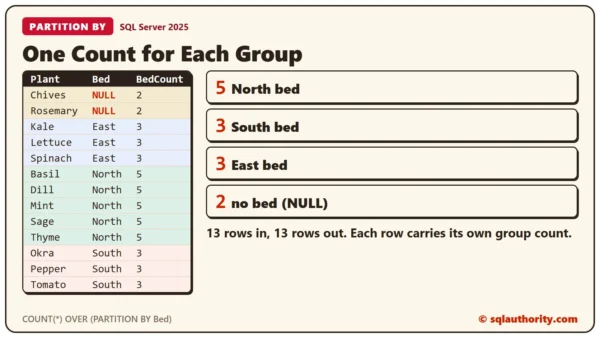
Partitioned aggregates let every row see a number for its own group, such as how many plants share its garden bed. This post uses thirteen seedlings in four beds to show PARTITION BY with COUNT and AVG. It also shows the integer division trap that turns every share into 0, and how to get one row per group.

FOR XML XSINIL: Emit Missing Fields as Explicit Nil Elements
FOR XML XSINIL can represent SQL NULL with an explicit element carrying the xsi:nil attribute. I compare that output with ordinary element omission. An empty string stays a separate input in both versions.

Aggregates With the OVER Clause: A Total Beside Every Row
Aggregates with the OVER clause put a total, an average or a minimum next to every row, so the rows do not collapse into one. This post uses eight trip costs to show the error a plain SUM gives, the fix, and the percent of the total for each row. It also shows how WHERE changes the total and how to filter on the result.

SQL Server: Use INSERT INTO SELECT Instead of a Cursor
Replace a row-by-row server inventory copy with INSERT INTO SELECT and test the results, including a loop that fails when IDs have gaps.

LIKE Character Ranges: [a-f], [^0-9] and Collation Traps
A bracket range sounds simple until the collation decides what sits between a and f. Test it once so a bad code never reaches your table.
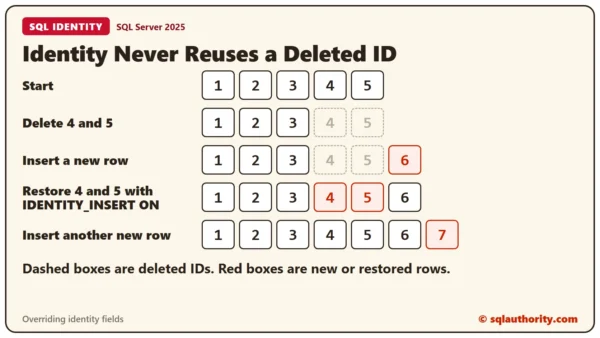
Overriding Identity Fields: Put a Deleted Row Back With Its Old ID
Overriding identity fields is rare, but restoring a deleted row with its old ID needs it. This post uses IDENTITY_INSERT to put two workshops back with their old numbers. It shows the five errors you will meet, what happens to the next automatic number, and why gaps in an identity column are usually fine.
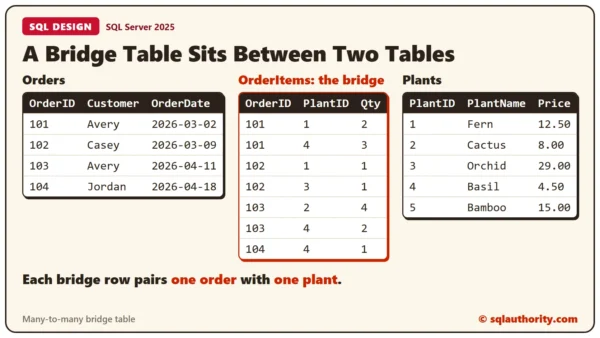
Many-to-Many Bridge Table in SQL Server: Model and Query It
A many-to-many bridge table links two tables that each have many partners in the other, such as orders and plants. This post builds one with a composite key and two foreign keys, then joins it three ways. It also shows what the keys block and why an inner join hides plants nobody ordered.
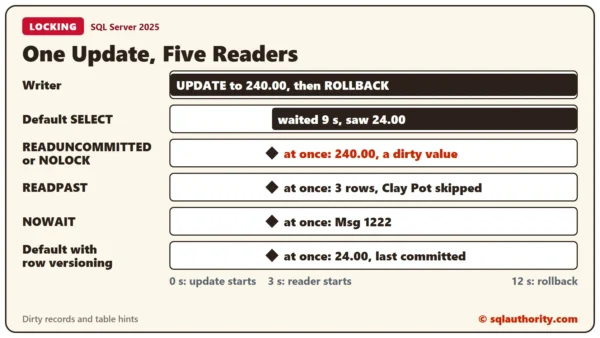
Dirty Records and Table Hints: Wait, Read Dirty, Skip or Fail
Dirty records and table hints decide what a SELECT does while another session has an uncommitted change. This post runs one update that rolls back and five readers against it: the default, READUNCOMMITTED, NOLOCK, READPAST and NOWAIT. It also shows how a database option changes the default.
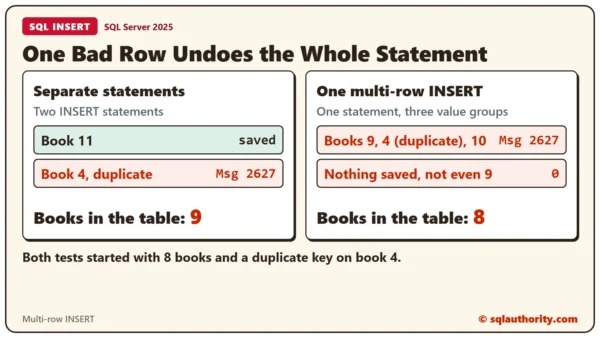
Multi-Row INSERT in SQL Server: One Statement, All or Nothing
A multi-row INSERT adds several rows with one statement, using a list of value groups separated by commas. This post compares it with separate INSERT statements on a small table of books. It shows that one bad row undoes the whole statement, and it covers the errors and the 1,000 row limit.

Unmatched Records Query: Four Ways to Find Rows With No Match
An unmatched records query finds the rows in one table that have no partner in another, such as plants that never sold. This post runs four versions on a small table: LEFT JOIN with a NULL test, NOT EXISTS, NOT IN and EXCEPT. It also shows the NULL trap that makes NOT IN return nothing.