

Keep SQL Server logs readable by recycling the error log weekly, retaining enough archives, setting a size cap, and checking history.

Designing a Simple ETL Framework
An ETL framework in SQL Server needs a small set of configuration, run logs, restart checkpoints, and alerts that operators can trust.

CHECKPOINT Behavior Quiz: What Lets the Log Be Reused?
This CHECKPOINT Behavior Quiz asks what lets SQL Server reuse transaction log space under the SIMPLE and FULL recovery models. The answers differ, and a tested script shows both. It also shows how one open transaction keeps the log from being reused.

Logging ETL Runs in a Table
Logging ETL runs in SQL Server gives each step start and end times, row counts, and errors so the next morning’s investigation has facts.
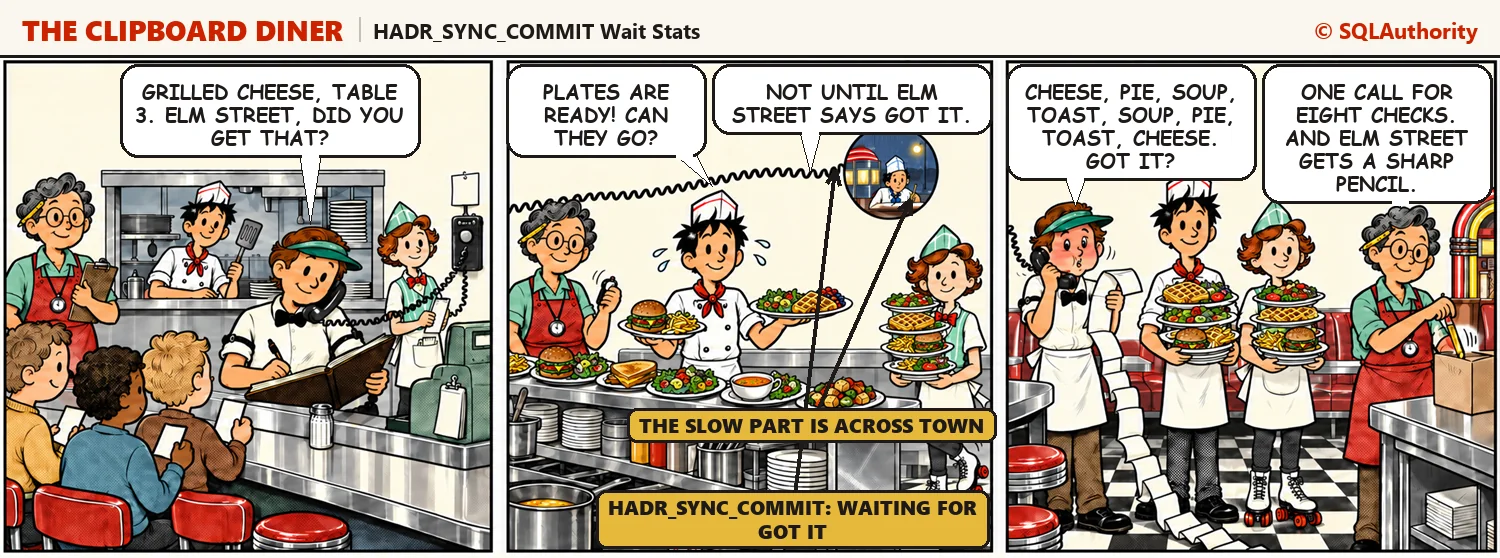
HADR_SYNC_COMMIT Wait Stats: Availability Group Commits
HADR_SYNC_COMMIT wait stats measure how long a commit waits for a synchronous secondary replica to harden the log. On Night 22 at the Clipboard Diner, every sale is phoned to a sister diner before the plate can leave. Learn what the wait includes, how to read the send and redo queues, and the fixes from the secondary’s log disk to asynchronous commit.
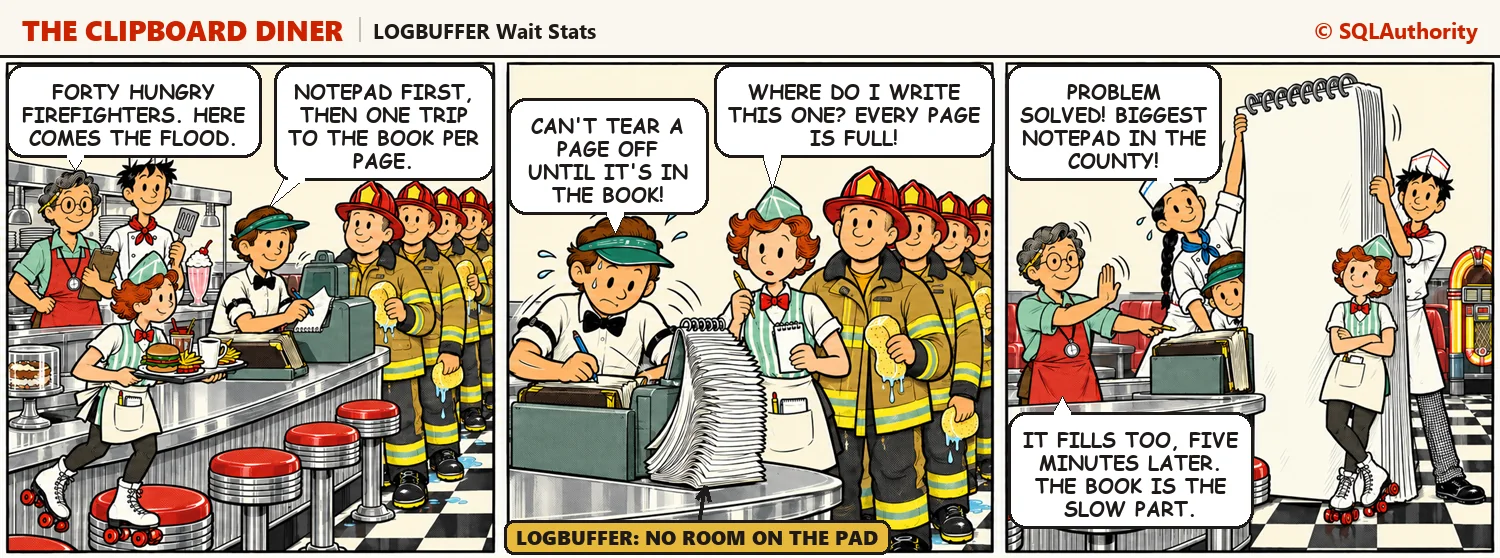
LOGBUFFER Wait Stats: When the Log Buffer Fills
LOGBUFFER wait stats mean a task is waiting for free space in the log buffer before it can write a log record. On Night 18 at the Clipboard Diner, Pat’s notepad fills up faster than Pat can copy it into the order book. Then two queries show whether your log can keep up, and the fixes in order.
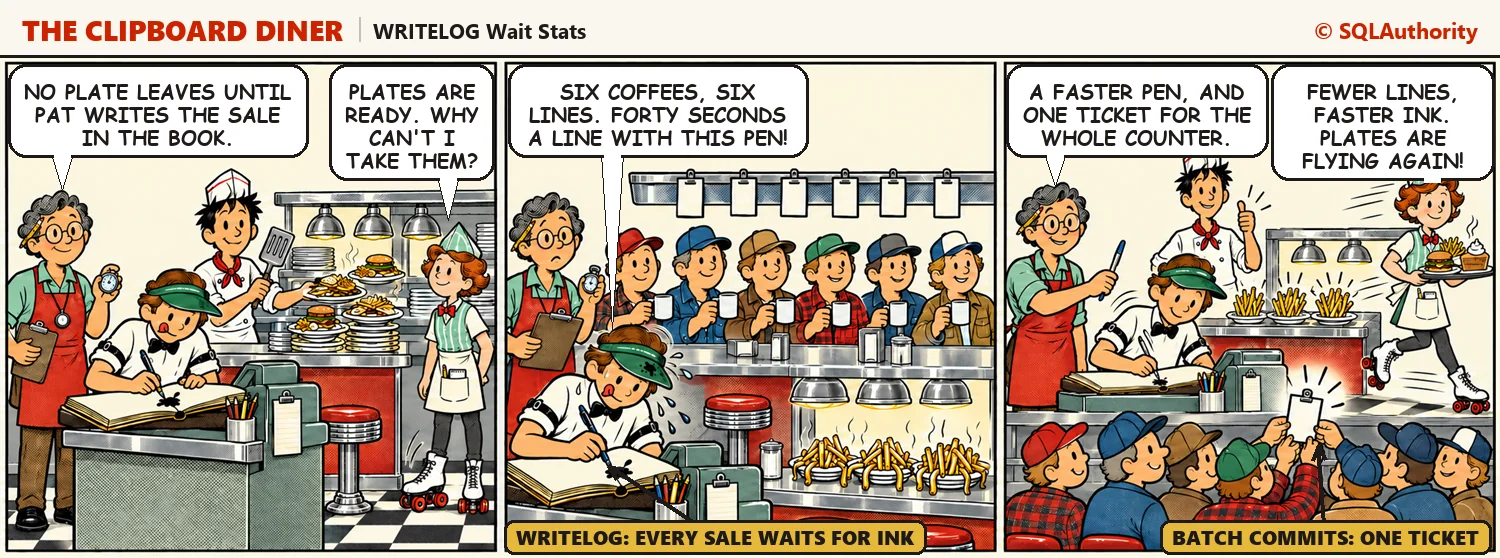
WRITELOG Wait Stats: Transaction Log Flush Waits
WRITELOG wait stats measure the time a commit waits for its log records to reach the disk. On Night 17 at the Clipboard Diner, Pat’s pen slows down and plates pile up at the pass. Then two queries show your log write latency, and a short script shows why many tiny commits hurt.