Rank your work every morning and give each task its own place, because only one task can be number one.
ROW_NUMBER in SQL Server never hands out the same number twice. Even when two rows look identical, one gets 1 and the other gets 2. Your task list needs the same discipline.

The Problem With a Priority List
Most task lists are a pile with labels. Five items are marked high, three are marked urgent and the rest say important. When everything is first, you pick whatever feels loudest or easiest.
That’s the same mistake as sorting data on a column full of equal values. The database returns something, but the order between equal rows isn’t guaranteed. It can change from one run to the next. Your day changes the same way, depending on who pinged you last.
A label isn’t a ranking. A ranking says what goes first, what goes second and what waits. If a list can’t answer that, it’s a list of things you worry about.
Why Ties Are the Enemy
SQL also has RANK, which lets two rows share first place and then skips second. I tested both on SQL Server 2025 with the values 5, 5, 3 and 1. ROW_NUMBER returned 1, 2, 3, 4, while RANK returned 1, 1, 3, 4.
Task lists behave like RANK. Two items share first place, and the third slides down without anyone noticing. Behave like ROW_NUMBER instead. Every task gets a unique place, so the order is a decision and not an accident.
Rank in Five Minutes
Write down every task you could do tomorrow. Then number them from 1, with no repeats. Number one gets your first and best block of time. Don’t start number two until number one is done or blocked.
Blocked is a real status. If you’re waiting on a review, send the request and move to number two. Come back later. Don’t let a wait turn into an excuse to reshuffle the whole list.
Do the ranking at the end of the previous day. Five calm minutes at 5 PM beat five rushed minutes at 9 AM, when messages are already competing for you. You walk in knowing what comes first.
A Morning Example
Here’s what a ranked list looks like for a DBA with five tasks on tomorrow’s plate. The tasks are made up, and the reasons are the part to copy.
| Rank | Task | Why it sits there |
|---|---|---|
| 1 | Review the schema change | A deploy depends on it, and the date is fixed. |
| 2 | Fix the flaky nightly job | It pages the on-call person when it fails. |
| 3 | Answer the data request | Someone is waiting, but there’s no hard date. |
| 4 | Update the runbook | It saves time later and nobody is blocked today. |
| 5 | Clean up old test tables | Nothing waits on it. |
Every row has a reason you can say in one sentence. If you can’t, the task is in the wrong place or the list is too long. Number five can wait all week, and that’s fine. Now it’s a choice you made on purpose.
Rank Only What You Could Do Tomorrow
Your whole backlog doesn’t belong on the ranked list. Fifty ranked items is a backlog with numbers on it. Rank the handful you could realistically start tomorrow, and leave the rest in a plain parking list.
Each evening, pull the next items up from the parking list as space opens. The ranked list stays short enough to read in ten seconds, and number one is always visible.
Break Ties With a Rule
Two tasks will look equal. In SQL you fix that by adding a second column to ORDER BY. The same input then always gives the same order. That second column is a tie-breaker, and your work needs one too.
Use the same questions in the same order. The first one that separates the two tasks decides.
- Does one task block another person?
- Does one have a hard date?
- Which costs more if it waits a week?
- Which is smaller?
Take the data request and the runbook update from the example. Neither has a hard date. The data request has someone waiting on it, so it goes first.
Write the rule down once and apply it without debate. You stop re-arguing the list every morning, and your teammates learn how you choose. After a while they stop asking you to guess.
Re-Rank When Something Real Arrives
Sometimes a new task outranks number one. A production issue or an urgent request from your manager qualifies. Insert it at the top and move everything else down one place. The old number one becomes number two, not a deleted task.
If the task that slid belongs to someone else, tell them the same day. A short message such as “this moved to second place, new date Thursday” keeps their trust.
Say it out loud: this new work is first, so the old work moves down. It keeps the ranking honest. A list that grows without anything moving down has turned back into a pile.
Be strict about what qualifies. A request that’s loud isn’t the same as a request that’s important. Run it through your tie-breaker questions like any other task, and let the answer set its place.

Start the Day With Number One
Give number one your first block, before email and before chat. Open the task, write one line about what done looks like and start. The ranking only works if the top item gets the best hours.
If you’re stuck on it for 45 minutes, don’t quietly drift to something easier. Write down exactly what’s blocking you, ask the person who can unblock it and then move to number two. Being stuck is a status, so say it out loud.
What Number Two Is For
Number two is the task you pick up when number one is blocked or finished. Because you ranked in advance, the switch costs nothing: you don’t spend ten minutes deciding what’s next.
Review the bottom of the list once a week. A task that stays at the bottom for a month needs a decision. Either it matters less than you thought, so drop it. Or it matters more, and you’ve been avoiding it.
Rank Meetings and Messages Too
Your list isn’t only tasks. A meeting invite or a chat message is also a claim on your time, and it deserves a rank. Ask where it falls against number one.
If it outranks the task you’re on, go. If it doesn’t, decline, send your input in writing or ask for the notes. The ranking works only when everything competes on the same list.
Share the Ranking
Put your ranked list where your team can see it. A shared note works, and so does a message at the start of the day. People stop asking whether you’ve started their request, because the list answers for you.
The Objection: Everything Is Priority One
The common pushback is that your manager calls everything a priority. You can’t rank what you’re told is equal.
You can still ask. Bring the ranked list and say: this is how I’m sequencing the work, please correct the order. A manager who labels everything first hasn’t seen the trade-off yet. A numbered list shows it.
Even a wrong ranking gets corrected faster than an unranked pile. Someone will say number three has to go ahead of number one, and now you know what matters.
Try This Week
- Write tomorrow’s tasks at the end of today.
- Number them from 1, with no repeats.
- Pick a tie-breaker rule and use it every time.
- Work on number one first and skip it only when blocked.
- When new work arrives, insert it and move the rest down.
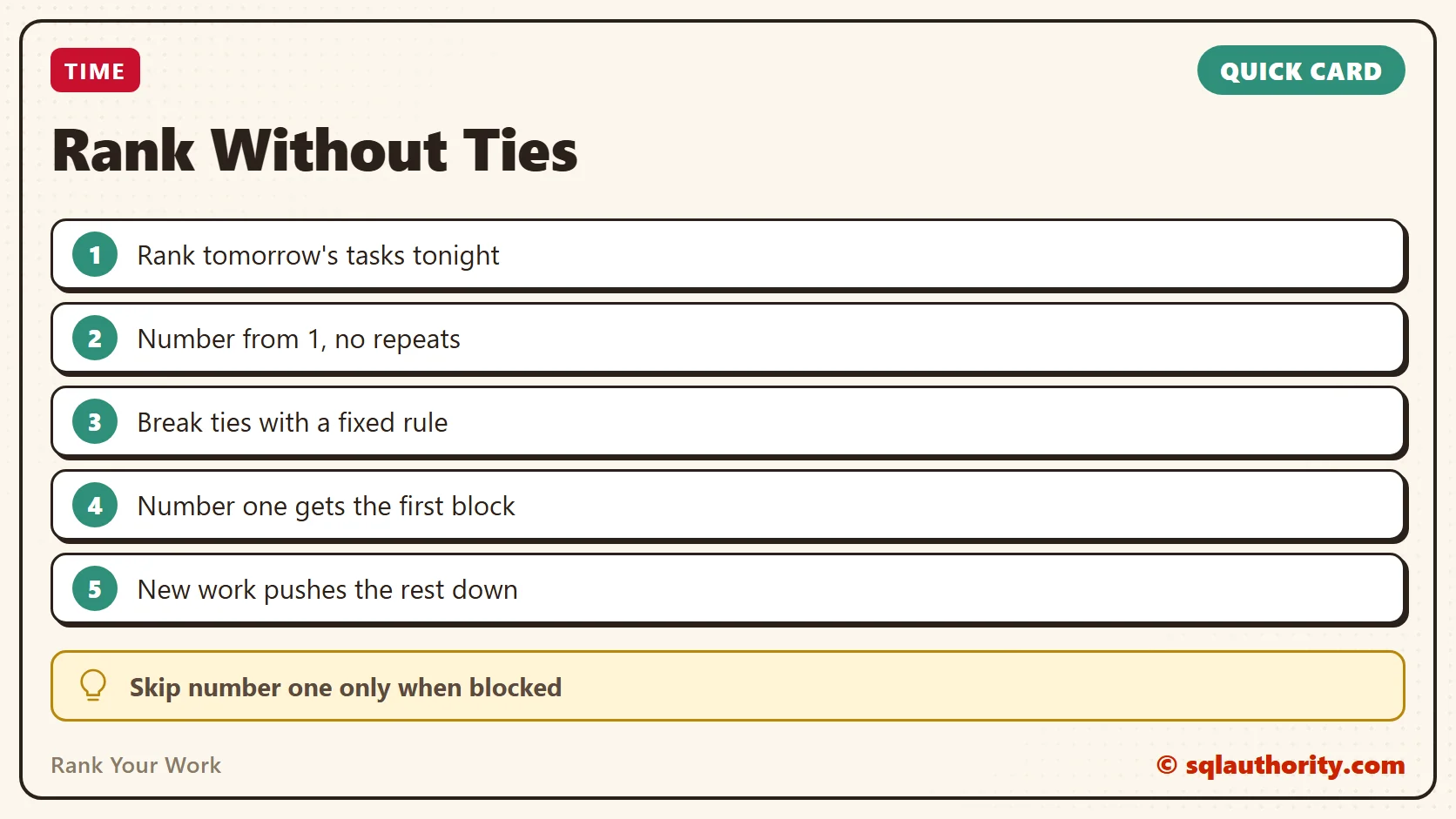
A priority list is not a list where everything matters, it is a list where one thing goes first.
Published by Pinal Dave on SQLAuthority. More of my work at pinaldave.com.
Discover more from SQL Authority with Pinal Dave
Subscribe to get the latest posts sent to your email.