To say no at work without burning bridges, queue the request instead of refusing it.
A server at capacity has two choices. It can accept everything and time out later, or it can queue requests and quote a wait. Most of us pick the first, because yes feels kind in the moment. The second is kinder in the long run.

Why Yes Costs More Than No
Every yes is a commitment with a deadline. When you’re already full, a new yes pushes work you promised earlier into the gap. Someone gets a late delivery, and it’s rarely the person who asked last.
That’s a timeout. The request was accepted and then failed after a long silence. That’s the worst outcome for a caller who planned around you. A quick “not this week” would have let them plan around something else.
Burned bridges come from broken promises, not from honest limits. A colleague who hears “Thursday” and gets it on Thursday trusts you. One who heard yes and waited three weeks doesn’t. A clear no today protects the relationship you’ll need next month.
Know Your Capacity First
You can’t queue what you can’t see. Write down everything you’ve already committed to, with dates, and count it carefully. That list is your connection pool: a fixed number of slots, and most of them are in use.
Update it whenever you take something on or finish something. A list kept only in your head always has room for one more thing. That’s how people end up over-committed.
Look at the list on Monday morning and again on Thursday. A weekly look shows which commitments are slipping while you can still warn someone.
Count your slots, too. If you can run two projects at once and still do your regular work well, you have two slots. Anything that arrives when both are taken goes in the queue, however small it looks.
Sort the Request First
Before you answer, ask one question: can this wait? A broken backup or a blocked release can’t. A report for next month, a code review with no date or a favor for another team can.
The first kind goes to the front, and something else moves down to make room. The second kind goes in line. Sorting takes ten seconds, and it stops you from treating a casual ask like an incident.

Answer Fast and Give a Place in Line
Reply within a day, even when the answer is later. Silence looks like a refusal and feels worse. A good reply acknowledges the request, says where it sits in your queue and gives a date.
For example: “I can’t start this week. My current work covers the migration and the audit fixes. I can start next Monday, or I can ask a teammate who has room now.” It’s short, honest and specific.
If you need time to check your calendar, say that and name the hour you’ll reply. “Let me check my list and answer by 3 PM” is a fine first message.
The reply has no long apology and no speech about your workload. The wait time does the explaining, and the requester can decide what to do with it.
Offer Options, Not Only Refusals
A server has more tools than accept or reject. It can shed load, serve a saved answer or route the call to another node. You can offer the requester the same range.
Propose a smaller version or a later start. Or ask what should move down: “If I take this, the report slips to Friday. Is that the trade you want?” The requester, or their manager, then makes the decision.
People accept a trade that’s laid out plainly. What they object to is finding out three days later that something else slipped.
Replies for Common Cases
The same shape works in most situations. Adjust the words so they sound like you. These examples are made up.
| Situation | A reply that queues |
|---|---|
| A teammate asks for a quick review | I can look at it on Thursday morning. Is that early enough? |
| Your manager adds a new project | I can start it. The migration then slips by a week. Do you want that trade? |
| Another team needs a script tomorrow | I can’t do tomorrow. I can send it Wednesday, or I can review a draft if someone else writes it. |
| A stakeholder wants one more report | It goes in my queue behind two items. I’ll confirm a date by Friday. |
Each reply gives a time or a trade. None of them leaves the person guessing. That shape holds whether you’re talking to a peer or a director.
Open With Thanks
A request is a sign that someone trusts you with the work. Say that before you say anything about the queue. “Thanks for thinking of me for this” costs nothing and changes how the rest of the message lands.
Keep the tone steady, not apologetic. You’re reporting the state of a system that has a limit, and every system has one.

Keep Your Place in the Queue
A date you give is a promise, so keep it. When the day arrives, do the work or say before the day that it’s moving. Send the update early. A short note before the date costs less than an apology after it.
Tell people when their request moves forward, too. A short note such as “your item is next” makes the wait feel managed. They stop asking for status, and you stop answering the same question five times.
When You Have Already Said Yes
Sometimes you said yes last week and you’re now over capacity. Say so as soon as you see it, not on the due date. Early news gives people time to adjust, and late news gives them a problem.
Go back with a plan. Offer a smaller scope or a new date, and name who can take part of it. Ask what matters most, and let that answer decide what you protect. Renegotiating early costs a short, awkward talk, and failing late costs far more.
Put a Limit on the Queue
An unlimited queue hides refusals. A request that waits six months has been refused already, without anyone saying so. Decide how long you can keep a request waiting, and say no outright after that.
If a request doesn’t fit your role, say so and point the requester to the right place. A clear refusal protects the relationship better than a vague “maybe later” that never arrives.
Sometimes the honest answer is no, with no date at all. Work outside your role should go back to the requester, with a suggestion of who can take it. Say it plainly and kindly, and give the reason in one sentence.
The Objection: My Boss Just Adds More
The pushback here is that queueing sounds nice, but when your boss assigns work, there’s no queue to join. The work lands.
Your boss owns the priorities, so show them the queue. Share the committed list and ask which item should move. A boss who hasn’t seen the whole list can’t weigh it. A visible list turns an order into a trade-off.
If everything stays, the list shows that a deadline will move, and you’ve said so in writing. That’s a different conversation from the one you’d have in a month, when something fails.
Try This Week
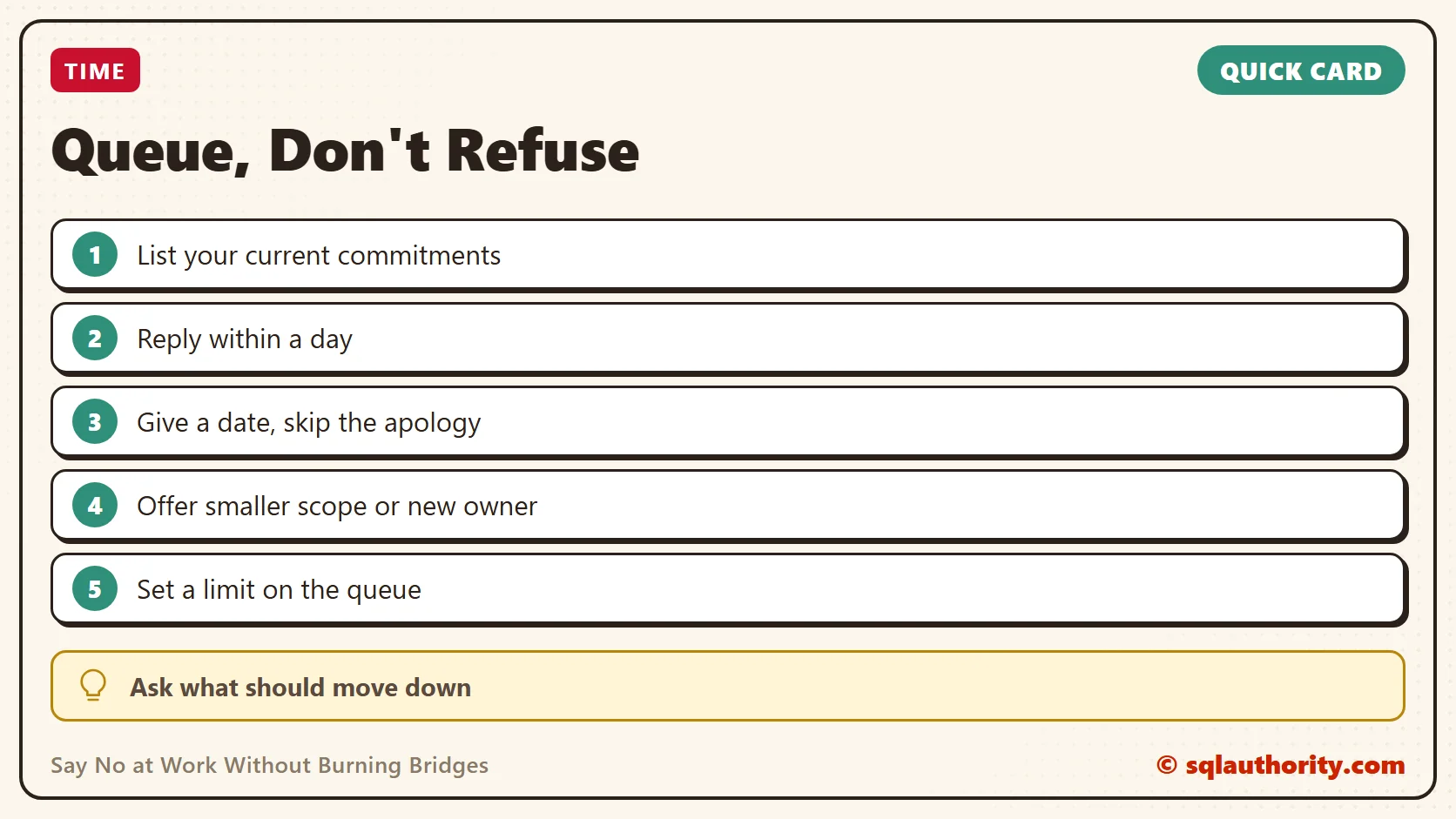
- List everything you’ve already committed to, with dates.
- Reply to each new request within a day, even if the answer is later.
- Give a start date, not an apology.
- Offer a smaller scope or a different owner.
- Decide how long a request may wait before you say no.
A good no is not a closed door, it is a place in line with a date on it.
Published by Pinal Dave on SQLAuthority. More of my work at pinaldave.com.
Discover more from SQL Authority with Pinal Dave
Subscribe to get the latest posts sent to your email.