

Store emoji safely with nvarchar or UTF-8 varchar, compare LEN and DATALENGTH, and choose message limits that fit full Unicode.

Cleaning Messy Data With T-SQL
Cleaning messy data With T-SQL means trimming text, parsing dates safely, and preserving rejected source rows for correction and replay.

CHAR, VARCHAR, NVARCHAR and VARCHAR(MAX) Quiz: How Many Bytes?
This CHAR, VARCHAR, NVARCHAR and VARCHAR(MAX) Quiz stores the text abc in three columns and asks how many bytes each one uses. The answer is 10, 3 and 6. A tested script proves it and shows the trailing space trap, the question mark problem and the 8,000 byte limit.


SQL SERVER 2012 – String Function CONCAT() – A Quick Introduction
SQL Server 2012 adds the String Function CONCAT(), which joins two or more values into one string. Examples show how it handles numbers, dates and NULLs.
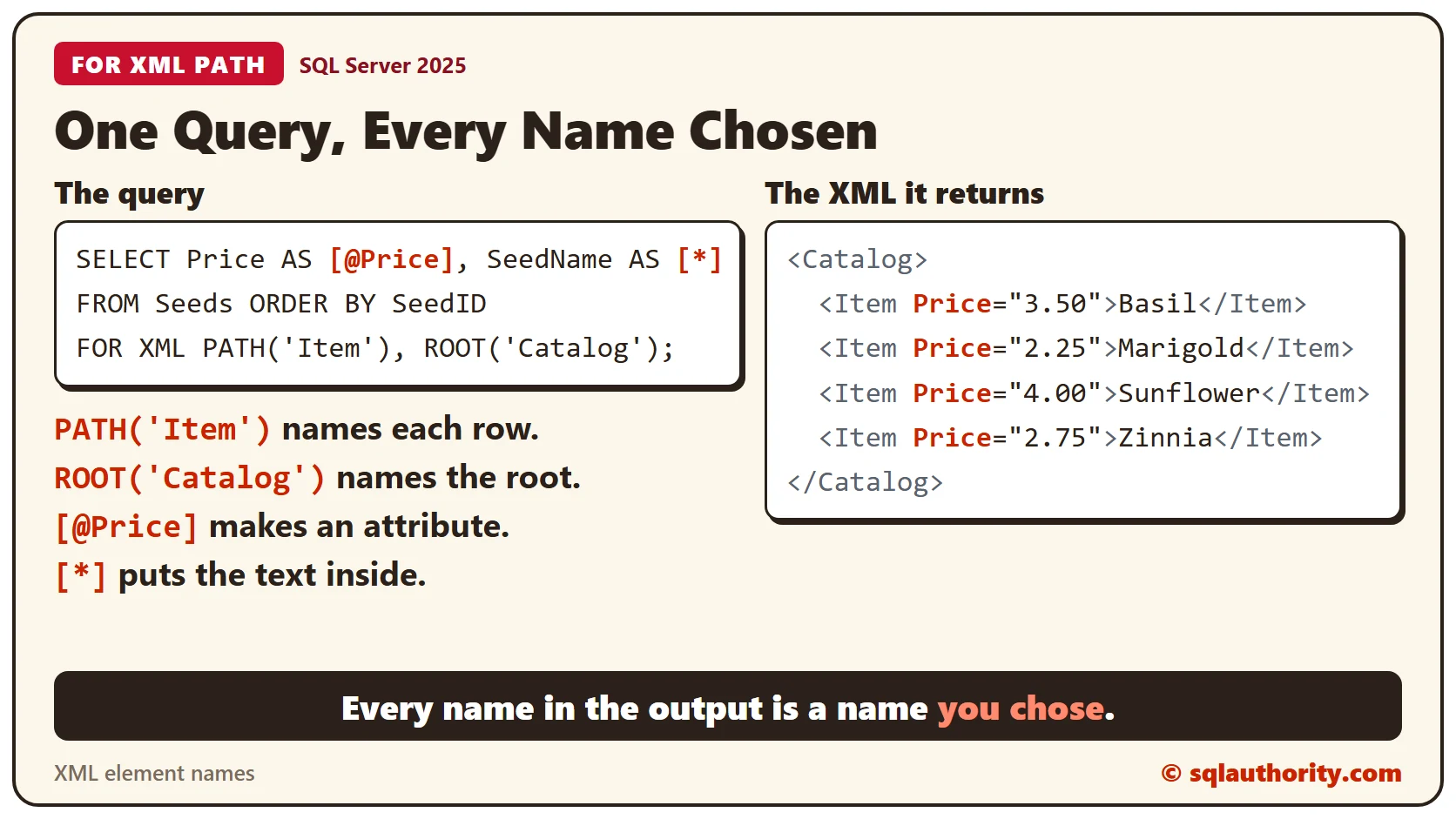
XML Element Names in SQL Server: Row, Root and Text With FOR XML PATH
XML element names in SQL Server come from your query, and FOR XML PATH lets you choose them. This post sets the row and root names, turns a column into an attribute, writes text inside an element and shows the error you get when an attribute column comes too late. Every result comes from SQL Server 2025.

AI_GENERATE_CHUNKS in SQL Server 2025: Splitting Long Text Into Pieces
AI_GENERATE_CHUNKS cuts one long piece of text into smaller pieces inside a query. This post tests the preview function on SQL Server 2025, shows what its columns hold and how overlap works, and explains how chunk size changes the number of pieces.