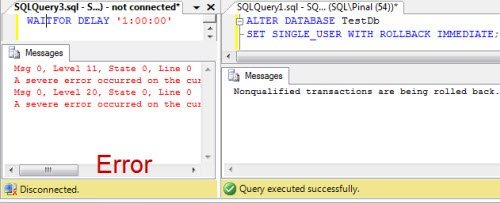
We are going to discuss something very simple topic. Difference Between ROLLBACK IMMEDIATE and WITH NO_WAIT during ALTER DATABASE.
SQL SERVER – Checklist for Analyzing Slow-Running Queries
I am recently working on upgrading my class Microsoft SQL Server 2005/2008 Query Optimization and & Performance Tuning with additional details and more interesting examples. While working on slide deck I realized that I need to have one solid slide which talks about checklist for analyzing slow running queries. A…
Read MoreSQL SERVER – Force Index Scan on Table – Use No Index to Retrieve the Data – Query Hint
Recently I received the following two questions from readers and both the questions have very similar answers. Question 1: I have a unique requirement where I do not want to use any index of the table; how can I achieve this? Question 2: Currently my table uses clustered index and…
Read MoreSQL SERVER – Improve Performance by Reducing IO – Creating Covered Index
This blog post is in the response of the T-SQL Tuesday #004: IO by Mike Walsh. The subject of this month is IO. Here is my quick blog post on how Cover Index can Improve Performance by Reducing IO. Let us kick off this post with disclaimers about Index. Index…
Read MoreSQL SERVER – Performance Comparison – INSERT TOP (N) INTO Table – Using Top with INSERT
Recently I wrote about SQL SERVER – INSERT TOP (N) INTO Table – Using Top with INSERT I mentioned about how TOP works with INSERT. I have mentioned that I will write about the performance in next article. Here is the performance comparison of the two options.
SQLAuthority News – Excellent Event – TechEd Sri Lanka – Feb 8, 2010
TechEd Sri Lanka was held at Waters Edge, Colombo between Feb 8 and Feb 10, 2010. It was one of the largest successful technical event in Sri Lanka. I was extremely surprised to how technically sound this event was and how excited the TechEd attendees were. I presented there on…
Read MoreSQL SERVER – Data and Page Compressions – Data Storage and IO Improvement
The performance of SQL Server is primarily decided by the disk I/O efficiency. Improving I/O definitely improves the performance. SQL Server 2008 introduced Data and Backup compression features to improve the disk I/O. Here, I will explain Data compression. Data compression implies the reduction in the disk space reserved by…
Read More