
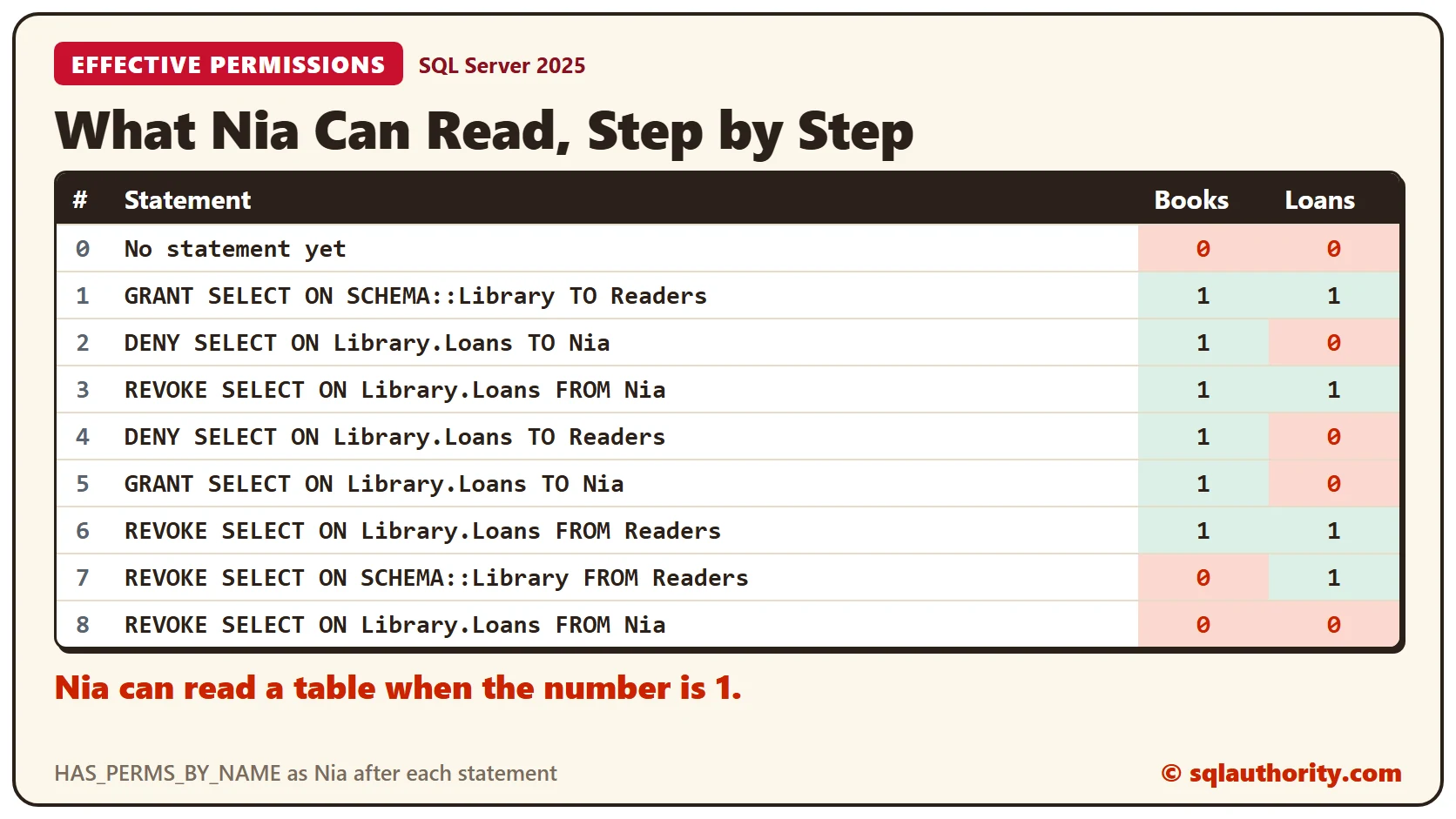
Effective permissions are what a user can do after every GRANT, DENY and REVOKE has been added together. This post follows one user through eight statements, with a role, a direct DENY and a direct GRANT, and checks the result after each step with HAS_PERMS_BY_NAME. It then shows how to take away one ability from a user who holds CONTROL. Every result comes from SQL Server 2025.

Word Search Without Full-Text: Build a Word Index Table
LIKE with a leading wildcard reads the whole table. A small side table of words turns that scan into a quick lookup, and you do not need full-text installed.


SQL SERVER – Identify Columnstore Index Usage from Execution Plan
My two word Twitter reply was “From Operators,” so here is the full answer on how to spot columnstore index usage in the execution plan.

SQL SERVER – A Tricky Question and Even Trickier Answer – Index Intersection – Partition Function
Can one table, used once, give 2 join operators in an execution plan? Readers used ranking functions, and my own answer relies on index intersection.

Reading Default Data and Log Paths With InstanceDefaultDataPath
Changing the default folder does not move a single existing file. Here is how to read the defaults and spot databases that ignore them.

SQL SERVER – Maximum Allowable Length of Characters for Temp Objects is 116 – Guest Post by Balmukund Lakhani
Object names in SQL Server can be up to 128 characters, but local temp tables stop at 116. Guest author Balmukund Lakhani explains this limit for Temp Objects.