The first time an enterprise AI system gives a wrong answer, people usually blame the model. Let us talk Enterprise AI’s Hidden Problem Is Organizational Amnesia in detail.
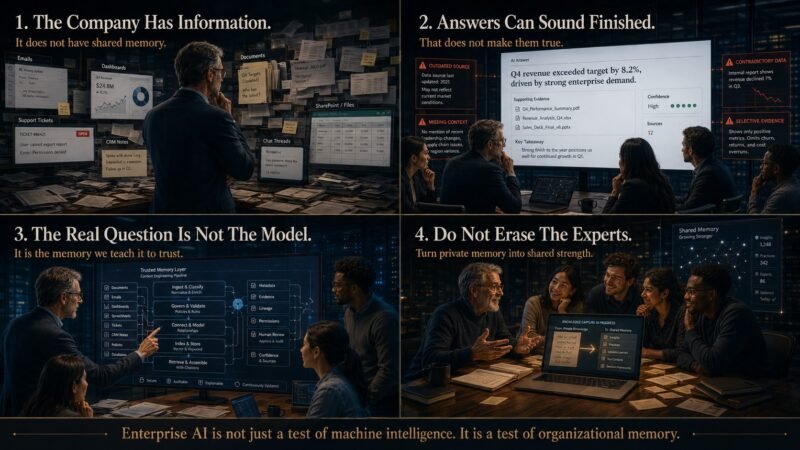
AI does not fail only when it forgets. It also fails when the company remembers badly.
Why the smartest model in the room still fails when the company cannot remember what it knows
The first time an enterprise AI system gives a wrong answer, people usually blame the model.
They say the model hallucinated. They say the prompt was weak. They say the vendor overpromised. They say the technology is not mature enough yet. Sometimes that is true. Models can be wrong. Prompts can be poor. Vendors can absolutely make a demo look like a magic show with a purchase order attached.
But after spending decades around databases, reporting systems, business rules, performance problems, and production surprises, I have learned something uncomfortable. Many enterprise AI failures do not begin inside the model. They begin inside the company.
The model is not always inventing the confusion. Sometimes it is simply reflecting the confusion that was already there.
That is the uncomfortable part of enterprise AI. Sometimes the model is not hallucinating. Sometimes the company is.
Every enterprise believes it knows what it knows. Ask any leadership team if the company has policies, customer history, process documents, pricing rules, support tickets, architecture diagrams, project notes, product knowledge, audit history, and years of decisions. The answer will usually be yes. Of course we have that. It is in the system.
Then you ask a slightly different question: which system?
That is when the room gets quiet in a very enterprise way.
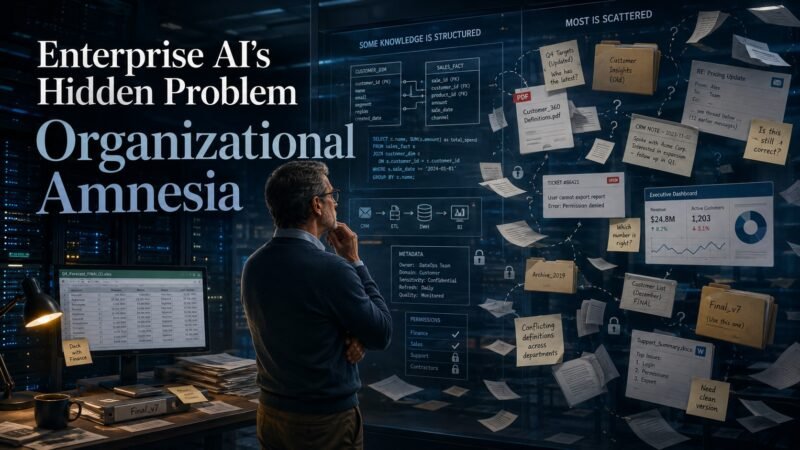
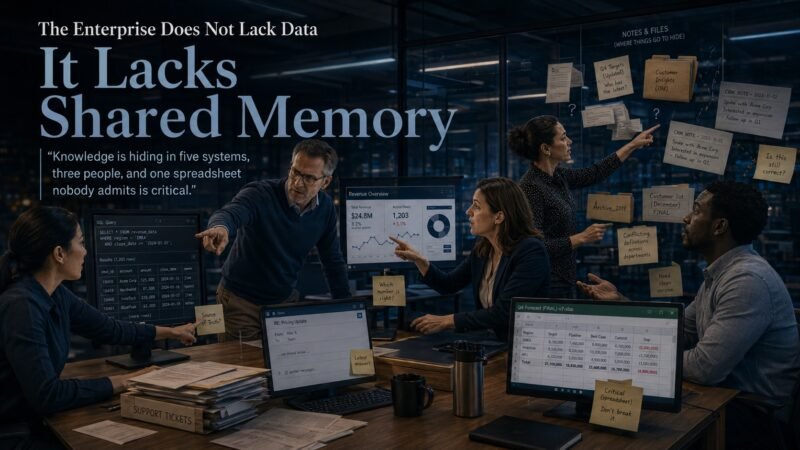
In most enterprises, knowledge is not missing. It is hiding in five systems, three people, and one spreadsheet nobody admits is critical.
The policy is in SharePoint. The newer policy is in a Teams channel. The practical version of the policy is in someone’s head. The customer exception is in an email thread. The contract note is in the CRM, but the real reason behind it was explained in a meeting recording nobody has opened since last quarter. The report is in Power BI, but everyone knows the finance team uses the spreadsheet because the dashboard has one filter nobody trusts. The process is documented, but the team follows the process that actually works.
This is where enterprise AI begins to struggle. Not because it lacks intelligence, but because the organization has memory scattered across tools, people, habits, exceptions, and history.
That is organizational amnesia.
The company has the information, but it cannot reliably remember it at the moment of need.
Enterprise AI is not asking whether your company has information. It is asking whether your company can find truth when it matters.
The Enterprise Does Not Lack Data. It Lacks Shared Memory.
Most companies are not starving for information. They are drowning in it. There are documents, tickets, dashboards, databases, emails, meeting notes, PDF files, internal portals, wikis, slide decks, support conversations, and old folders with names that look like archaeological evidence.
I have seen this pattern for years in the SQL world. There is a table everyone uses, but nobody knows who created it. There is a stored procedure that nobody wants to touch because it “just works,” which usually means it stopped being understood long ago. There is a report that drives business decisions, but the logic behind it is buried in joins, filters, assumptions, and one magical CASE statement written by someone who left the company in 2017. There is always one person who knows why the number is different on Monday morning. That person is not a system of record, but many companies quietly treat them like one.
Every database professional knows this truth: data can be technically stored and still be practically lost.
Humans have learned to survive inside this mess. They know whom to ask. They know which file is trusted. They know which dashboard is official and which dashboard is useful. They know which column is badly named but important. They know which “final” document is not final at all.
AI does not know any of this.
AI has no office instinct. It does not understand that “Final_v7_Updated_ReallyFinal.pdf” may still not be final. It does not know that the official pricing document is technically current but commercially useless because sales has been following a newer exception rule. It does not know that a dashboard is accurate for one region but dangerous for another. It does not know that a policy was approved by legal but quietly avoided by operations because it breaks the workflow.
The model reads what the company gives it. If the company gives it scattered memory, the answer becomes scattered too, only with better grammar.
A model does not magically become enterprise-ready because it can read documents. It becomes useful only when it can trust the right documents.
That is why AI demos look beautiful and production AI feels hard. In a demo, the context is clean, the source is selected, the user journey is controlled, and the answer has a comfortable path. In production, the AI system has to live inside the real organization, where knowledge is stale, duplicated, missing, restricted, contradictory, political, and sometimes undocumented because “everyone knows that.”
Everyone does not know that.
The model certainly does not.
The Psychological Trap: We Trust Answers That Sound Finished
One of the most dangerous things about generative AI is not that it can be wrong. Humans have been wrong in enterprises for a very long time. We had wrong reports before AI. We had bad assumptions before AI. We had meetings where ten people confidently discussed a number nobody had validated. AI did not invent that tradition. It just made the tradition faster.
The real danger is different. AI can be wrong in a tone that feels complete.
The most dangerous AI answer is not the one that sounds wrong. It is the one that sounds right too quickly.
A broken query usually complains. A missing column shows itself. A failed ETL job sends an alert. A slow report makes people impatient. But a generative AI answer can be incomplete, outdated, or poorly grounded while still sounding calm, structured, and executive-ready.
That is a new kind of risk.
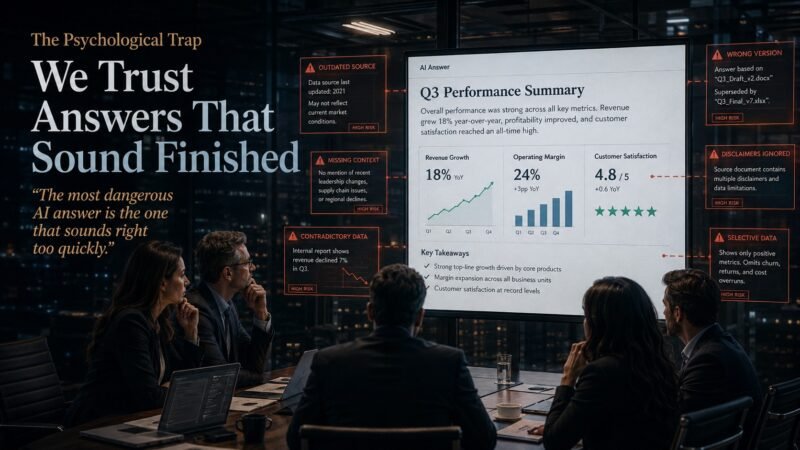
The human brain often confuses fluency with truth. When something is written clearly, we feel it is more reliable. When the answer is well organized, we assume the thinking is organized. When the model sounds confident, our guard drops for a moment. In enterprise work, that small moment can be expensive.
In business, confidence without context is not intelligence. It is theater.
This is why AI systems cannot be judged only by how nicely they answer. They must be judged by how honestly they answer. Did the model use the approved source? Did it retrieve the latest document? Did it respect the user’s permissions? Did it mix a draft policy with a signed policy? Did it use a customer note from last year when a new contract changed the rule? Did it know the difference between public knowledge, internal knowledge, privileged knowledge, and outdated knowledge?
Without that context, AI becomes a persuasive intern with access to half the building.
Smart enough to be useful.
Confident enough to be risky.
Enterprise AI must not only answer well. It must know when an answer deserves trust.
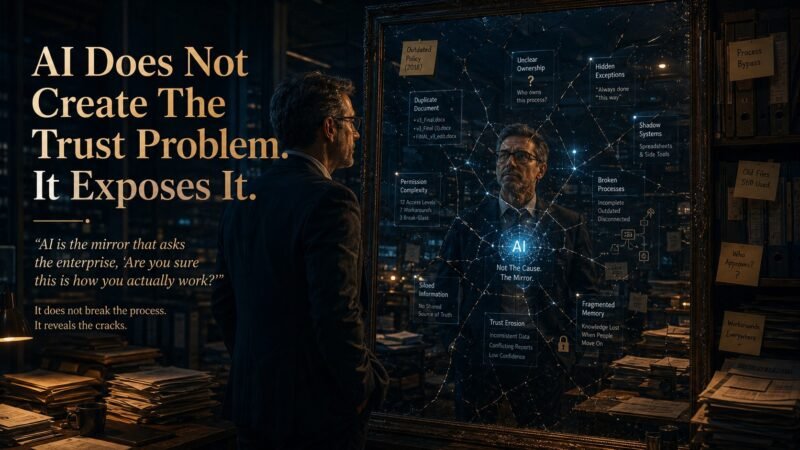
AI Does Not Create The Trust Problem. It Exposes It.
This is the part many enterprises do not like to hear. AI is not creating most of these problems. It is revealing them.
The messy document library was already there. The unclear ownership was already there. The old process nobody updated was already there. The customer exceptions were already there. The permission gaps were already there. The business rule hidden inside someone’s head was already there. AI simply walks into the room and asks the company to explain itself.
Where is the approved source?
Who owns this rule?
Why are there four different versions?
Which one is current?
Why does the dashboard say one thing while the team does another?
Why does the official process differ from the real process?
These are not only technical questions. They are psychological questions. They ask the company to confront how it handles truth, memory, ownership, and accountability.
That is why enterprise AI feels uncomfortable. It is not just automation. It is a mirror.
AI is the mirror that asks the enterprise, “Are you sure this is how you actually work?”
A normal application can stay politely inside one workflow. A report can show one slice of the business. A database can store what it was told to store. But an AI assistant tries to move across the organization. It touches documents, data, processes, people, policies, security boundaries, and decision logic. When it moves across all of that, it finds the cracks.
And sometimes the cracks are not in the model.
They are in the organization.
AI does not make weak ownership dangerous. It makes weak ownership visible.
Context Engineering Is The New Memory Discipline
This is why the serious phase of enterprise AI is not only about bigger models. Bigger models will help. Longer context windows will help. Better reasoning will help. Lower latency and lower cost will help. But none of these solve the central enterprise problem by themselves.
The enterprise needs a memory layer.
That memory layer is not just a document upload feature. It is not a chatbot connected to a folder. It is not a vector database with a nice logo. It is a disciplined architecture that decides what the model should know, what it should retrieve, what it should ignore, which source sh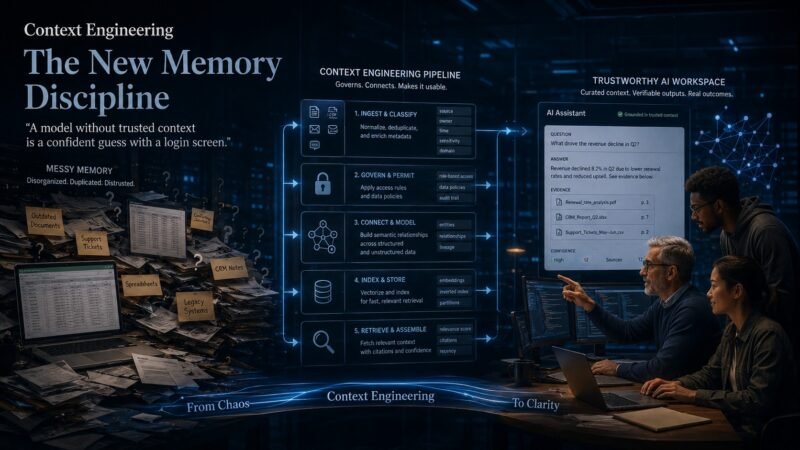 ould be trusted, which permission should be enforced, which answer needs evidence, and when the system should stop and ask a human.
This is context engineering.
A model without trusted context is not an enterprise system. It is a confident guess with a login screen.
In practical terms, it means retrieval pipelines that understand business meaning, not only keyword similarity. It means chunking documents carefully so the model receives useful sections instead of broken fragments. It means embeddings that support semantic search, but also reranking that can separate a close match from the right match. It means metadata that tracks document owner, approval status, effective date, region, product, audience, source system, and freshness. It means permission-aware retrieval so a user cannot receive an answer based on a document they were never allowed to see.
It also means connecting structured and unstructured knowledge. Enterprise truth does not live only in PDFs. It lives in SQL tables, ERP systems, CRM records, support tickets, logs, contracts, policies, dashboards, and workflow systems. A serious AI system may need to retrieve a policy, call a database, check a customer record, run a calculation, validate a business rule, and then produce an answer with evidence.
That is not a chatbot.
That is an operating layer.
And like every operating layer, it needs monitoring. It needs evaluation sets. It needs telemetry. It needs feedback loops. It needs cost controls. It needs version tracking. It needs to know when the model changed, when the source changed, and when the answer quality moved.
The model is the visible brain.
Context engineering is the nervous system.
The model may speak, but the context decides whether the answer deserves to be heard.
Why SQL Professionals Understand This Before Many AI Teams Do
People who have worked deeply with databases understand this problem in their bones. We have lived with the difference between data and meaning for years.
A column name does not always tell the truth. A NULL value does not always mean unknown. A customer table does not always contain customers in the way the business speaks about customers. A date column may be order date, ship date, invoice date, posting date, or the date someone fixed a mistake. Two reports can use the same table and produce different answers because the filters, joins, time zones, business rules, and assumptions are different.
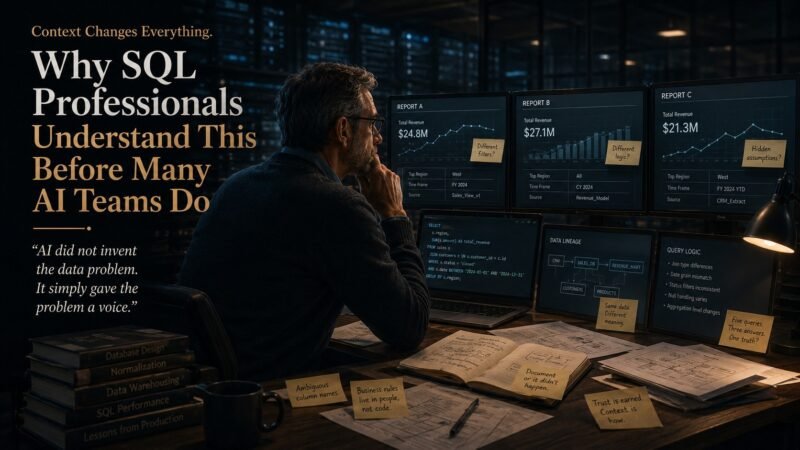
This is not new. AI simply makes the old problem more visible.
For years, companies invested in databases, warehouses, BI tools, governance programs, catalogs, lineage, master data, and reporting standards because they wanted trusted answers. AI raises the pressure. It does not only ask for trusted numbers. It asks for trusted meaning.
AI did not invent the data quality problem. It simply gave the problem a voice.
That is a harder problem.
A dashboard can show revenue. An AI assistant may need to explain why revenue changed, whether the change matters, what actions are available, which policy applies, who should be notified, and what risk exists if the company waits. That answer may require data, documents, history, rules, and judgment. If the company’s memory is broken, the AI answer will inherit the brokenness.
This is why enterprise AI needs data professionals at the center, not sitting politely on the side while someone else builds a shiny interface. The people who understand lineage, quality, performance, access control, metadata, and business meaning are not optional in this new world. They are the adults in the server room.
And yes, sometimes the server room badly needs adults.
If you have spent years cleaning bad data, fixing broken reports, and explaining why two dashboards disagree, congratulations. You were already training for enterprise AI.
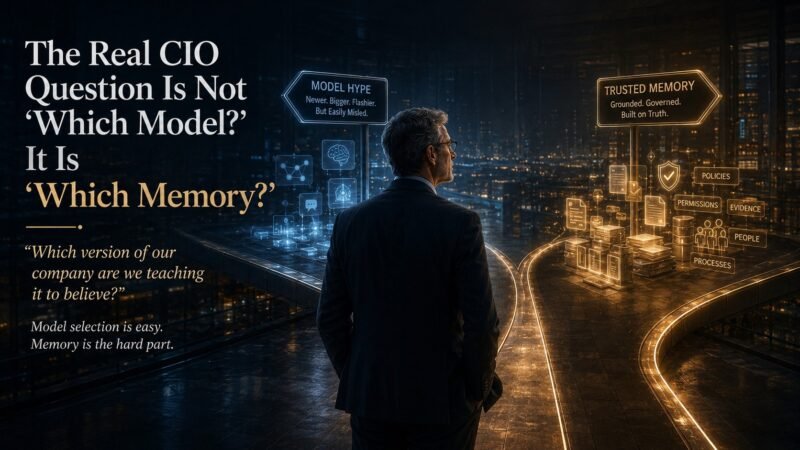
The Real CIO Question Is Not “Which Model?” It Is “Which Memory?”
Many executive AI conversations still begin with the model. Which model should we use? Which vendor is best? Which one is cheapest? Which one has the largest context window? Which one is safest? These are valid questions, but they come too early.
The more important question is this: what memory of the company will this model rely on?
The next CIO question is not, “Which model are we buying?” It is, “Which version of our company are we teaching it to believe?”
That question changes the conversation immediately. It forces leaders to think about whether the organization has a trusted knowledge layer. It forces business teams to own the quality of the documents they expect AI to use. It forces security teams to define access not just at login, but at retrieval time and answer time. It forces legal and compliance teams to define what evidence is required before AI output can be used in a real workflow. It forces data teams to think beyond tables and dashboards into meaning, context, and decision support.
It also creates an uncomfortable ownership question: who is responsible for the company’s truth?
In many enterprises, truth is distributed but ownership is unclear. The data team owns the pipeline. The business team owns the process. IT owns the system. Legal owns the policy. Operations owns the exception. Customer support owns the pain. Leadership owns the outcome. Then AI enters and asks, “Which version should I believe?”
That is when everyone suddenly becomes very interested in governance.
Not because governance became exciting.
Because AI made the absence of governance visible.
Governance becomes interesting when the AI starts quoting the wrong version beautifully.
Trustable Memory Will Become Competitive Advantage
The next advantage in enterprise AI will not belong only to companies that buy the most advanced model. It will belong to companies that build trustable memory around the model.
Trustable memory means the AI system knows which documents are current, which sources are approved, which data is authoritative, which user can see what, which business rules apply, and which answer needs evidence. It means a draft policy, a signed contract, a sales note, a support comment, and a board-approved rule do not carry the same weight. Enterprises do not treat every piece of text equally. AI should not either.
Enterprise AI does not need access to everything. It needs access to the right thing, for the right person, at the right time, with the right proof.
This is where the future becomes interesting. Once a company builds this memory layer, it can use different models more safely. It can route simple tasks to smaller models, complex reasoning to stronger models, sensitive tasks to private environments, and deterministic tasks to tools or databases. It can measure answer quality instead of guessing. It can evaluate failures and improve the system. It can reduce hallucination not by begging the model to behave, but by giving it better context and stronger boundaries.
That is the real enterprise AI shift.
Not a smarter chat window.
Not a prettier search box.

Not a demo where the model summarizes a document everyone already read.
The real shift is building a system where AI can reason over enterprise knowledge with permission, evidence, freshness, and accountability.
The companies that win with AI will not be the ones that remember the most. They will be the ones that remember correctly.
The Human Side Of Organizational Memory
There is also a human side to this story, and it may be the most important part.
In many companies, knowledge is not only stored in systems. It is carried by people. There is always someone who knows why the report changed. Someone who remembers why the rule exists. Someone who knows which customer needs special handling. Someone who can explain why the official process is not the real process.
The most valuable knowledge in a company is often not in a database. It is sitting quietly in someone who is tired of being asked the same question every Thursday.
For years, enterprises have depended on these people without always recognizing them. They are the human memory layer. They save projects. They prevent mistakes. They answer questions in hallway conversations. They quietly hold together workflows that the system never fully captured.
AI will change their role, but it should not erase their value. In fact, the best enterprise AI programs will treat these people as knowledge architects. They can help identify trusted sources, explain exceptions, validate outputs, build evaluation cases, and turn hidden knowledge into shared memory.
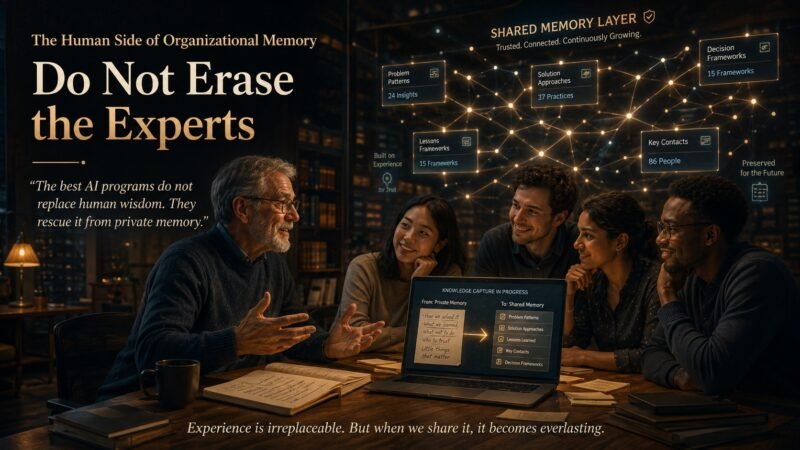
This is the lovable part of enterprise AI when it is done well. It does not replace human wisdom. It rescues it from being trapped in private memory.
That matters. Because when knowledge lives only in people’s heads, the organization becomes fragile. When those people leave, retire, move teams, or simply get tired of answering the same question for the 800th time, the company forgets again.
AI can help, but only if the company is humble enough to admit what it does not remember.
The best enterprise AI programs will not erase experts. They will finally stop trapping expertise inside private memory.
The Future Is Not A Chatbot Sitting On Top Of Confusion
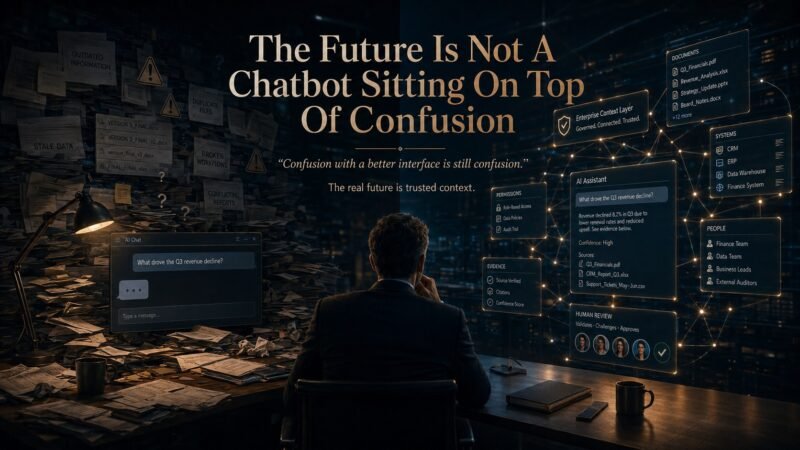
The future of enterprise AI is not a chatbot sitting on top of a broken knowledge base. That is not transformation. That is confusion with a better user interface.
The real future is a trusted context layer connected to models, data, permissions, evidence, evaluation, and human review. A system that can answer, but also explain. A system that can act, but also stop. A system that can use company knowledge, but also respect company boundaries. A system that can say, “I do not know,” when the memory is not strong enough.
That kind of AI will do more than improve productivity. It will make the organization more honest. It will reveal stale documents, weak ownership, duplicate rules, hidden dependencies, and unclear processes. It will show where the company’s memory is strong and where it is pretending.
That may be the biggest value of enterprise AI.
Not that it remembers everything.
But that it forces the company to ask what is worth remembering, who owns it, and whether the next person can trust it.
The future of enterprise AI will not belong to companies that remember everything. It will belong to companies that know what is worth remembering.
Because the deepest problem in enterprise AI is not that the model forgets.
The deeper problem is that the company forgot first.
And for the first time, the company has a machine brave enough to ask where the truth actually lives.
Enterprise AI is not just a test of machine intelligence. It is a test of organizational memory.
Published by Pinal Dave on SQLAuthority. More of my work at pinaldave.com.
Discover more from SQL Authority with Pinal Dave
Subscribe to get the latest posts sent to your email.