
Question: What is a Worktable in SQL Server, and why can it appear in SET STATISTICS IO when my query names no Worktable?

Answer: I had been waiting to write about this question. I keep this interview series to questions I actually hear in interviews or in my SQL Server performance workshop, and at last this one arrived.
The original demonstration used AdventureWorks2014, enabled I/O messages, and crossed the Product table with itself:
USE AdventureWorks2014;
GO
SET STATISTICS IO ON;
GO
SELECT *
FROM Production.Product AS p
CROSS JOIN Production.Product AS p1;
GO
SET STATISTICS IO OFF;
Run a cross join only in a safe sample environment; it can produce far more rows than you expect. In my historical run, SSMS reported Product and a second entry called Worktable. That raised the real interview question: where did this other table come from?
Table 'Product'.   Scan count 2, logical reads 30, ...
Table 'Worktable'. Scan count 1, logical reads 8110, ...
The same example in a current sample database
I ran the same cross join in AdventureWorks2025 on SQL Server 2025. It returned 254,016 rows and again reported 8,110 logical reads for the Worktable. These are observations from this sample run, not promised counts for every installation.
USE AdventureWorks2025;

SET STATISTICS IO ON;

SELECT *
FROM Production.Product AS p
CROSS JOIN Production.Product AS p1;

SET STATISTICS IO OFF;
The complete I/O messages from that run were:
Table 'Product'. Scan count 2, logical reads 30, physical reads 1, page server reads 0, read-ahead reads 20, page server read-ahead reads 0, lob logical reads 0, lob physical reads 0, lob page server reads 0, lob read-ahead reads 0, lob page server read-ahead reads 0.
Table 'Worktable'. Scan count 1, logical reads 8110, physical reads 0, page server reads 0, read-ahead reads 0, page server read-ahead reads 0, lob logical reads 0, lob physical reads 0, lob page server reads 0, lob read-ahead reads 0, lob page server read-ahead reads 0.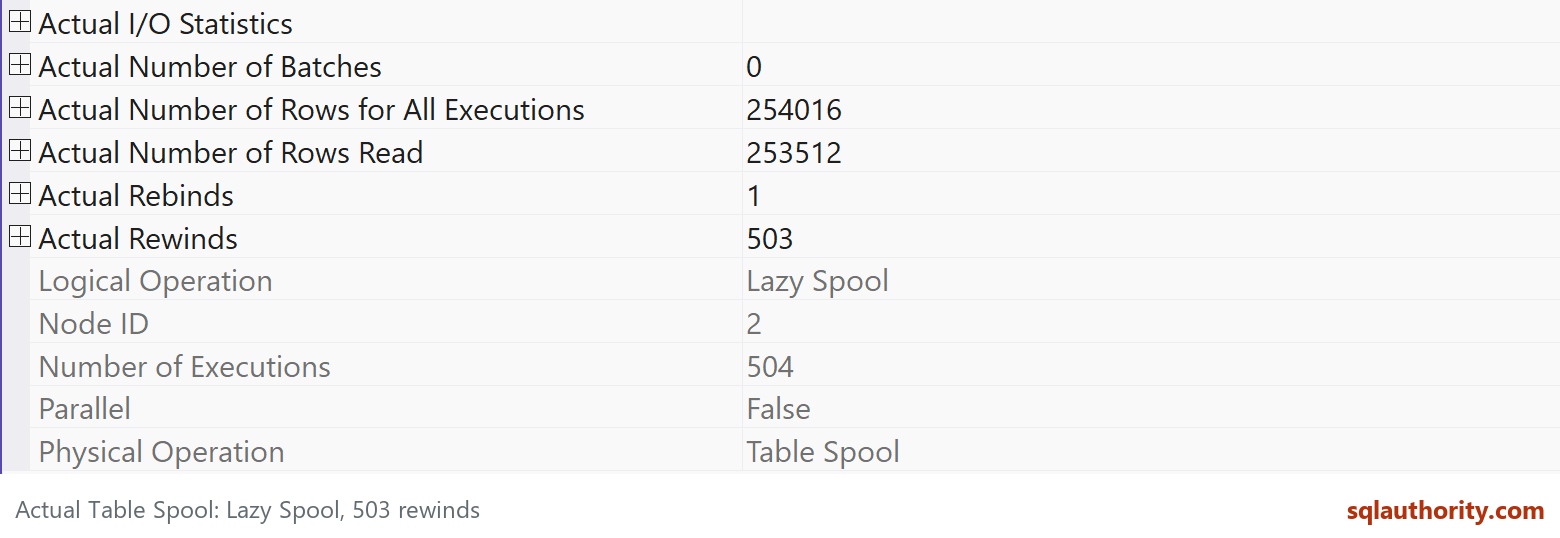
Actual Table Spool: Lazy Spool, 503 rewinds. Captured in SSMS on SQL Server 2025.
The actual plan contains a Table Spool with the logical operation Lazy Spool. Its properties show 503 rewinds. The plan’s row counts and STATISTICS IO’s logical-page reads measure different things.
SQL Server can create an internal worktable to support an operation in the execution plan, such as a spool, sort, or cursor. It lives in tempdb and is managed by the engine. You do not have to name it in the SQL, and it is not the same thing as a user-created #temp table.
Do not infer too much from the I/O line alone. A Worktable entry tells you that the plan used an internal structure. The logical-read count is not automatically the number of physical disk reads, and the entry alone does not prove a memory-grant spill. Inspect the actual execution plan and any warnings before attributing a slow query to a particular operator or to tempdb pressure. Plan choice and I/O counts may differ by version, data size, indexes, and settings.
The short answer for an interview is: a Worktable is an engine-created internal staging structure in tempdb. The useful follow-up question is which plan operation needed it in this particular execution.
Published by Pinal Dave on SQLAuthority. More of my work at pinaldave.com.
Discover more from SQL Authority with Pinal Dave
Subscribe to get the latest posts sent to your email.




11 Comments. Leave new
Well yes, but is that enough of an answer? When does it do this? Is it good or bad? Does a worktable have statistics? Indexes? If you see a worktable with millions of reads or IOs, what do you do about it?
is these are same to magic table ?
No they are very different.
Thanks Pinal for the valuable information.
My pleasure. I am glad you liked it.
What’s the difference between a worktable and a workfile please?
Good evening!
Bus the worktable is good or bad? it
Does it hinder my performance?
If so, can you optimize it?
Pinal,
I have a question on it. I have a query, If i use a perfect index on that query, Logical reads in worktable goes up to 554 but when i drop that index, comes down to 0. How is this table related to index usage? Thanks for your continuous support to community.
Hi Sir,
We are facing problem frequently in Sql server that temp tables (work tables) in a huge and applications are getting stucked. This is happening frequently.
Even we restart server with in 30 mints more that 8000 tables get created.
Please suggest me what to do.
Regards,
Balakrishna
Hey Balakrishna..Did you find any solution to this.
A query returns 0 logical reads for ‘Worktable’ in DEV environment. The same query returns over 4 million logical reads for ‘Worktable’ in PROD environment. The DEV and PROD table being queried are identical in both environments. Why so many logical reads in PROD??? How can I knock them down?