
Readers still send me this interview question even though I have answered it before: how do you return random records from a table? One reason I like the question is that the short answer is easy to remember, while its cost is easy to forget.

A simple random row query
In an AdventureWorks database, run this query twice. The order can differ between executions because NEWID() supplies a value for each candidate row. TOP returns only the requested number of rows.
SELECT TOP (5) BusinessEntityID, FirstName, LastName
FROM Person.Person
ORDER BY NEWID();
My older example used ORDER BY CHECKSUM(NEWID()). That also changes the order between runs, but the checksum compresses a GUID into a smaller value and can produce ties. ORDER BY NEWID() states the intent directly. Neither expression promises the same result on a later execution, so do not use this as a stable page order.
The original three-run demonstration
My earlier all-row example used this CHECKSUM ordering. Its result is still useful: three executions show different leading rows. The current TOP example above limits the output and avoids compressing the GUID.
-- Run each SELECT as a separate batch.
SELECT FirstName, LastName
FROM Person.Person
ORDER BY CHECKSUM(NEWID());
GO
SELECT FirstName, LastName
FROM Person.Person
ORDER BY CHECKSUM(NEWID());
GO
SELECT FirstName, LastName
FROM Person.Person
ORDER BY CHECKSUM(NEWID());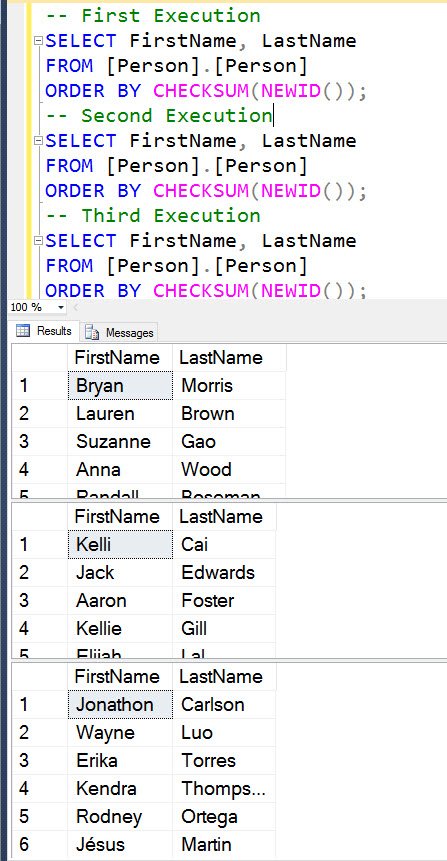
Do not ignore the cost
SQL Server must assign ordering values across the qualifying rows and choose the first five after that random ordering. On a large table, the scan and sort can be expensive even though the output contains only five rows. Filter to the intended candidates first, and check the actual plan and logical reads on representative data before using this in a frequent production request.
If you need a rough page-level sample instead of an exact count, TABLESAMPLE is a different tool with different sampling behavior. Do not assume that it chooses every row with equal probability. The interview answer should first clarify whether the caller needs a quick demo, an exact number of random rows, or a statistically defensible sample.
If you have a more efficient method for your workload, share the conditions that make it work. I will be happy to examine it and give due credit. For related examples, see my earlier NEWID() sample, random number range question, and random number generator script.
Published by Pinal Dave on SQLAuthority. More of my work at pinaldave.com.
Discover more from SQL Authority with Pinal Dave
Subscribe to get the latest posts sent to your email.




5 Comments. Leave new
If I remove the checksum () function, the result of the query would still be the same. What is the real need to use it?
As the title says – How to Get Random Records from Table
Hello Pinal, I have same question we can generate a unique number for each raw using the NEWID() and if we perform ORDER BY(NEWID()) it always provide a random numbers of record, but why you use Order By(CHECKSUM(NEWID)) , is there some advantages if i use CHECKSUM() with NEWID().
It depends if generating the newid, or sorting the table that is the expensive part. If generating the I’d then you can still get a random ordering from the md5 of the primary (or surrogate) key. This has an advantage of being repeatable, and if you want a run just for your report, add the (milli) second TimeStamp as a salt or offset to an integer column. Note : (binary) checksum is not random enough for this purpose, you have to use something else.
If sorting is the expensive part, then you can get a random cut of the db by asking what the char values of the hash are : eg, keep hashes like ‘AA[0-3]%’ for a 1 in 1024 cut, or if you don’t mind a biased cut, and have an identity column on hand : right(identity, 3)=1 for 1 in 1000
Thanks for your help Andrew.