Median day planning means you build your week around a typical day, not your best one.
Most plans get written on a good day. You have energy, the build is green and nobody has pinged you. Then Tuesday arrives with a failed deploy and a meeting that doubled in length. The plan falls apart by noon.
The fix isn’t more discipline. It’s a better number to plan from. This post shows how to find that number in ten workdays and how to build a week around it.

Why the Average Day Misleads You
In SQL, the median is the middle value of a sorted list. It ignores extremes. The average gets pulled toward them. One huge value can drag it a long way while the median stays put.
Your output behaves the same way. Imagine you count the tasks you finish on ten workdays. The made-up counts are 1, 1, 1, 2, 2, 2, 2, 3, 3 and 12. The 12 was a quiet Friday with no meetings, when you cleared a pile of tiny tickets.
I ran these ten values on SQL Server 2025. The average came out at 2.9, and the median was 2. If you plan three tasks a day because the average allows it, you’ll miss on seven of ten days. One lucky Friday set the target for the other nine.
Decide What Counts as a Task
A count only works if the unit stays the same. Define a task as something you can finish in one sitting of two hours or less. If an item is bigger, split it before you count it, and finish the pieces one at a time.
Without that rule, one giant migration ticket and one two-minute reply both count as one. The numbers then say nothing. A clear unit takes a few minutes to set up and makes every later number honest.

Find Your Median
Spend two weeks measuring. Each evening, write down the tasks you finished and the hours of focused work you got. Don’t judge the numbers. You’re collecting a baseline, the way you would before tuning a query.
Do it at the same time every day, ideally in the last five minutes of work. Memory flatters you, so write the numbers down.
After ten workdays, sort each list and take the middle value. With ten days, that’s the average of the fifth and sixth numbers. This is your median day, and it’s the capacity you plan against.
Keep the sheet and refresh it every quarter. A new team, a new on-call rota or a new project changes your baseline. An old median plans for a job you no longer have.
If your weeks differ a lot, keep two medians. A sprint’s first day and its last day differ, and a release week looks like neither. Plan each kind of week from its own numbers.
Plan to the Median
Size your week as five median days, then subtract what’s already fixed: meetings and on-call duty. What remains is your real capacity. Fill it in order of importance, so that when the week shrinks, the bottom items are the ones that slide.
Now split your list in two. The commit list holds what you’ll finish this week, sized to the median. The stretch list holds what you’ll pick up if a day goes better than normal.
Good days feed the stretch list, so they get used without breaking the plan. You finish more than you promised, and nobody has to rescue a missed deadline.
Don’t borrow capacity from tomorrow. If Monday goes badly, don’t plan Tuesday as a double load to catch up. Tuesday has its own median. Move the leftover work to the stretch list or to next week, and keep every day sized as it is.
A Worked Week
Say your median is two finished tasks a day and three focused hours. A week holds ten tasks. On Wednesday you’re on call and a planning meeting takes the afternoon, so you remove two. Your commit list holds eight tasks, no more.
You write those eight on Monday, in order, and put four more on the stretch list. By Thursday you’ve done six. A bug eats most of Friday, so you finish seven and one slides to next week. You told its owner on Thursday, so nobody was surprised.
Plan the Bad Day, Too
Some days fall below the median. A bad night or a long outage can take half your capacity. Prepare for it with a minimum day: one task that must happen, even when everything else slips.
Choose it on Monday and write it at the top of the list. On a rough day, finish that one task and let the rest move. You still end the day with something done. A rough day stays a rough day instead of turning into a rough week.

Use Hours as Well as Tasks
Tasks measure output. Focus hours measure the time you have to produce it, and they set a ceiling on your hardest work. If your median is three focused hours, book three hours of deep work, not six.
The leftover hours are for email, small questions and meetings that can’t move. Planning them stops you from filling the calendar with work you have no hours to do.
Quote Deadlines From a Typical Week
Everyone who works with you hears your estimates as promises. “I’ll have it Thursday” should come from a typical week, not a perfect one. Check your commit list before you answer, and count the days carefully.
When the answer is later than the requester wants, say so early. A date you can keep earns more trust than a date you hoped for. After a few weeks, your colleagues learn that your Thursday means Thursday.
Share your median with your manager, too. It turns a vague talk about workload into a number both of you can see. When a new request comes in, you can say where it fits and what moves to make room.
Keep a Buffer for the Unplanned
If you measured carefully, your median already contains the interruptions: the questions and the meeting that ran long. Don’t add extra optimism on top of it. Add a small buffer instead.
Leave the last hour of Friday empty. Work that slipped during the week lands there, not in next week’s plan. If nothing slipped, you’ve earned an early finish or a head start on the stretch list.
Think of a data file with free space. A file packed to its last page has to grow at the worst moment, mid-transaction. A little free room makes the whole system calmer.
The Objection: This Lowers My Ambition
Planning for a typical day sounds like setting the bar low. Ambitious people plan for the best case and push.
Push as hard as you like. The problem is promising. The median plan decides what you commit to, and the stretch list holds your ambition. A best day depends on luck, such as a quiet inbox or a calm release.
Planning on that luck means planning on something you don’t control. The median is a number you measured yourself, and the good days still count toward the stretch list.
Try This Week
- At the end of each day, write down finished tasks and focus hours.
- After ten workdays, sort the numbers and take the middle one.
- Fill a commit list to that size and move the rest to a stretch list.
- Leave the last hour of Friday open.
- Quote every deadline from a typical week.
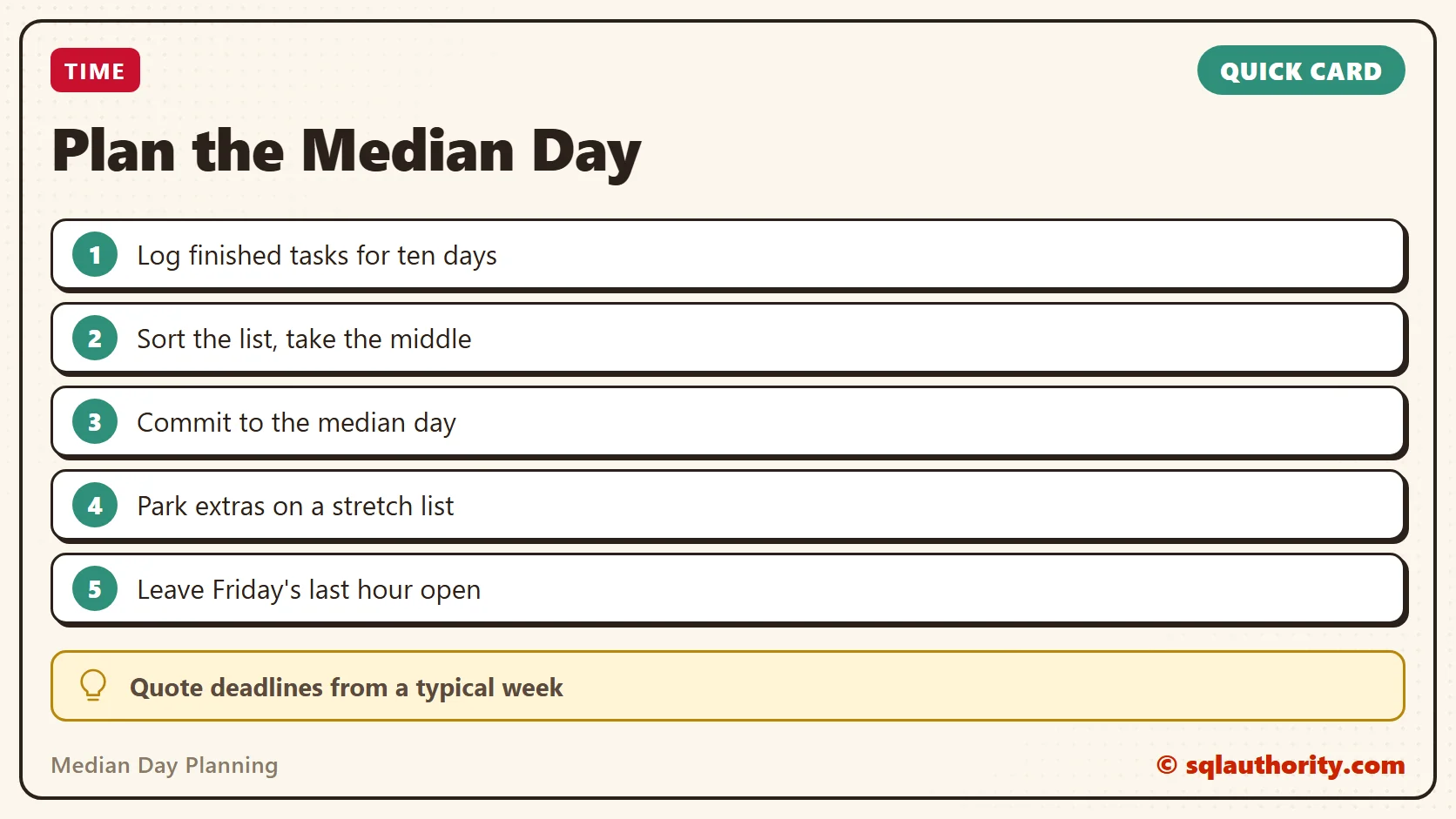
A good plan is not built for your best day, it is built for the median one.
Published by Pinal Dave on SQLAuthority. More of my work at pinaldave.com.
Discover more from SQL Authority with Pinal Dave
Subscribe to get the latest posts sent to your email.