

A short T-SQL script to set server level FILLFACTOR, plus the Books Online definition of FILLFACTOR and what its values from 0 to 100 mean.

Scaling Out Read Queries
Scaling out read queries uses replicas, caches, and routing with measured freshness and operating cost; learn when each path fits.

Fast Bulk Inserts From Python
Bulk inserts from Python work best with parameterized executemany, measured batch sizes, a tested fast_executemany path, and clear restart rules.

Memory Grants: Why a Query Waits for Memory
Memory grants can leave SQL Server queries waiting on RESOURCE_SEMAPHORE; inspect estimates, grants, and spills before adding memory.

Estimating How Much Memory SQL Server Needs
How much memory SQL Server needs depends on the active working set, grants, and host headroom; learn to measure pressure and avoid fixed ratios.
What Is a Heap in SQL Server?
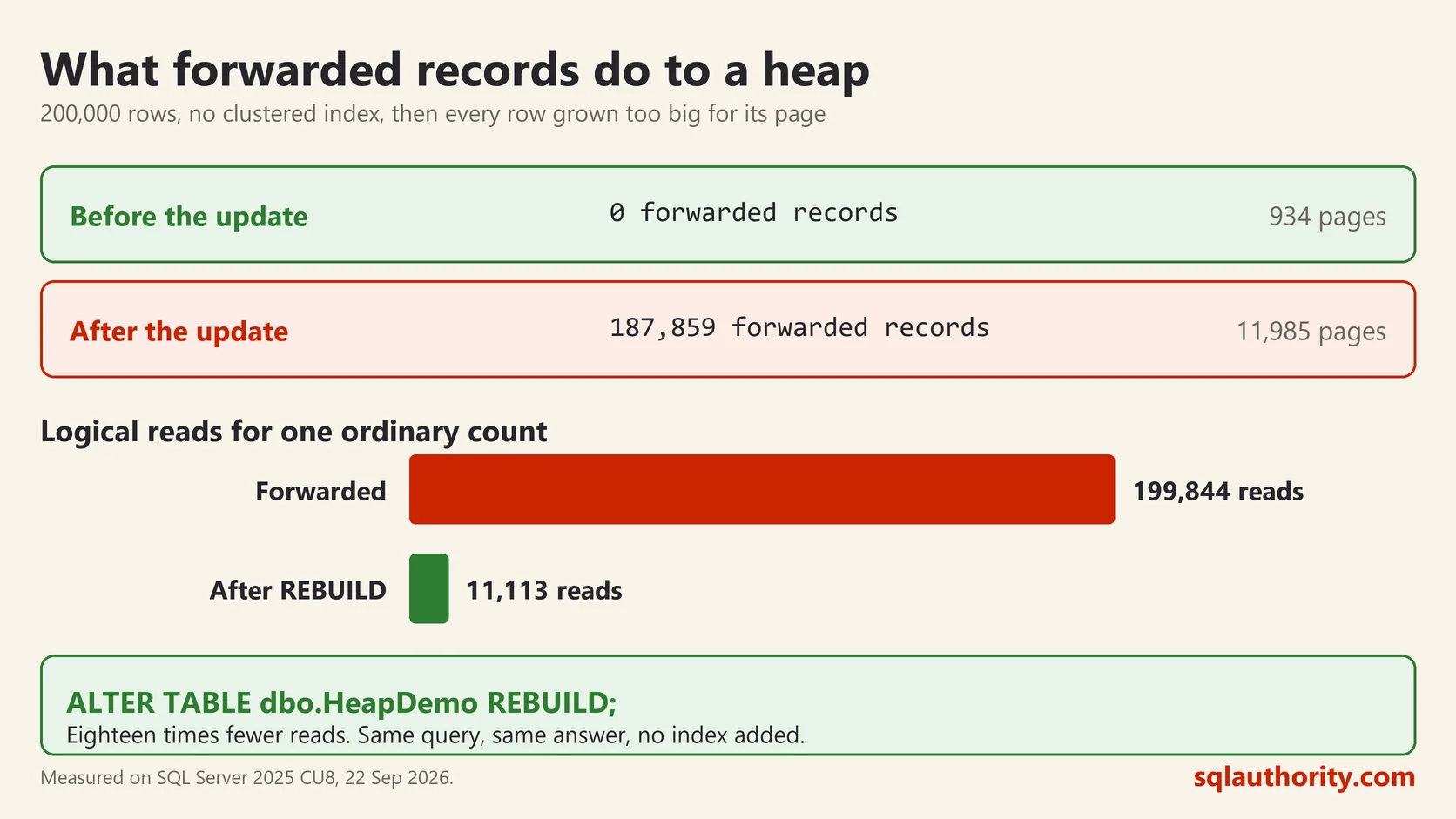
A heap in SQL Server is a table with no clustered index. Forwarded records pushed one count from 11,113 reads to 199,844, and a single REBUILD put it back. When a heap is fine and when it is not.

Silent Truncation When Building Strings in nvarchar(max) Variables
Silent truncation can happen while SQL Server evaluates a bounded expression. These examples compare the lost characters with a max expression and a max REPLICATE input. Check stored lengths before blaming a clipped display.