No join predicate calls for checking the intended relationship before tuning the plan. A query can legally return every combination of two tables. That result is useful for a pairing matrix, but wrong for customer-owned orders.

Compare complete pairs using small sample tables
The example has two customers and three orders. Customer one owns orders ten and eleven. Customer two owns order twelve. It works on SQL Server 2012 or later.
CREATE TABLE #Customers(CustomerId int NOT NULL PRIMARY KEY);
 CREATE TABLE #Orders(OrderId int NOT NULL PRIMARY KEY,CustomerId int NOT NULL);
 INSERT #Customers VALUES(1),(2);
 INSERT #Orders VALUES(10,1),(11,1),(12,2);
A missing relationship returns all six combinations
SELECT c.CustomerId,o.OrderId FROM #Customers AS c,#Orders AS o
 ORDER BY c.CustomerId,o.OrderId;
The comma-separated tables have no customer-order predicate. Every customer pairs with every order, producing six rows. That includes customer one paired with order twelve. SQL Server executes the request, even though the pair violates our ownership requirement.
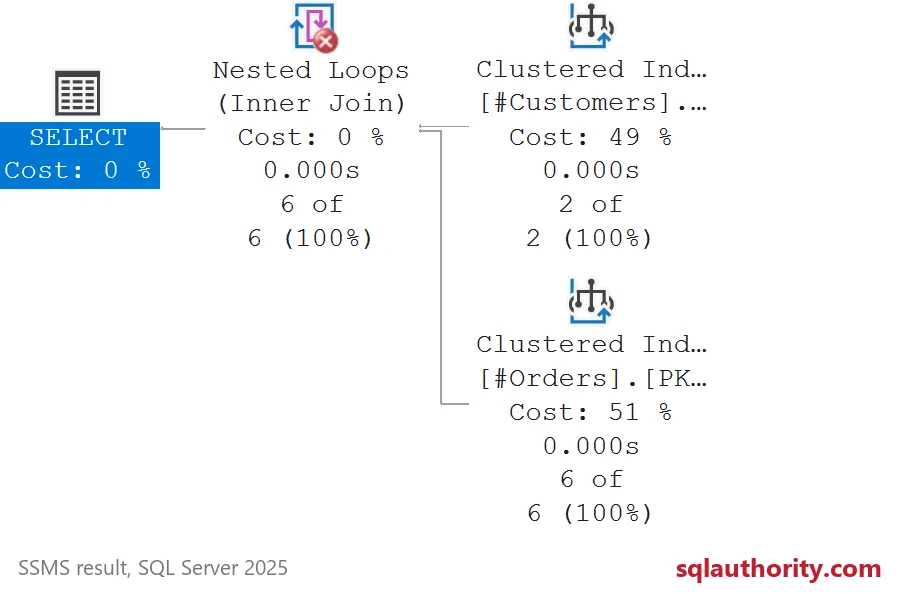
The actual plan has a Nested Loops join with a missing-join-predicate warning. Its output contains six complete pairs. These observations come from SQL Server 2025. Plan shape and warnings can differ with a different query or data.
State an intentional matrix with CROSS JOIN
SELECT c.CustomerId,o.OrderId FROM #Customers AS c CROSS JOIN #Orders AS o
 ORDER BY c.CustomerId,o.OrderId;
This explicit form returns the same six combinations. CROSS JOIN describes the cross-product in the query text. Use it when every pairing is the actual requirement. Rewriting the syntax alone does not repair an unintended relationship.
The ownership predicate returns the intended three pairs
SELECT c.CustomerId,o.OrderId FROM #Customers AS c
 JOIN #Orders AS o ON o.CustomerId=c.CustomerId ORDER BY c.CustomerId,o.OrderId;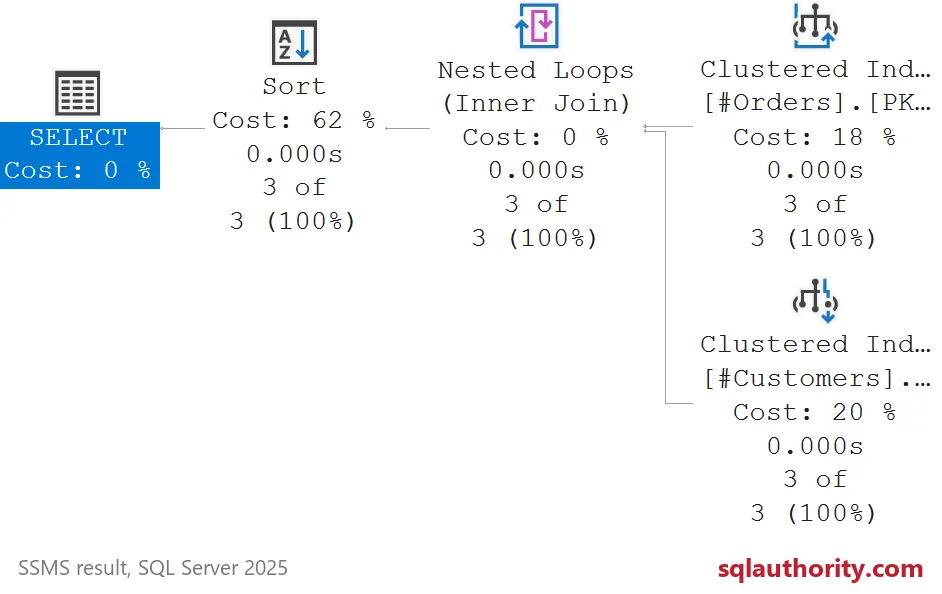
The verified pairs are (1,10), (1,11) and (2,12). The actual plan shows no warning. It uses Nested Loops and a final Sort. The Sort keeps the requested result order; its presence does not make the relationship wrong.
Operator costs in these plans are optimizer estimates. The tiny tables do not establish a runtime performance benchmark.
A plausible count can still contain the wrong pairs
SELECT c.CustomerId,o.OrderId FROM #Customers AS c CROSS JOIN #Orders AS o
 WHERE c.CustomerId=1 ORDER BY o.OrderId;
Filtering to customer one reduces the Cartesian result to three rows. Order twelve still appears, although it belongs to customer two. Three rows therefore do not prove three correct relationships. This example makes no claim about warning presence for that filtered plan.
When you are done, remove the temporary tables.
DROP TABLE #Orders;
DROP TABLE #Customers;
Treat the warning as a review prompt
A missing-join warning is a prompt to verify whether the missing predicate is intentional. Inspect complete key pairs and expected multiplicity. Do not hide unexpected combinations with DISTINCT or TOP. Those changes can conceal an incorrect relationship.
Logical joins and physical algorithms describe different aspects of the query. An index can change how pairs are found without defining which pairs are correct. Verify ownership first. Then evaluate reads, row estimates and the actual workload before selecting a tuning change.
Ask who owns what first, and the tuning work gets much shorter.
A missing join predicate is not a tuning problem, it is a question about the relationship.
Published by Pinal Dave on SQLAuthority. More of my work at pinaldave.com.
Discover more from SQL Authority with Pinal Dave
Subscribe to get the latest posts sent to your email.