

Use DROP_EXISTING to change an index definition in one operation, inspect its columns, and check online availability and dependencies.

SQL SERVER – Columnstore Index and sys.dm_db_index_usage_stats
My Columnstore index DMV script failed on SQL Server 2012 RTM because sys.column_store_index_stats was gone. What I found next, with sys.dm_db_index_usage_stats.

Columnstore Indexes for Reporting Tables
Columnstore indexes for reporting tables can cut scan work, but clustered and nonclustered designs affect loading and point lookups differently.

Word Search Without Full-Text: Build a Word Index Table
LIKE with a leading wildcard reads the whole table. A small side table of words turns that scan into a quick lookup, and you do not need full-text installed.

SQL SERVER – Identify Columnstore Index Usage from Execution Plan
My two word Twitter reply was “From Operators,” so here is the full answer on how to spot columnstore index usage in the execution plan.

SQL SERVER – A Tricky Question and Even Trickier Answer – Index Intersection – Partition Function
Can one table, used once, give 2 join operators in an execution plan? Readers used ranking functions, and my own answer relies on index intersection.
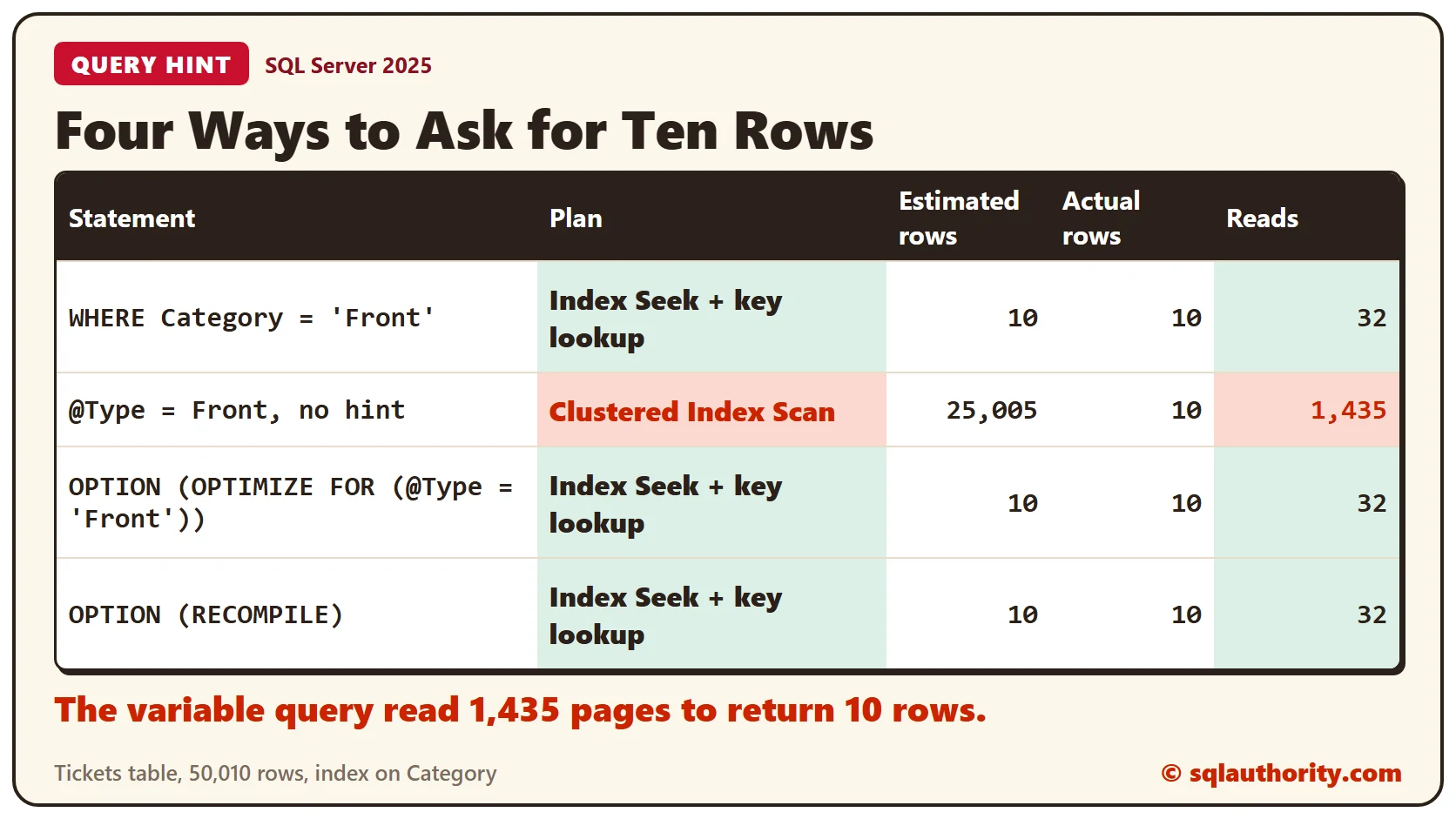
Query Hint Basics: Why a Variable Scans and OPTIMIZE FOR Seeks
Query hint basics start with one idea: a query hint is an instruction you add to one statement in the OPTION clause. This post builds a table of 50,010 tickets, shows a seek for a literal value, a scan for the same value in a variable, and a seek again with OPTIMIZE FOR and with RECOMPILE. It also shows what the hint costs when the value changes. Every number comes from SQL Server 2025.