
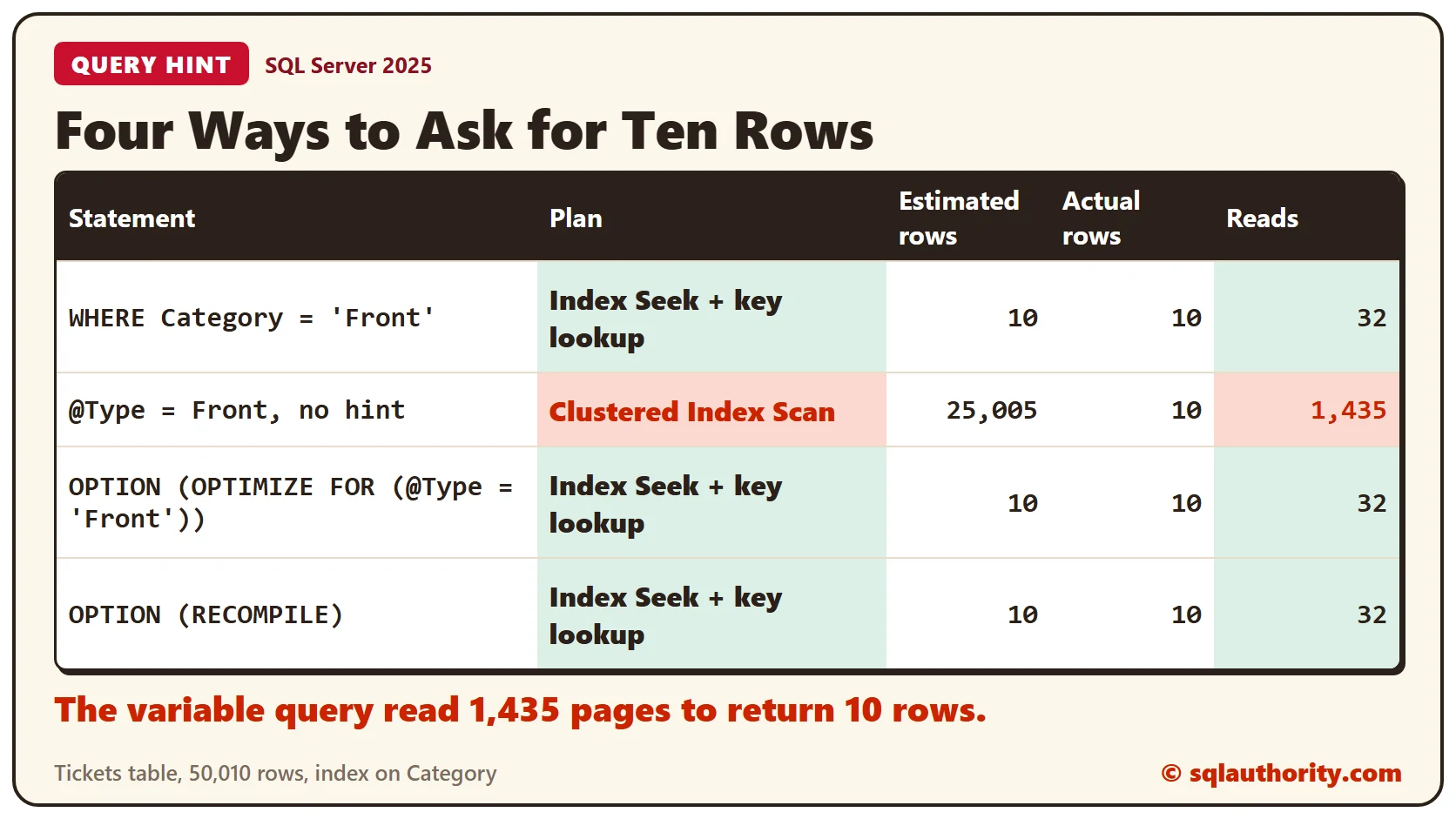
Query hint basics start with one idea: a query hint is an instruction you add to one statement in the OPTION clause. This post builds a table of 50,010 tickets, shows a seek for a literal value, a scan for the same value in a variable, and a seek again with OPTIMIZE FOR and with RECOMPILE. It also shows what the hint costs when the value changes. Every number comes from SQL Server 2025.

MAXDOP 1 in SQL Server: SQL in Sixty Seconds #008
MAXDOP 1 requests serial execution for one SQL Server query. I measured four variants of one query on SQL Server 2025, and the serial plan was the slowest in elapsed time with about the same CPU. The post shows the settings behind the hint and how to read the degree of parallelism a query actually used.

Puzzle – Usage of New Index Hints – ForceSeek and ForceScan
SQL Server Denali adds the FORCESCAN hint next to FORCESEEK. A weekend puzzle on these Index Hints: write a query where each one improves performance.

OPTIMIZE FOR and RECOMPILE Hints Compared
OPTIMIZE FOR and RECOMPILE address parameter-sensitive plans differently; compare stable representative values with per-run compilation cost.

Row Goals: Why TOP and EXISTS Change the Plan
Inspect row goals from TOP and EXISTS, read EstimateRowsWithoutRowGoal, and compare a targeted optimizer hint using actual plans.
SQL Server – Understanding Table Hints with Examples – 2
A plain guide to understanding table hints in SQL Server: the three kinds of hints, what NOLOCK really means, and a checklist before you use one.
SQL SERVER – Query Optimizer Hint ROBUST PLAN – Question to You
What does the query optimizer hint ROBUST PLAN do? I explain query hints in simple words and ask you for a practical example of ROBUST PLAN in action.