

This Table Partitioning Quiz asks whether a query for last month runs faster once a sales table is partitioned by month. The answer is only when the filter lets SQL Server skip partitions. A tested script shows the partition count, the reads, and a partition SWITCH.

Query Store Quiz: Where Is Last Week’s Slow Query?
This Query Store Quiz starts with a slow query from last week and a plan cache that restarted empty. The answer is Query Store, which keeps plans and run times inside the database. A tested T-SQL script finds the query, its plan and its duration.

Stored Procedure Recompile Quiz: What Forces a New Plan?
This Stored Procedure Recompile Quiz asks which action makes SQL Server build a new plan for a procedure. The answer is a new index on a table it reads. A tested script uses plan counters to show what reuses the plan and what rebuilds it.

Scalar Functions and Performance
Scalar functions can hide row-by-row work in SQL Server; learn when inlining helps, how to inspect eligibility, and when a set-based rewrite wins.
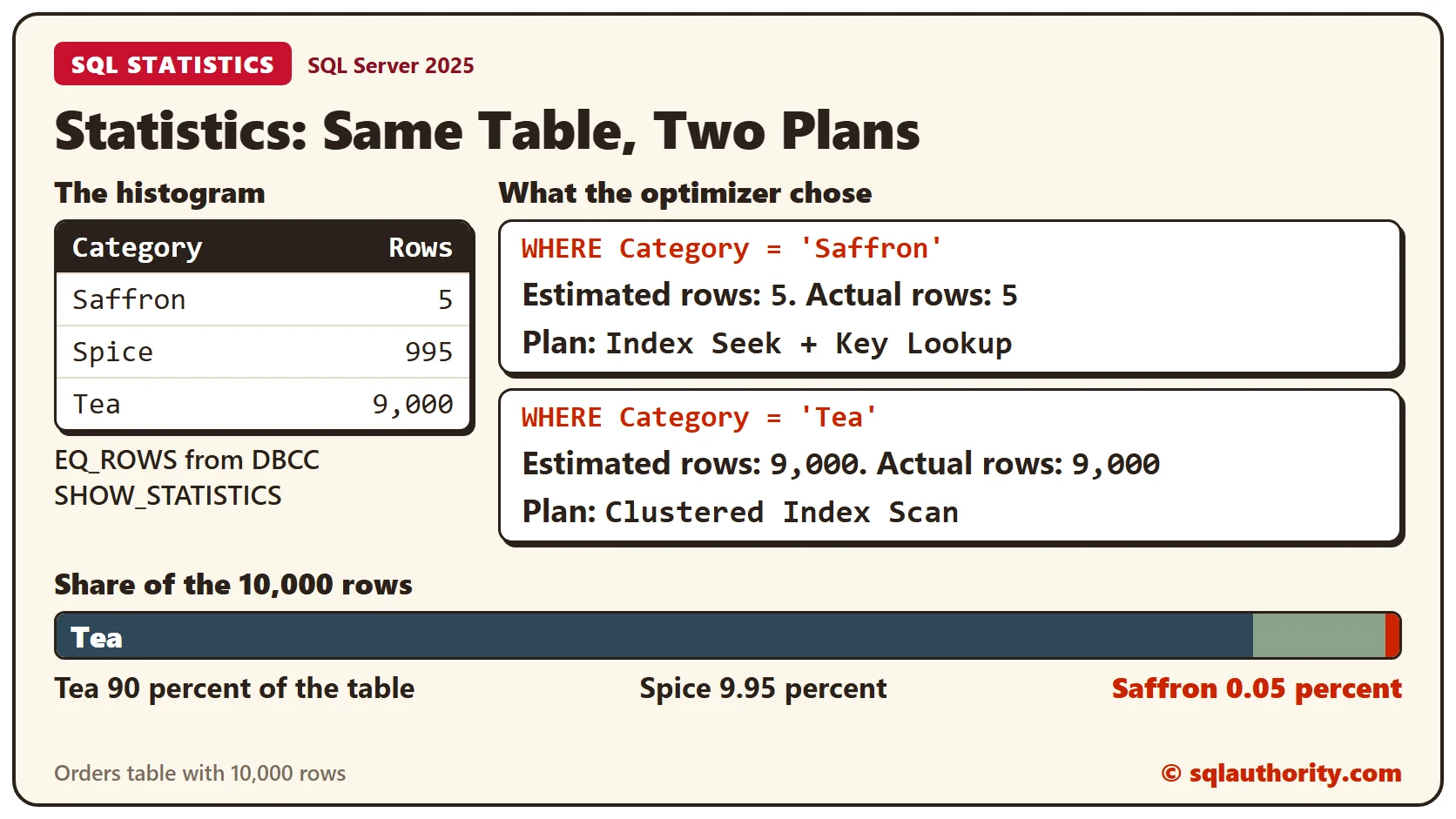
SQL Statistics: How SQL Server Estimates Row Counts
SQL statistics are small summaries of your data that tell the optimizer how many rows a query will return. This post builds an orders table with one rare value and one common value, reads the histogram, compares estimated and actual rows in the plans, and shows a stale statistic fixed with UPDATE STATISTICS. Every result comes from SQL Server 2025.

Parameter Types From .NET: Stopping Implicit Conversions at the Source
Match parameter types from .NET to SQL Server columns, avoid implicit conversions, and inspect cached plans for mismatched strings.

Statistics Histograms Explained
Statistics histograms explained through steps, RANGE_ROWS, EQ_ROWS, and DBCC SHOW_STATISTICS help connect data shape to plan estimates.