A CASE Expression can appear in a default, but can’t reference another row column there. My earlier blanket prohibition was incorrect.

CREATE TABLE #DefaultExample
 (ID int, Col1 int,
  ConstantCase int DEFAULT (CASE WHEN 1=1 THEN 10 ELSE 20 END));
INSERT #DefaultExample(ID,Col1) VALUES (1,1),(2,2),(3,3);
ALTER TABLE #DefaultExample ADD ColumnName varchar(100) NOT NULL DEFAULT '';
UPDATE #DefaultExample SET ColumnName=CASE Col1
 WHEN 1 THEN 'FirstVal' WHEN 2 THEN 'SecondVal' ELSE '' END;
SELECT ID,Col1,ConstantCase,ColumnName FROM #DefaultExample ORDER BY ID;
DROP TABLE #DefaultExample;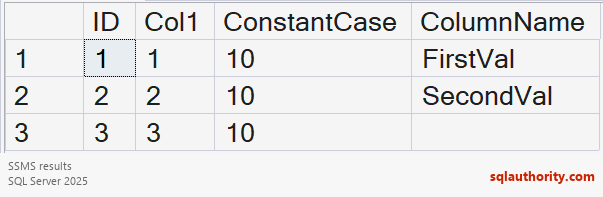
The constant CASE expression is valid. A Col1-dependent rule needs an explicit UPDATE, INSERT expression or suitable computed column. Choose derived versus independently stored data deliberately.
I also used invalid ALTER COLUMN … DEFAULT syntax. Add a new column with ALTER TABLE … ADD. An existing-column default uses ADD CONSTRAINT … DEFAULT … FOR. The add-and-populate pattern must preserve those distinctions.
The empty-string fallback matches this demonstration only. Choose a meaningful production fallback and validate existing values. Coordinate writers so the migration does not leave incorrectly initialized rows.
Check the expression requirement before choosing a constraint. A default can’t read another column from the same row. CASE itself is permitted when its inputs meet default rules.
Related reading
- SQL in Sixty Seconds
- Read Only Tables – Is it Possible? – SQL in Sixty Seconds #179
- One Scan for 3 Count Sum – SQL in Sixty Seconds #178
- SUM(1) vs COUNT(1) Performance Battle – SQL in Sixty Seconds #177
- COUNT(*) and COUNT(1): Performance Battle – SQL in Sixty Seconds #176
- COUNT(*) and Index – SQL in Sixty Seconds #175
- Index Scans – Good or Bad? – SQL in Sixty Seconds #174
- Optimize for Ad Hoc Workloads – SQL in Sixty Seconds #173
- Avoid Join Hints – SQL in Sixty Seconds #172
- One Query Many Plans – SQL in Sixty Seconds #171
CASE syntax is not the default limitation, it is the row-column reference that this constraint can’t use.
Published by Pinal Dave on SQLAuthority. More of my work at pinaldave.com.
Discover more from SQL Authority with Pinal Dave
Subscribe to get the latest posts sent to your email.