
I start every tuning exercise with Statistics IO. Here is how to read its output: scan count, logical reads, physical reads and read-ahead reads per table.

SQL SERVER – What is Filtered Statistics?
Filtered statistics, added in SQL Server 2008, help the optimizer estimate rows when data is correlated. Here is a small demo with Employee and Sales tables.
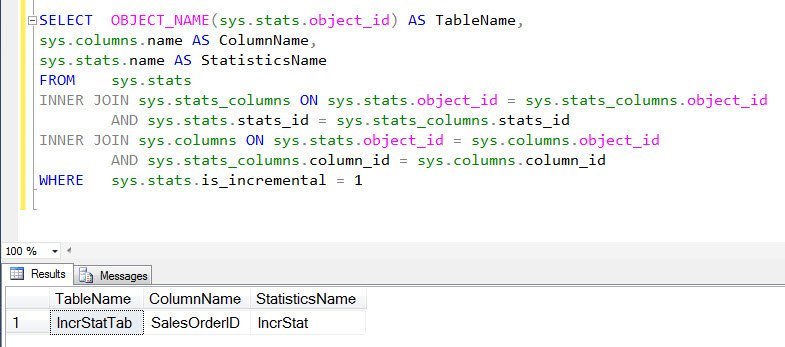
SQL SERVER – DMV to Identify Incremental Statistics – Performance improvements in SQL Server 2014 – Part 3
Part 3 of my series on SQL Server 2014 performance improvements: a DMV to identify incremental statistics, after the basics and a simple example.

SQL SERVER – Simple Example of Incremental Statistics – Performance improvements in SQL Server 2014 – Part 2
Part 2 of my series on SQL Server 2014 performance improvements: a simple example of incremental statistics, after learning what it is in part 1.

SQL SERVER – What is Incremental Statistics? – Performance improvements in SQL Server 2014 – Part 1
This is the first part of the series Incremental Statistics. Here is the index of the complete series. Let us learn it together in the blog.
SQLAuthority News – Microsoft Whitepaper – Optimizing Your Query Plans with the SQL Server 2014 Cardinality Estimator
Joe Sack’s white paper on optimizing query plans with the SQL Server 2014 Cardinality Estimator is 43 pages long, and every word is worth reading.

SQL SERVER – Wrap on Series of Temporary Statistics
The final post on temporary statistics answers reader questions, like whether you can update them. Only SQL Server can, but you can drop them.