
Becoming a good conference speaker has less to do with slides than most people think. I learned that in one wild year of 18 international conferences in 14 countries. Twice that year, I walked on stage with a severe flu. I also said yes to one event mainly because of the art in its city. On November 1, 2019, this blog turned 13 with its 4,918th post. It felt like the right day to write down what that year taught me.

One Year, 18 Stages
The year before, I had spoken at 10 conferences. Then the count jumped to 18. I had a great time presenting, but looking back, 18 in one year was too many. Here is where the talks went.
| Kind of conference | Count |
|---|---|
| Developer conferences | 7 |
| SQL conferences | 7 |
| Private company conferences | 2 |
| Open source conference | 1 |
| Professional development | 1 |
A year like that has two columns, like any honest balance sheet. Here is mine.
| What the year gave | What the year cost |
|---|---|
| Lessons from fellow speakers | Two talks with a severe flu |
| Much better presentation skills | Many skipped CrossFit sessions |
| A more diverse audience | Clients I couldn’t help in time |
| A library and an art museum in every city | Less new business from talks than I hoped |
Every lesson below comes from one of those eight boxes.
Lesson 1: Know Which Room You’re In
At a SQL conference, people know the SQLAuthority name. At a developer conference, even the smartest developer in the room can work with something other than SQL Server. There, it’s easy to go unrecognized, and that’s a great teacher. Your name buys you nothing, so the talk has to earn the room.

So start with the audience, not the slides. Ask the organizers who registered. A developer cares about the query the application sends. A DBA cares about what that query does to the server. The same demo can serve both rooms, but the first minute must speak to the people in the chairs.
Lesson 2: Learn From the Speakers Before You
The biggest gift of that year was the other speakers. I learned a lot from them, and my presentation skills improved big time. Sit in on other sessions whenever you can, even outside your topic. Watch how a strong speaker opens, how they handle a hard question and how they finish one minute early.
Then take one idea home from each session and try it in your next talk. That’s how skills grow between conferences, not only on stage. I wrote more about the craft itself in Presentation Skills for Technical Speakers.
Lesson 3: Treat Your Demos Like Production
More than once that year, I had to download my own demos before a session. Every DBA knows that production needs a backup and a way back. A demo deserves the same respect. Keep every script and sample database in the cloud, so any machine can rebuild it.
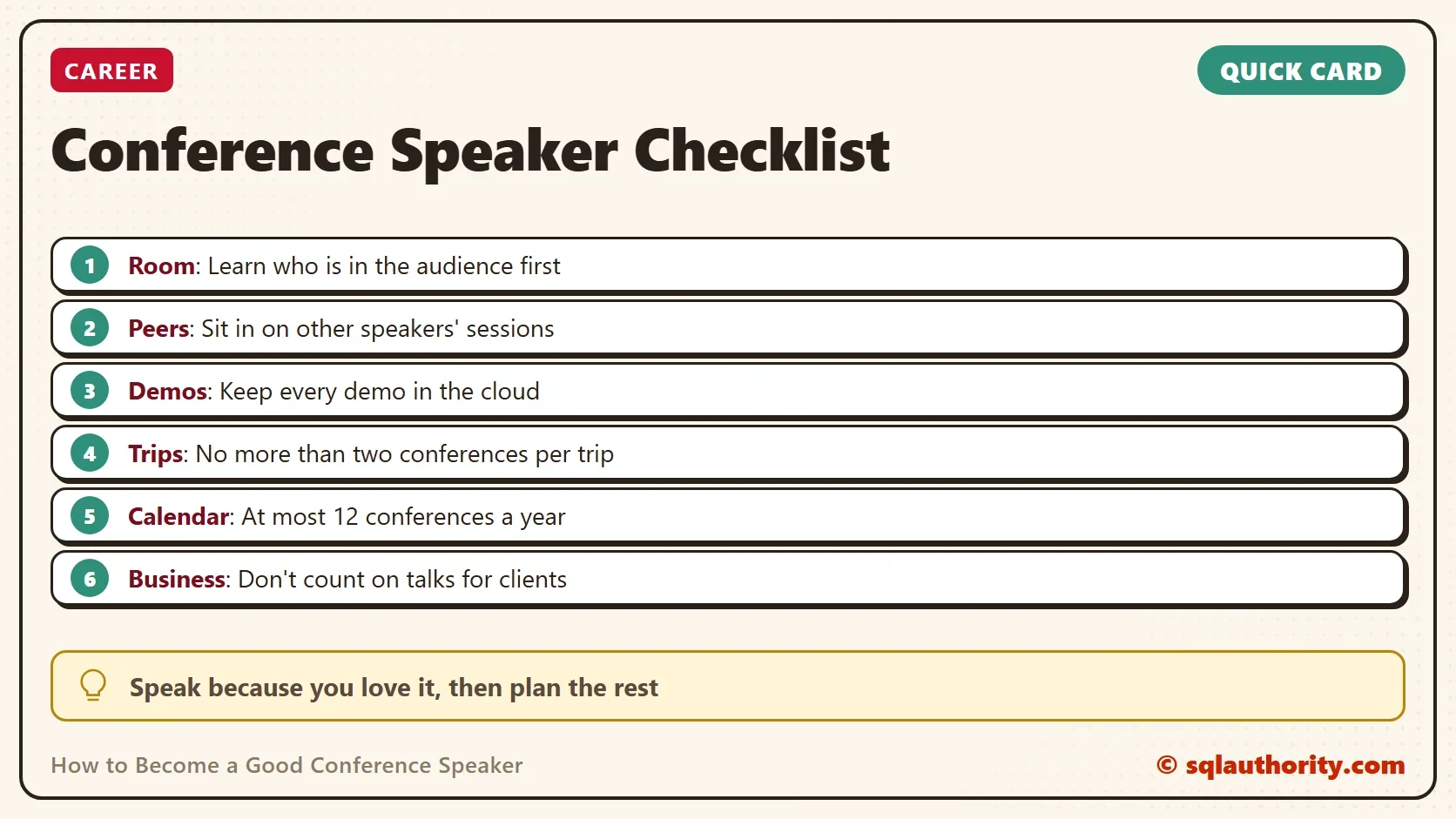
Write a reset script that puts the demo back to its starting point in seconds. Run the whole demo once on the venue’s network before your slot. A demo that fails in front of a full room teaches the room one thing: the speaker didn’t rehearse.
Lesson 4: Protect the Speaker, Not Only the Talk
Travel has a cost that nobody prints on the agenda. Twice, I presented with a severe flu. I skipped many CrossFit sessions, because I was on the road or too tired to go. A tired speaker gives a tired talk, however good the slides are.
That year gave me a simple rule. Never combine more than two conferences in one trip, because it becomes far too hectic. Leave a quiet day between events for sleep, good food and a walk. Your voice and your patience are part of the talk.
Lesson 5: Say No With a Ranking List
The calendar suffers too. Some of my clients needed help with SQL Server performance while I was away. I couldn’t help them in time. So I set a limit: no more than 12 conferences a year.
A limit needs a way to choose. I built a personal ranking list of conferences, and the top of the list gets my time. Rank each event by its audience, the travel and the timing for the people who depend on you. Then saying no stops feeling personal. The list decides.
Lesson 6: Speak for Love, Not for Leads
I had hoped that speaking would bring new clients for my Comprehensive Database Performance Health Check. My clients did grow by 12 percent that year. But the share of new business that came from conferences went down. Speak because you love it, and keep another path for new work.
You could argue that a good conference speaker should say yes to every stage. More stages mean more practice. That’s true up to a point. After that point, the talks get tired, and the people who depend on you wait.
Lesson 7: Leave Room for the City
Some speaker dinners happened in rare and beautiful places. In every city, I made time for two stops: the city library and the local art museum. A speaker who comes home curious comes back to the next stage with better stories.

What to Remember
Know your room, learn from other speakers and treat demos like production. Protect your health, limit your trips and say no with a list. Don’t count on talks to bring clients. If you speak at conferences, which lesson would you add? Tell me in the comments.
A good conference speaker is not the one with the most talks, it is the one the room remembers.
Published by Pinal Dave on SQLAuthority. More of my work at pinaldave.com.
Discover more from SQL Authority with Pinal Dave
Subscribe to get the latest posts sent to your email.



14 Comments. Leave new
Congratulations on your BLOG POSTING for the last 13 years and entering into 14th hope you would bring more interesting and successful campaigns on SQL SERVER and other associates around.
Thank you so much .
Congratulations, sir! Great job on blogging and sharing your knowledge. Here’s to another 13 years – unless you can retire before then, of course!
Thank you so much sir! You just made my day with this comment. I am so so honored.
Congrats!! Thanks for your Valuable blogs. Wishing you many more successful years !!
Thank you so much sir!
Congratulations Pinal Dave. You are truly an inspiration to several million IT professionals.
Thank you so much sir!
Congratulations on your milestone!
Thank you so much sir!
Congratulations Pinal. This blog post has been a constant source of great knowledge that has been very helpful to many people including me. I thank you and wish you continued success.
You are very kind of you!
Congratulations Pinal!!! I have gained much knowledge by reading your blog posts and has built a very successful career too. Hope you continue doing this for many more years and inspire people.
Thank yo so so much!