
Question: What is a serious limitation of ISDATE() in SQL Server?

Answer: I wish the interview question had been phrased that way. In the meeting, the candidate was actually shown two statements and asked why one returned 1 and the other 0. That tests whether someone remembers a particular boundary, when I would rather give them room to reason about the data type.
SET DATEFORMAT ymd;
SELECT ISDATE('6666-04-30') AS IsValidDate;
SELECT ISDATE('1111-04-30') AS IsValidDate;
The session uses year-month-day interpretation for these strings. These are the original SQL Server results from the article. The first returns 1; the second returns 0.
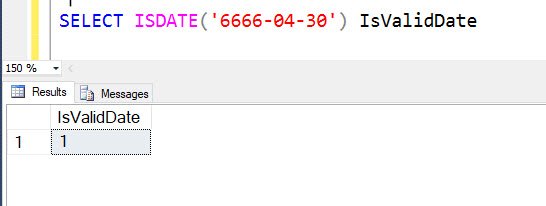
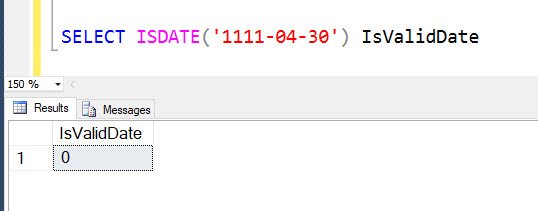
The crucial word in the function’s definition is datetime. ISDATE asks whether its input is valid as the older datetime type. That type begins at 1753-01-01. The date and datetime2 types begin at 0001-01-01. So the year 1111 is a valid date, yet ISDATE rejects it. My original explanation said the boundary was 1582; that was incorrect for SQL Server datetime.
When the destination type is date, validate conversion to that actual type. Here style 23 specifies the year-month-day text format:
SELECT
    ISDATE('1111-04-30') AS IsValidDatetime,
    TRY_CONVERT(date, '1111-04-30', 23) AS ValidDate,
    TRY_CONVERT(datetime, '1111-04-30', 23) AS InvalidDatetime;
The expected result is 0, 1111-04-30, and NULL, respectively. The returned NULL means the requested datetime conversion failed; it does not make the calendar date invalid.
There is a second limitation worth discussing with a candidate. Ambiguous strings, especially two-digit years, can be interpreted according to language, date-format, and cutoff settings. A typed input or a documented four-digit format is a stronger contract than a guess about a short date string. ISDATE also does not validate the full precision of a datetime2 value.
I would prefer to ask: “Which type will store this value, and how would you test conversion to it?” That lets the candidate demonstrate the reasoning that matters in a real database. What would you ask instead?
Published by Pinal Dave on SQLAuthority. More of my work at pinaldave.com.
Discover more from SQL Authority with Pinal Dave
Subscribe to get the latest posts sent to your email.



5 Comments. Leave new
Select ISDATE(‘1583-04-30’) IsValiDate
this is returning 0 , as your answer this should be return 1 but I’m getting 0 ?? what is the reason??
Julian calendar vs. Gregorian calendar. ISDATE() handles dates in the Gregorian calendar which was _created_ in October 1582. The research as to why and any other details of the two calendars is left as an exercise for the curious.
if we execute
select ISDATE(1807-28-26) isvaliddate
its will return 1 but it’s not correct valid date.
@Ashish Kumar
I think you should pass date value in single quote
then check, you will get 0…
I have checked limitation – 1 you mentioned years range 1582 to 9999. But it should 1753 to 9999.