
Interview question: Can you build a three-part SQL Server name from an object_id?
Answer: Yes, if you also know the database context. Within that database, combine DB_NAME, OBJECT_SCHEMA_NAME, and OBJECT_NAME, wrapping each part with QUOTENAME. An object ID is unique within a database, not across the whole instance, so an isolated number does not tell you which database to search.

I have asked this question more than once in interviews. I am not expecting everyone to memorize every metadata function; I want to see whether the candidate asks, “Which database does that ID belong to?” I explored a related example in my earlier three-part-name article.
Run the following in the database that contains Sales.SalesOrderDetail, such as a suitable AdventureWorks sample. Getting the ID from the name makes the example portable across database versions:
USE AdventureWorks2025;
GO
DECLARE @ObjectId int = OBJECT_ID(N'Sales.SalesOrderDetail');

SELECT CASE WHEN @ObjectId IS NULL THEN NULL
            ELSE QUOTENAME(DB_NAME()) + N'.'
               + QUOTENAME(OBJECT_SCHEMA_NAME(@ObjectId)) + N'.'
               + QUOTENAME(OBJECT_NAME(@ObjectId))
       END AS three_part_name;
The expected shape is [AdventureWorks...].[Sales].[SalesOrderDetail]; the database part reflects the actual sample you use. QUOTENAME safely delimits names containing spaces or punctuation.
My original demonstration hard-coded object ID 1154103152 in an AdventureWorks2012 database. The historical SSMS capture below shows that exact database-specific result:
SELECT QUOTENAME(DB_NAME()) + N'.'
     + QUOTENAME(OBJECT_SCHEMA_NAME(1154103152)) + N'.'
     + QUOTENAME(OBJECT_NAME(1154103152));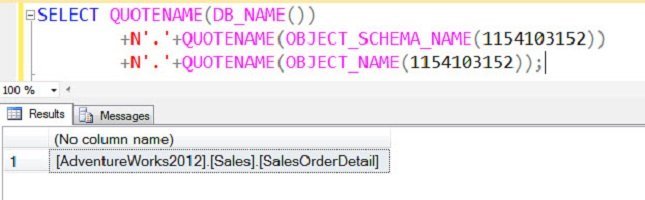
Do not paste that numeric ID into a different database and expect the same name. If your application knows the database ID separately, pass it as the optional second argument to OBJECT_NAME and OBJECT_SCHEMA_NAME, and use DB_NAME for the same database ID. A missing object or insufficient metadata visibility can return NULL; handle that instead of concatenating an incomplete name.
Published by Pinal Dave on SQLAuthority. More of my work at pinaldave.com.
Discover more from SQL Authority with Pinal Dave
Subscribe to get the latest posts sent to your email.


6 Comments. Leave new
This also works
select ‘[‘+DB_Name()+’].[‘+s.name+’].[‘+o.name+’]’ from sys.objects o
inner join sys.schemas s
on s.schema_id = o.schema_id
where object_ID = 1154103152
Great Point!
This one also
select DB_Name()+’.’+SCHEMA_NAME(schema_id)+’.’+name from sys.objects
where object_ID = 1154103152
Well, things might break if there is a space in object names. like database name “A Database having space”
Yes so used this select ‘[‘+DB_Name()+’].[‘+SCHEMA_NAME(schema_id)+’].[‘+name+’}’ from sys.objects
where object_ID = 1154103152
Great