
Following may be very simple to some and helpful to other type of question. I have seen this in my server log as well as this has been always first question in my Developer Team. It is about finding the old Query Analyzer in SQL Server 2005.
Where is SQL SERVER 2005 Query Analyzer?
SQL SERVER 2005 has combined Query Analyzer and Enterprise Manager into one Microsoft SQL SERVER Management Studio (MSSMS). To see the familiour Query Analyzer Window follow the image below.
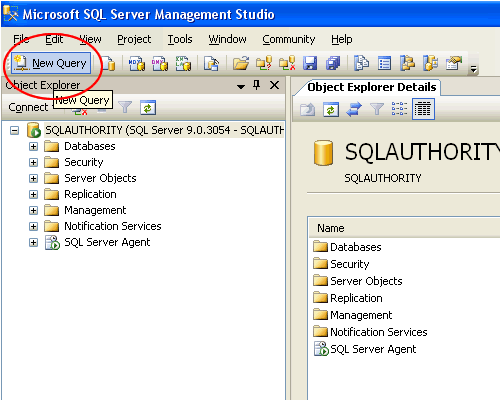
Moving From Query Analyzer to Management Studio
If you spent years in the old tool, Management Studio can feel crowded at first. The good news is that the query window works almost the same way. Click New Query, pick a database from the list, type, and press F5 to run.
A few things that help the move:
- Object Explorer on the left takes over from the old object browser and from most of Enterprise Manager. Right click almost anything to script it.
- Ctrl+T switches results to text and Ctrl+D brings back the grid, just as before.
- Ctrl+R hides the results pane so you have more room for code.
- Registered Servers keeps your list of servers in one place, so you do not type names each time.
Management Studio also lets you open many query windows as tabs, each with its own connection, and save execution plans as .sqlplan files to share with a colleague. Once those habits settle in, most people do not miss the old tool.
Many old habits still work in the query window. F5 and Ctrl+E run the code, Ctrl+L shows the estimated plan, and highlighting part of a script runs only that part. Your old .sql files open without any change, since they are plain text. If a script uses commands from SQL Server 2000, run it on a test server first: the editor opens anything, but the server decides what still works.
Today Management Studio is a free, separate download from Microsoft, and it works with many versions of SQL Server. Keep it updated, because new releases fix bugs and add support for the newest features.
Published by Pinal Dave on SQLAuthority. More of my work at pinaldave.com.


43 Comments. Leave new
i have two questions
1>does sql server express 2005 work without management studio.
and
2> how to attach the adventure work database in windows
vista
plz answer thank you.
IN SIMPLE STEP BY STEP PROCESS:
Id there a way to enter data in a table usint query analyzer in sql 2005?
Where is analyzer?????
How do you use it.
I have a class and the instructor will not tell us how to do anything.
It is known as Database Engine query in SSMS
Hello Mr. Dave,
I recently installed VS 2005 and got SQL Server 2005 along with it.But being new to SQL Server,I tried to understand from help files how to configure and create a new database and found mention of Enterprise Manager and Query Analyzer,which either didn’t get installed or are missing.Can you please shed some light on this?
Regards,
Anindya Basu
hi
I visisted ur side but i didn’t find Query Analyzer in Sql server 2005 v. so pls. provide me help file with which i can install sql server 2005. in my single system. pls. operate me or send me any information..
thanx
by
dilip
i want to establish a connection with java programming through sql 2005.
please suggest me how i will establish this connection with the help of an example….
Refer this to knwo the connection string
http://www.connectionstrings.com
Is it possible to call the stored procedure with in a function
Have you tried it? I think it is not possible
Hi guys,
I do have an sql script which I am using to update a table in SQL server 2008.I would like to know how I can use a .bat file to do the update automatically. I am using Windows Authentication for the SQL Server.
Please advise.Thanx
Dear Sir,
I don’t know about sql2005.
I want to use this project so please give me quarry and tell me that how i can use this project.
Thanks & Regard,
Manoj Kumar
Dear Sir,
I found an ERROR if i am opening my Query Editor it says corrupt or unreachable.
Please guide how to resolve it.
I am using SQL Server 2005 Express.
Regards,
Himanshu
hi friends , for working in sqlserver 2005,i hav to install the management studio vah?????
plz reply.I was in need of it
can i ask the link of the microsoft sql server management studio ??
the download link ?
https://docs.microsoft.com/en-us/sql/ssms/download-sql-server-management-studio-ssms?view=sql-server-2017
A little Googling is all you need to do bro
Thanks Dave,
You saved me yet again! :)
declare @qwe nvarchar(50)
declare @qwe1 nvarchar(50)
set @qwe=’select ”5”’
set @qwe1=exec(@qwe)
select 10/@qwe1
i need to execute a string and store it in variable like above. is it possible in sql server.
thank you
i have two questions
1>does sql server express 2005 work without management studio.
and
2> how to attach the adventure work database in windows
vista
plz answer 4 diz
Hi Frnds,
Will you please tell me some awesome url’s for SQL Interview Questions.
Please Send me some nice url’s for SQL interview Questions
sir guide me how to detect that any DML query is running by query analyzer or by application
where can i get SQL Quarry Analyzer setup / installation