

HAVING without GROUP BY filters the single implicit aggregate group produced by the query. I use that distinction when a summary should appear only if its aggregate condition passes. A false condition can remove the summary row entirely.

SQL SERVER – Order of Conditions in WHERE Clause
Conditions in a WHERE clause don’t define a short-circuit evaluation sequence. I inspect actual behavior instead of relying on text order.

SQL SERVER – PIVOT and UNPIVOT Table Examples
If you PIVOT a table and then UNPIVOT it, do you get the original back? Not always. My PIVOT and UNPIVOT table examples show why aggregation loses data.

Compound Assignment Operators in T-SQL with Simple Examples
Compound Assignment Operators let T-SQL do a calculation and an assignment in one step, so SET @Stock -= 2 replaces SET @Stock = @Stock – 2. This post tests all eight operators on SQL Server 2025 with a small garden center inventory. It also shows integer division, NULL, string and flag examples, and where the shorthand does not help.

SQL SERVER – Create a Comma Delimited List Using SELECT Clause From Table Column
I received following question in email : How to create a comma delimited list using SELECT clause from table column?
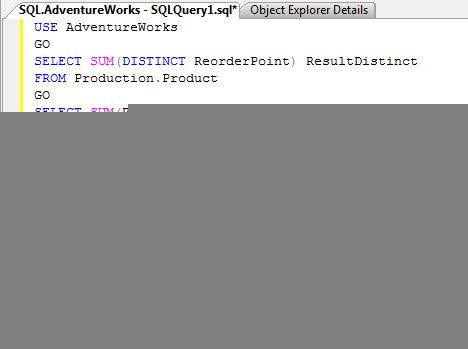
SQL SERVER – Example of DISTINCT in Aggregate Functions
Does DISTINCT in Aggregate Functions make a difference? Yes. A quick AdventureWorks example compares SUM(DISTINCT ReorderPoint) with a plain SUM.

SQL SERVER – Order Of Column In Index
Adding more columns does not make an index better. The order of column in index matters most, since an index is used only when its first column is in the query.