

Find the tipping point where key lookups cost more than a scan, then compare covering and filtered indexes with measured reads.

DBCC CHECKDB Running Slow? Check the MAXDOP Option
DBCC CHECKDB running slow can trace back to the MAXDOP option. A CHECKDB with no MAXDOP option uses the server’s max degree of parallelism, and one with its own option overrides it. This post times CHECKDB on a 2 GB database with four settings, adds PHYSICAL_ONLY, and lists the other causes to rule out.

Azure – Which One to Get – Standard Disks or Premium Disks
Many customers get a slower SQL Server after moving to Azure. Should you pick Standard or Premium Disks? My short answer is Premium, and here is why.
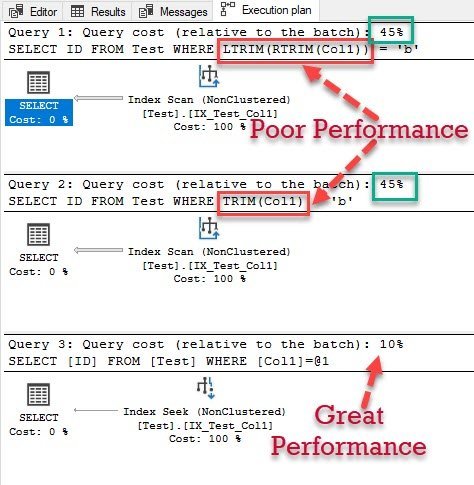
SQL Server – Performance Comparison of Function Trim and LTRIM(RTRIM)
A workshop question: what is the performance comparison of function TRIM and LTRIM(RTRIM) in SQL Server? Here are the test results.

Disk Space Needed to Build a Clustered Index on a Big Table
A clustered index build holds the old table and the new index at the same time. Here is a small demo of that peak, and what to check first.

Collecting Server Hardware Facts Before a Tuning Session
Capture server hardware facts from SQL Server views, keep an inventory, and distinguish visible resources from workload sizing evidence.

High CPU Consumption in SQL Server: Where to Look First
High CPU consumption in SQL Server comes from a handful of causes, and a short checklist finds them in order. This post reads the scheduler queue, ranks cached queries by CPU, and checks the Common Criteria Compliance setting that caused a known CPU problem after upgrades. It ends with the update that fixed that case and the questions to ask before you add cores.