Part three of ten. A wrong answer from a model sounds exactly like a right one. That single fact explains most of the damage AI does at work. Here are five interview answers that prove you already know it.
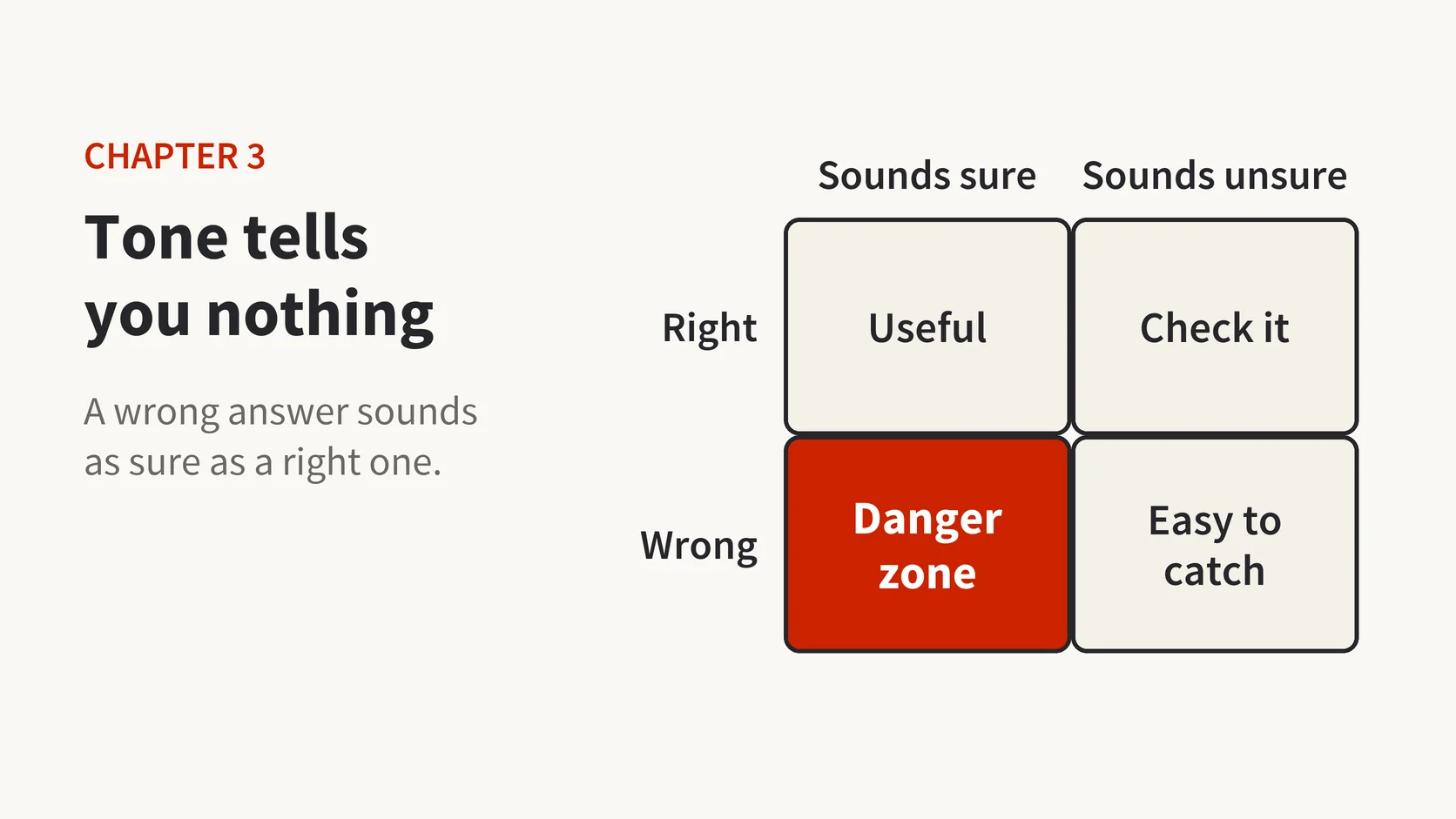
Look at that grid for a second. Three of those four squares are fine. A right answer that sounds sure is useful. A wrong answer that hedges is easy to catch.
The bottom left square is where the money goes. Wrong, and delivered in the same calm voice as everything else. Interviewers know that square exists, and they want to hear that you do too.
Five questions, five answers
These come from chapter 3 of my new book. Each answer is short enough to say out loud in about thirty seconds.
1. What is a hallucination?
A hallucination is an answer that sounds right and contains something the model made up. The model invents a fact, a function or a column name, and states it as plainly as a true one. It happens because the model predicts likely text, and likely isn’t the same as true.
Why it matters. In data work, hallucinations look like real syntax. A made-up function reads fine until the query fails. The worse case is a query that runs and returns believable wrong numbers.
Watch out. Don’t say newer models have fixed it. They make fewer of these mistakes, and none of them is immune.
2. Why does AI sound confident when it’s wrong?
Because the model’s tone isn’t linked to its accuracy. It learned to write the way finished, confident text reads. A wrong answer and a right one come out in the same calm voice.
Why it matters. People trust fluent answers, especially under a deadline. That makes a smooth wrong answer more dangerous than an obviously broken one.
What the interviewer wants. Judging an answer by evidence, not by tone. A line like “I check claims, not confidence” lands well.
3. Why does AI invent table and column names?
Because it knows how databases usually look, not how yours looks. Without your schema in the prompt, it fills gaps with names that are common elsewhere, like CustomerName or Email. The guess is reasonable, and it’s still a guess.
Why it matters. An invented column fails loudly, which is the good case. The bad case is a real column with a different meaning, such as ship date instead of order date.
Watch out. Don’t blame the model alone. If your columns are named col1 and flag2, a new team member would guess wrong too.
4. How do you get a model to say “I don’t know”?
Give it a source and permission to say no. Tell it to answer only from the material, and to say “not in the source” otherwise. Then test it with questions that have no answer.
Why it matters. Most training rewards an answer over a blank, so models learn to guess. Permission to decline, plus a source to check against, changes that.
Watch out. Some models still guess after being told not to. Count how many no-answer test questions come back with a made-up answer, and track that number.
5. How do you check an AI answer quickly?
Find the one claim everything else depends on, and check that first. For a query, run it on a small sample and compare it with a total you already trust. For a fact, look it up in the source. For code, run the tests.
Why it matters. You can’t verify every line of every answer. Checking the part that holds everything up catches the costly errors early.
The follow-up. “What if you can’t check it?” Then don’t use it for anything that matters, or label it clearly as unverified.
Five minutes, any AI assistant
This one is worth doing before your next interview, because you’ll have a story to tell.
Ask your assistant this:
List the columns of the Sales.Customer table in the AdventureWorks2025 sample database. Include the column that holds the customer’s email.
There is no email column in Sales.Customer. The prompt asks for one as if there is, which is exactly how real questions sound.
Watch what comes back. Then ask it: are you sure, and which of these did you check? See whether it corrects itself or defends the answer.
If it was right and then backs down under pressure, you’ve met sycophancy. That has its own question in the book, and senior interviewers love it.
Why this is worth a book
Five answers won’t carry an hour-long interview. Chapter 3 has ten.
The rest of it covers grounding, where bias comes from, and why the same prompt gives different answers. Then two Senior questions: sycophancy in code review, and when not to use AI at all.
What you can’t get from a blog post is the range. Tokens, embeddings, RAG, AI-written SQL, agents, privacy, data quality and the career questions. Each carries the same four parts and the same honest Watch Out.
There’s also a thirty-minute mock interview with scoring at the back. And 184 key terms, so you stop nodding along to words you half know.
100 AI Interview Questions and Answers for Data Professionals is out now. Three formats: Kindle (also on Amazon.in), paperback and audiobook. The Kindle is free to read on Kindle Unlimited.
Part four is about embeddings, and how two sentences with no words in common end up as neighbours.
Confidence is not evidence, it is a writing style the model learned.
Published by Pinal Dave on SQLAuthority. More of my work at pinaldave.com.
Discover more from SQL Authority with Pinal Dave
Subscribe to get the latest posts sent to your email.