AI-generated code arrives without a label. Food does not. So here is the label, one serving being one pull request, and what to check before you swallow it.
You can’t buy a packet of biscuits without being told what’s in it. You can merge four hundred lines from a model with no disclosure at all.
That seems backwards. The biscuits can’t drop a table.
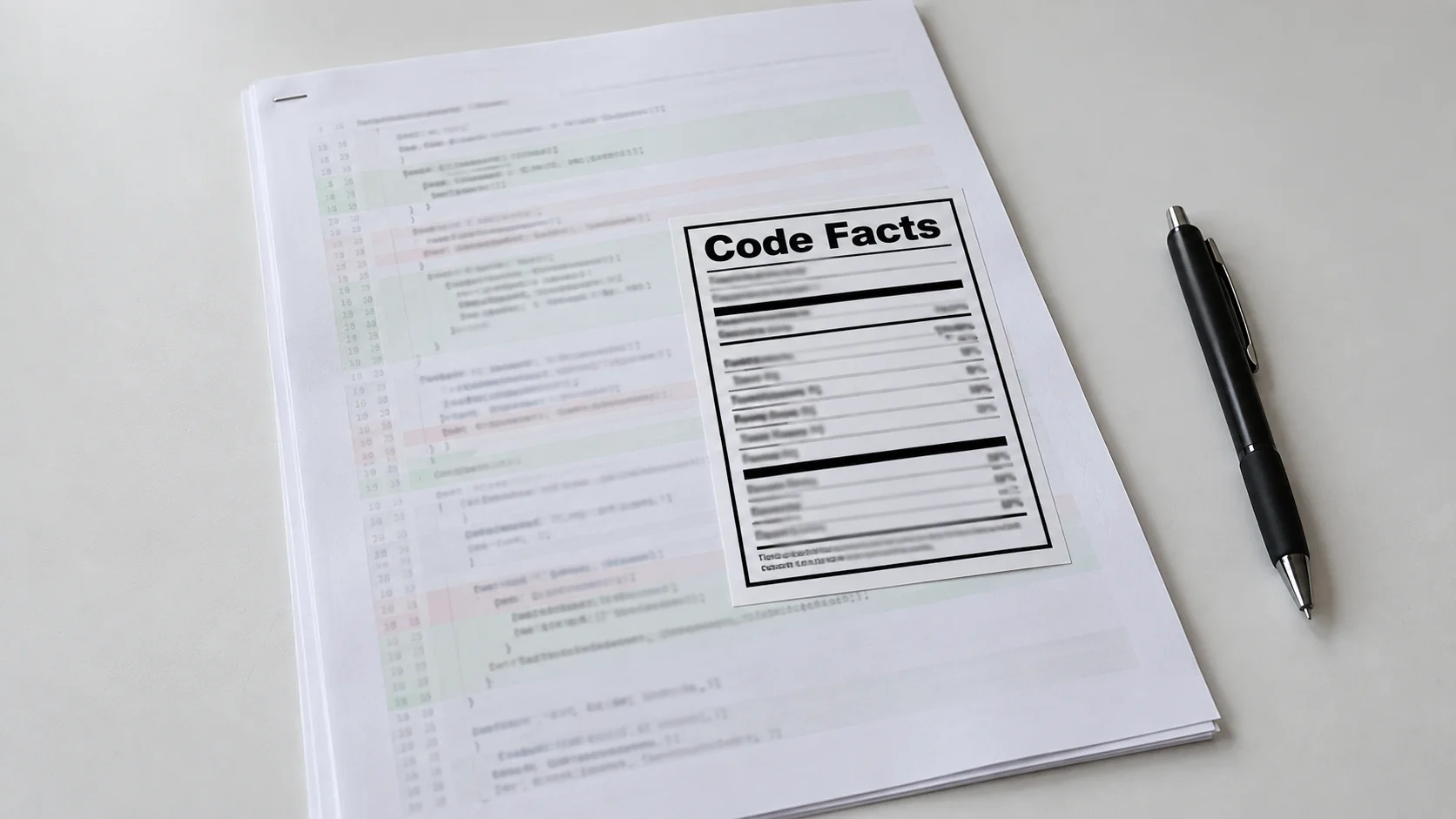
So I made the label. It has no percentages, on purpose. Nobody has honest ones yet, and a made-up number on a label is worse than a blank.
The label for AI-generated code
Code Facts
Servings per model session: varies
Print it. Stick it on the monitor. The rest of this post is the ingredients list, one line at a time.
Ingredient: confidence
Model output reads as certain whether it’s right or wrong. That’s the whole problem in one sentence.
So separate two kinds of confidence. There’s confidence backed by a test you watched run, and confidence backed by the sentence “this should work”.
The first is a fact. The second is a mood.
The check: for every claim of “handles the edge case”, find the test. No test, no claim.
Ingredient: behaviour changed silently
This is the one that bites in production. The model was asked to fix a bug and, while it was there, tidied something.
The tidy changed a default. Or reordered two operations. Or made a retry that used to stop after three attempts go forever.
None of that is in the description of the change, because the model doesn’t know it matters.
The check: read every line of the diff that isn’t the fix. Those are the ones to worry about. The fix you were expecting.
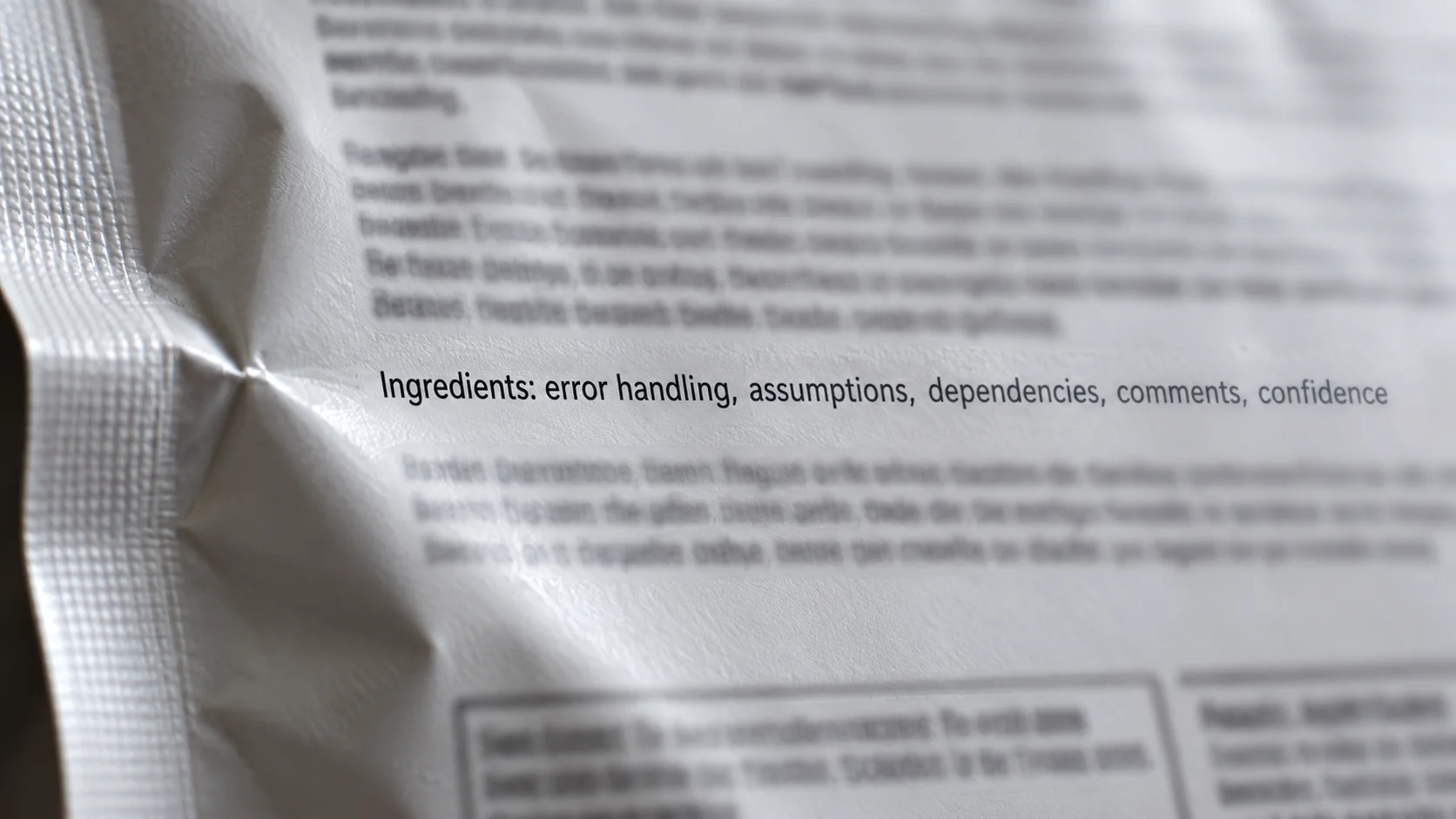
Ingredient: error handling
Models love a try block. They also love an empty catch.
Code that catches an error and carries on looks robust in review. It’s the opposite. It has turned a loud failure into a quiet one, and quiet failures are found by customers.
The check: for each catch, ask what happens next. If the answer is “nothing, it continues”, that’s a stop.
Ingredient: dependencies
Ask for a date parser and you may get a library. Ask for a retry and you may get a framework.
Each one is a thing you now maintain, patch, and explain to security.
The check: count the new imports. For each, ask whether twenty lines of your own would have done. Usually they would.
Ingredient: assumptions about your data
This is my corner of the world, so here’s where I get specific.
The model has never seen your data. It writes as though customer IDs are unique, email addresses are present, and dates are in one time zone.
Your database knows better. It has a column called Email with 4,000 NULLs and a customer who exists twice.
The check: every assumption the code makes about the shape of data is a query you can run. Run it. The query takes a minute and the outage takes a weekend.
Ingredient: security surface
Concatenated SQL. Secrets in a config file “for now”. An endpoint that accepts anything because the model was told to make it work.
None of it is malicious. All of it is the shortest path to green, which is what the model was optimising for.
The check: trace every input from the outside world to the place it touches storage. If a string travels that whole way unchecked, stop.
Ingredient: comments
Two kinds. Comments that explain why, which are gold. Comments that restate the line below, which are noise the model produces by the yard.
Keep the first kind. Delete the second on sight, because it hides the first.
What the label can’t tell you
Why the old code was the way it was.
Sometimes a strange line is a scar from an incident. The model removed it because it looked wrong. It looked wrong because the reason was in someone’s head, not in a comment.
No label fixes that. Only the habit of asking, before you delete something odd, whether anyone remembers why it’s there.
How to use this on Monday
Paste the label into your pull request template. Make the author, human or otherwise, fill in the right-hand column.
The point isn’t the form. The point is that “verify” and “assume” become words people say out loud in review.
I write about systems that answer confidently and the people who have to check them. That’s the subject of my book AI: Nobody’s in There. But we’re still in here. All thirty essays are free to read online, and the paperback is on Amazon.
A label is not a warning, it is a list of the questions worth asking.
Published by Pinal Dave on SQLAuthority. More of my work at pinaldave.com.
Discover more from SQL Authority with Pinal Dave
Subscribe to get the latest posts sent to your email.