
It was a Sunday evening. Around 8:15 PM. The kind of evening where the whole house smells of cardamom and warmth, and you trick yourself into believing that time has stopped moving. Here is the story of AI, Disposable Apps, and the Sunday Evenings We Are Losing.
My wife had a novel open in her lap. I was on the sofa, half-asleep, letting the weight of a long work week melt into the cushions.
And our teenage daughter was sitting right next to us. Right there on the same sofa, in the same warm room, breathing the same cardamom air. We could have started talking about anything at all. About her day at school. About the book my wife was reading. About nothing in particular, the way families do when the evening is slow and there is nowhere else to be.
But we didn’t. And she didn’t either.
She was on her phone. Her thumbs moved so fast. Her face carried a deep frown. I watched her for a few seconds, this girl I used to carry on my shoulders, this girl who once cried if I left the room for two minutes. And I thought: when did she stop looking at me?
Then she looked up.
Not at her phone. At me. Directly at me. And her eyes were not angry. They were confused. They were tired. They were the eyes of a sixteen-year-old girl who is growing up in a world that does not make sense to her.
She looked up and said:
“Dad, why does every app feel temporary? I download something, I use it once, and I delete it. Nothing feels like it belongs to me anymore. Nothing stays.”
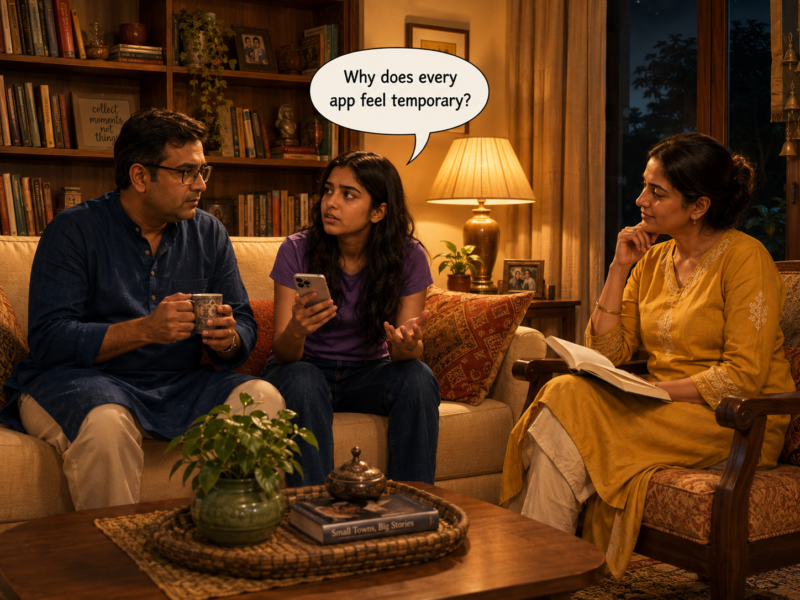
I opened my mouth. But nothing came out.
Because she was not asking about apps. Not really. She was asking about her life. She was asking why the world she is growing up in feels like sand running through her fingers. She was asking why nothing holds still long enough for her to love it.
And I did not have an answer. Because I feel it too.
She wasn’t asking about apps. She was asking why nothing stays.
The Age of the Paper Cup
Let me describe the world we are building.
You want to organize a small dinner with old friends. You do not download an app. You do not sign up for anything. You just tell an AI: “Make me a quick tool where five people can vote on pizza toppings and split the bill.” Five seconds later, the tool exists. You share a link. Everyone votes. You eat. You laugh. You hug your friends goodbye. And then, quietly, the tool vanishes from the server. Gone. Like it was never there. No one saves it. No one remembers its name. No one even notices it disappeared.
It is brilliant. It is efficient. It is the future.
And it is a paper cup. You drink from it once. You crush it in your hand. You throw it away without a second thought.
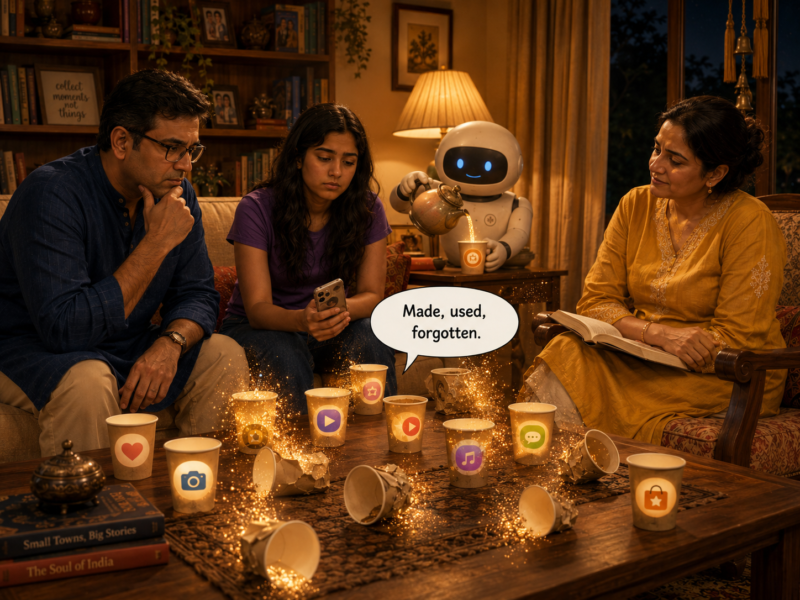
Now, you might be thinking: what is wrong with that? Paper cups are useful. Disposable apps are convenient. Why should I care?
Here is why.
Because every paper cup you throw away teaches your hands something. It teaches them that things are not worth holding onto. That if something is imperfect, if the design is a little off, if it does not match your mood in this exact second, you can just get a new one. No cost. No effort. No guilt. No grief.
Every paper cup teaches your hands that nothing is worth holding onto.
And that lesson does not stay inside your phone. It follows you home. It sits down at your dinner table. It crawls into your marriage, your friendships, your relationship with your children. It rewrites the way you love.
And you do not even notice. Not until it is too late.
The Muscle We Forgot to Exercise
I want to tell you something personal. Something I am not proud of.
Last month, I was sitting at my desk debugging a complex SQL Server query. It was a hard problem. The kind that does not give you the answer in five minutes. The kind that requires you to sit with the discomfort, stare at the screen, and think slowly.
And I caught myself reaching for my phone. Not because I needed to check anything. But because my brain could not tolerate the discomfort of not knowing the answer immediately. My own mind was trying to escape the difficulty. It wanted the fast thing. The easy thing. The paper cup.
That scared me.
I remembered the early days of computing in India. The heavy CRT monitors. The screaming sound of dial-up internet. The way a single webpage could take a full minute to load, and you just sat there, hands folded, watching a progress bar crawl across the screen like a tired animal. And you were fine with it. You did not rage. You did not swipe. You waited. You breathed. You let the slowness wash over you.
That waiting was not a waste of time. It was a workout. Every slow query, every stubborn bug, every hour of confused reading was training something inside us. I call it the patience muscle. And like any muscle, it grew stronger every time we used it.
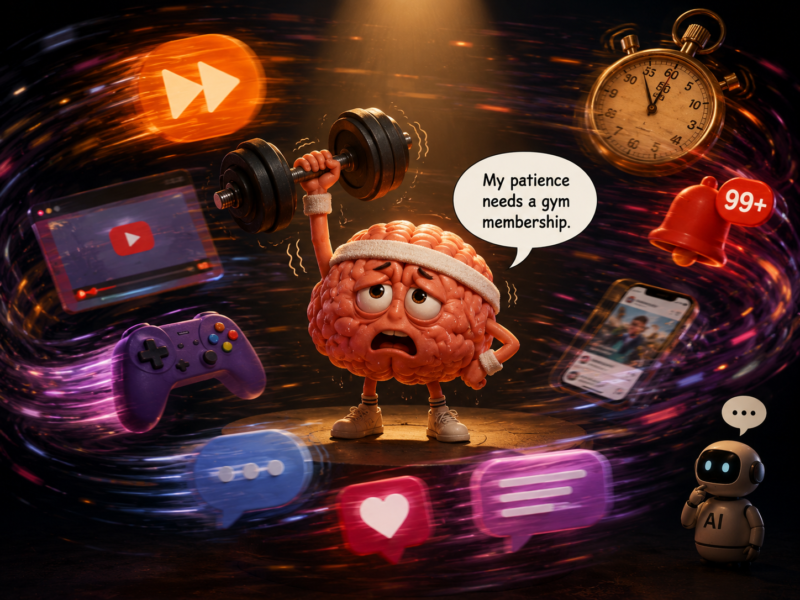
But we stopped using it. And now it is dying.
We called it slowness. It was strength, and we let it go soft.
With AI disposable apps, there is no friction. If a button is in the wrong place, you do not learn to work with it. You command the AI to rebuild the whole thing. Instantly. You have become a tiny god of your own digital kingdom, demanding that reality reshape itself around your every preference, your every mood, your every passing whim.
And here is the part that should frighten every parent, every spouse, every human being who loves someone:
Your brain does not know the difference between how you treat your technology and how you treat your people.
When you spend ten hours a day commanding machines to obey you without resistance, your brain quietly recalibrates. Friction becomes intolerable. Waiting becomes unbearable. Imperfection becomes unforgivable. And then you close your laptop and sit down across from your wife, your husband, your child. Real, messy, beautiful, imperfect human beings who cannot be rewritten with a prompt. And you find yourself getting irritated. Not because they did anything wrong. But because they are not as fast, as smooth, as instantly perfect as the digital world you just left.
Think about the last time you felt impatient with someone you love. Not over something big. Over something small. A story that went on too long. A question that could have been Googled. A pause in conversation that felt uncomfortable.
Now ask yourself: was that impatience always there? Or did you learn it?
The Beautiful, Quiet Loneliness
But the loss of patience is not even the part that keeps me awake. The part that keeps me awake is the loneliness.
In the older world of technology, we shared a common landscape. We all used the same clunky operating systems. We all wrestled with the same confusing software. We all cursed at the same blue screens. And because we shared these small frustrations, we shared something much larger: a sense of belonging. You could walk up to a coworker and say, “Did you see that crash?” and they would nod and groan and laugh. And in that tiny, forgettable moment, neither of you was alone.
Disposable apps are destroying that shared world. Quietly. Invisibly. Without anyone voting for it.
When every piece of software is custom-generated by an AI that knows exactly how you think, exactly what you like, exactly what makes you comfortable, you are no longer part of a shared digital community. You are living inside a private universe. A universe of one.
A universe of one. Perfectly comfortable. Perfectly alone.
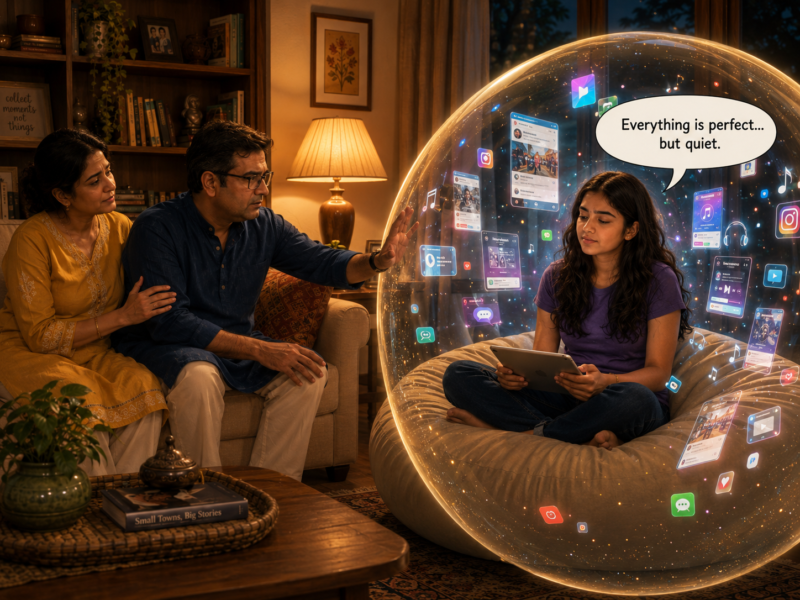
Look at that image carefully. That is a girl inside a bubble. Everything inside is beautiful. Every app is tuned to her. Every notification is personalized. Every screen knows her name.
And right outside the bubble, three feet away, sit two people who love her more than any algorithm ever could. Two people who would give anything to hear her laugh. Two people whose tea is going cold because they are waiting for her to look up.
She does not look up. The bubble is too perfect. The bubble is too comfortable. The bubble asks nothing of her.
This is the loneliness I am afraid of. Not the dramatic kind you see in movies. Not the kind where someone is stranded on an island. The quiet kind. The kind where you are surrounded by people who love you, and you do not even notice them. The kind where your whole family is in one room, and everyone is in a different universe.
Real people are not customizable. Your spouse will have bad days when they are short-tempered and unreasonable. Your children will say hurtful things they do not mean. Your friends will cancel plans and forget to call back. None of these people can be debugged. None of them will update their personality based on your feedback. Loving them requires you to sit with imperfection, with frustration, with the slow and sometimes painful process of understanding another human heart.
No one you truly love can be rewritten with a prompt.
And if we spend our days inside bubbles that demand nothing of us, we will slowly lose the ability to do the one thing that makes life worth living: to love someone who is difficult to love, and to stay.
The Question That Will Not Leave Me
My daughter is sixteen. In two years, she will leave for college. Maybe in a different city. Maybe across the country. She will build her own life, with her own routines, her own Sunday evenings, her own cups of tea with people I may never meet.
The Sunday evenings we have left. The ones with the three of us on this sofa, in this room, with the smell of cardamom in the air. Those evenings are numbered. I can count them. And the number is so much smaller than I thought it would be.
So when I watch her disappear into her phone, into a world that is custom-built to hold her attention forever, I feel something I do not have a word for. It is not anger. It is not frustration. It is something older and heavier than both of those things.
It is grief for a moment that has not ended yet.
She is right there. Three feet away. I can hear her breathing. And I am losing her to a paper cup.
But here is the thing that makes my chest tight when I really think about it: she is not the only one disappearing. I am too. Every time I check my email during dinner. Every time I scroll through my phone while she is talking. Every time I choose the screen over the human being sitting next to me. I am teaching her, with my own hands, that people are interruptible. That presence is optional. That love can wait.
What if she learns that lesson? What if she carries it into her marriage, her friendships, her own family one day? What if the reason she cannot put her phone down is because I never put mine down first?
Maybe she cannot look up because she learned it from a father who never did.
That is the question that will not leave me.
A Point to Ponder
I am not writing this to lecture anyone. I have no right to. I am as guilty as anyone. Maybe more.
But I am writing this because I believe we are standing at a crossroads that most of us do not even see. On one side is a world of perfect convenience, where every tool is disposable, every experience is customized, and every moment of friction is eliminated before you even feel it. On the other side is something messier. Slower. Harder. And infinitely more beautiful.
Here are a few things I have started doing. Not because I have figured anything out. But because I am afraid of what will happen if I don’t:
- I write with a real pen. When I make a mistake, I cannot undo it. I cross it out and keep going. The smudge stays on the page. And somehow, that imperfection makes the words feel more honest than anything I have ever typed.
- I let myself be bored. When the chai is brewing, I stand in the kitchen and listen to the water. I do not reach for my phone. I just stand there. Doing nothing. Being no one. And those ninety seconds of silence are more nourishing than anything on my screen.
- I stay in the hard conversations. When a talk with my wife or my daughter gets tense, when every instinct tells me to glance at my phone and escape, I stay. I sit with the discomfort. I let the silence stretch. I remind myself that love is not about being comfortable. Love is about being present when it is hard.
- I build things with my hands. A recipe I know by heart. A plant that needs watering every morning. Three clumsy chords on an old guitar. Things that resist my impatience. Things that teach me, again and again, that the most beautiful things in life are the ones that refuse to be rushed.
Technology will keep getting faster. Apps will become more disposable. AI will keep getting better at giving us exactly what we want, in exactly the moment we want it, with zero friction and zero resistance.
But I do not want to become disposable. And I do not want my daughter to grow up believing that the people in her life can be swiped away as easily as the apps on her phone.
So here is what I am going to do tonight. And I am asking you, from the bottom of my heart, to consider doing the same.
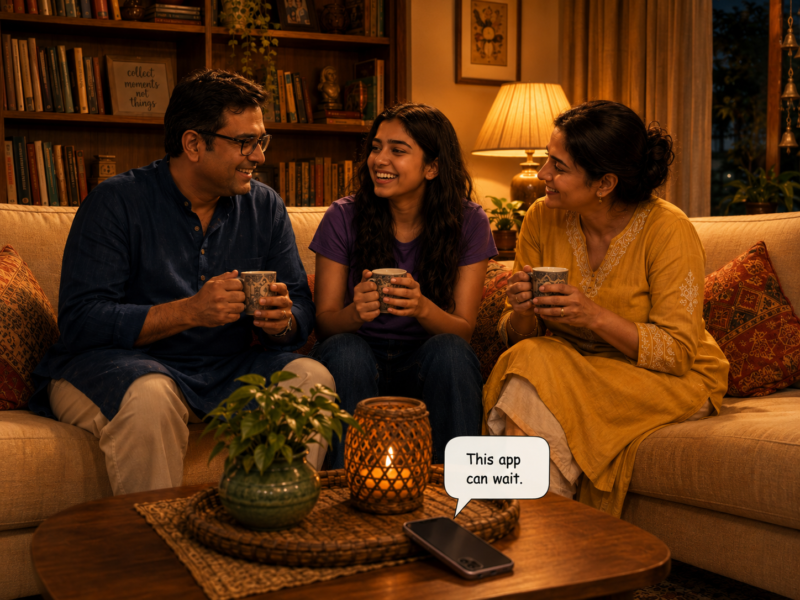
Close this screen. Put the phone face-down on the table. Walk into the room where the people you love are sitting. Look at them. Not at a screen. At them. Their faces. Their eyes. The way they hold their cup of tea. The way they breathe when they do not know you are watching.
And start a conversation. A real one. A slow one. An imperfect, stumbling, beautiful conversation about nothing in particular. The kind of conversation that has no purpose and no destination. The kind that cannot be optimized or prompted or generated by any machine.
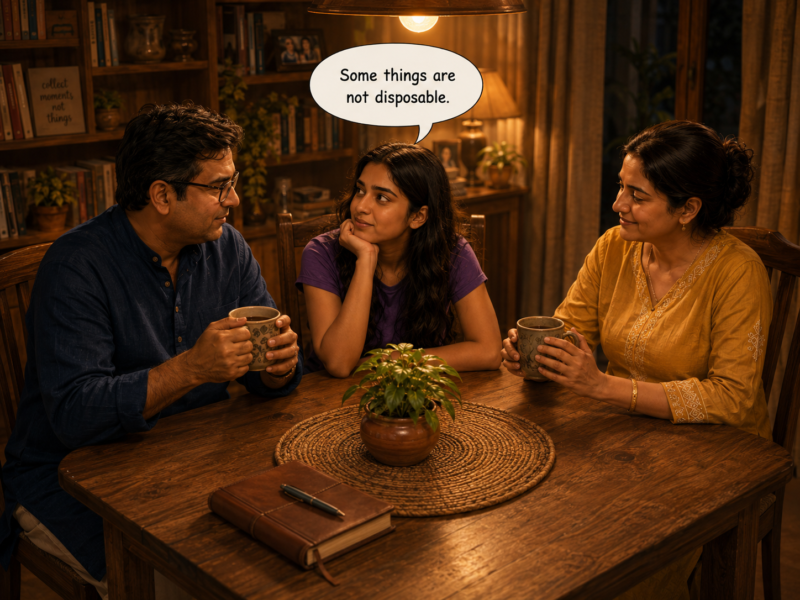
Because some things in this world are not disposable. Your marriage is not a paper cup. Your friendships are not a one-time-use app. The evenings with your family, the ones you think will go on forever, are not infinite. They are running out. Right now. While you are reading this.
And if someone you love is in the next room right now, I am begging you: put this down. Go sit with them. This blog post will be here when you come back.
They might not.
Well, that’s it for today! Let’s keep building connections that last.
Reference: Pinal Dave (https://blog.sqlauthority.com/), X




1 Comment. Leave new
Thank you. That was beautifully said. I do have one small disagreement. The 90 seconds for the chai to brew should not be a time to be bored. It should, instead be a time to quietly anticipate the amazing flavor that will soon be ready to sip. If you blend your own spices to make your chai, it can also be a time to consider whether this particular pot will be more noteworthy than the pot from yesterday or last week. Do you have the optimal balance of ginger, cardamom, peppermint, other flavors? What is optimal anyway and how does it change over time?