Question: What is the difference between sql_handle and plan_handle?

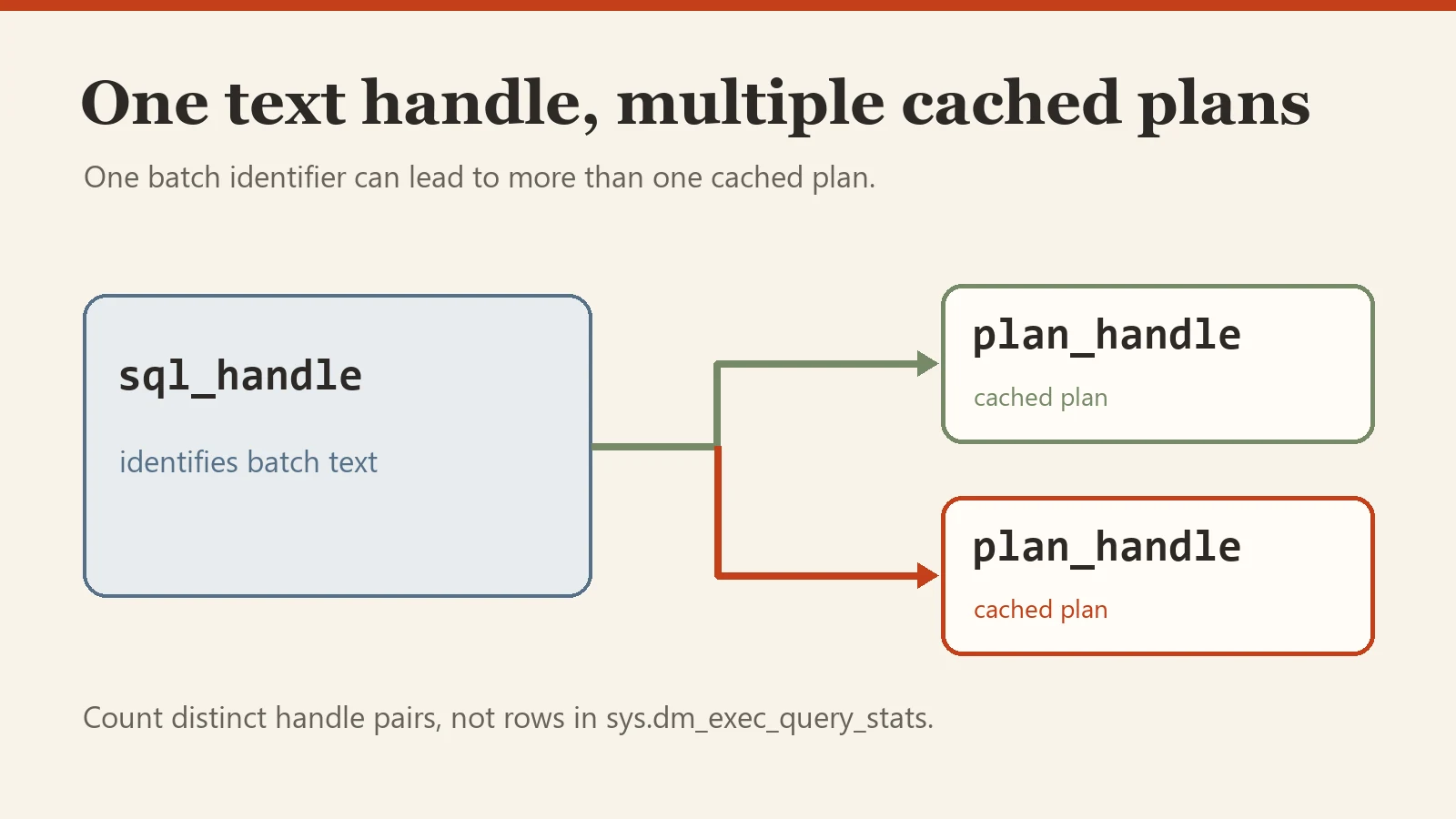
Answer: I was asked this during a Comprehensive Database Performance Health Check. A sql_handle identifies the batch or stored procedure text. A plan_handle identifies a cached execution plan. Neither value is the text or plan itself; each is a token you pass to the appropriate function to retrieve more information.
See Both Handles in the Cache
sys.dm_exec_query_stats is the place to start. The text function below makes the batch behind a sql_handle visible. Results depend on what is cached on your instance, so your grid will look different from anyone else’s.
SELECT TOP (10)
       qs.sql_handle,
       qs.plan_handle,
       st.text AS BatchText
FROM sys.dm_exec_query_stats AS qs
CROSS APPLY sys.dm_exec_sql_text(qs.sql_handle) AS st;
One batch can have more than one cached plan under different compilation contexts. But sys.dm_exec_query_stats has a row for each statement within a cached plan, so a plain COUNT(plan_handle) counts statement rows, not distinct plans. To count the distinct plans per SQL handle, first remove duplicate pairs:
WITH HandlePairs AS
(
    SELECT DISTINCT sql_handle, plan_handle
    FROM sys.dm_exec_query_stats
)
SELECT sql_handle,
       COUNT(*) AS DistinctCachedPlans
FROM HandlePairs
GROUP BY sql_handle
HAVING COUNT(*) > 1
ORDER BY DistinctCachedPlans DESC;
This is a snapshot of the plan cache, not a permanent history of a query. Cached plans can age out, and a query currently running or not cached may not appear here. During a health check, the pair can point me toward a question about repeated compilation, but I investigate the plan attributes and workload before calling it a problem.
Reading this DMV requires VIEW SERVER STATE on SQL Server 2019 and earlier, or VIEW SERVER PERFORMANCE STATE on SQL Server 2022 and later.

A sql_handle is not a plan, it is the text’s address, and one text can have several cached plans.
Published by Pinal Dave on SQLAuthority. More of my work at pinaldave.com.
Discover more from SQL Authority with Pinal Dave
Subscribe to get the latest posts sent to your email.