
Question: Do parallel workers process equal numbers of rows?

Answer: No. They can process different numbers of rows. A parallel plan shares work, but it does not promise an equal row count for every worker at every operator.
This question came up during a performance health check. The original AdventureWorks query was a straightforward way to inspect the difference:
-- AdventureWorks2025 sample database; actual plan Ctrl+M in SSMS.
SELECT SalesOrderID, SalesOrderDetailID, CarrierTrackingNumber,
       OrderQty, ProductID, SpecialOfferID, UnitPrice,
       UnitPriceDiscount, LineTotal, rowguid, ModifiedDate
FROM AdventureWorks2025.Sales.SalesOrderDetail
ORDER BY UnitPriceDiscount
OPTION (RECOMPILE, MAXDOP 4);
Turn on the actual execution plan with Ctrl+M, execute the query, select a parallel scan operator and open Properties. Expand its actual row counts by thread. The query above uses the current sample-database name and caps this statement at MAXDOP 4. That cap does not force a parallel plan, and RECOMPILE does not clear other queries’ cached plans.
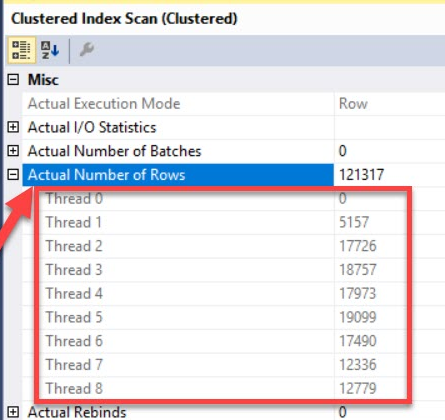
Those are the original scan’s counts, not expected values for today’s run. The number of workers and distribution depend on the plan, data, hardware and execution. A serial plan cannot demonstrate per-worker distribution; inspect a real parallel operator rather than assuming the hint guarantees one.
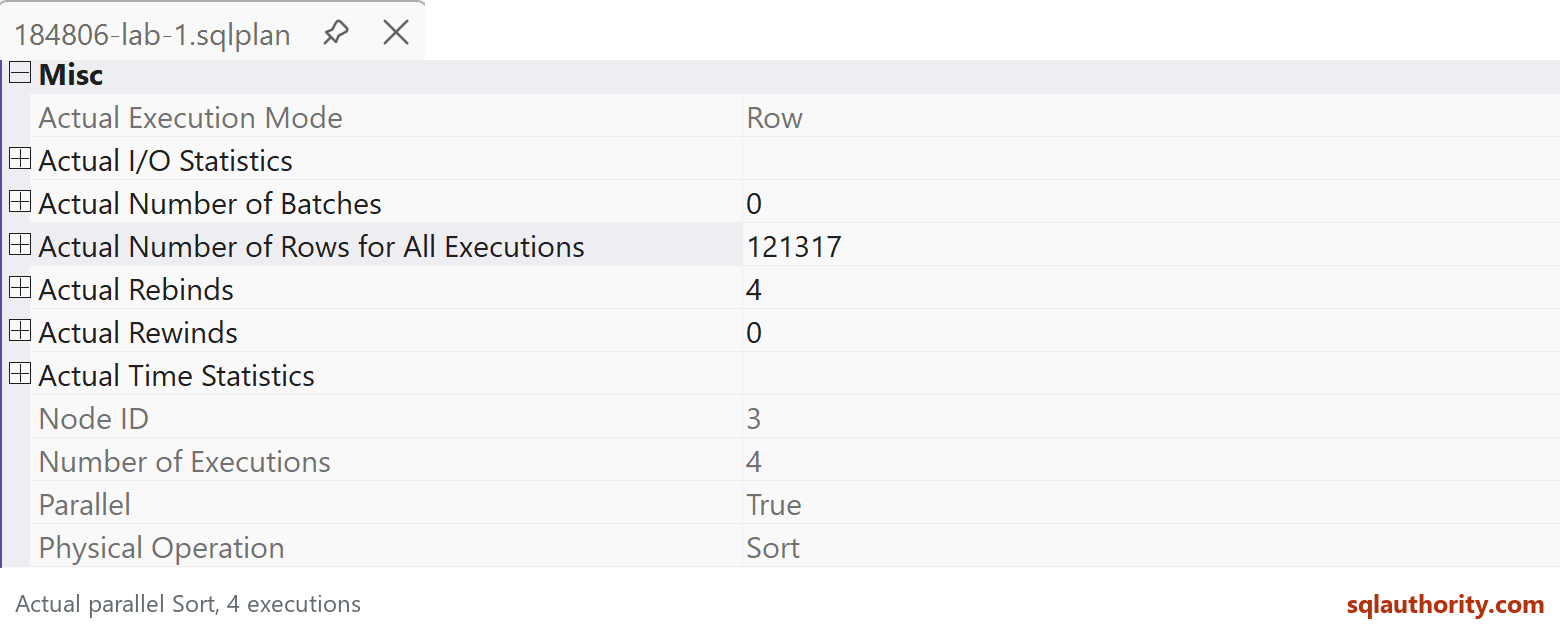
At a scan, work can be handed to workers as they become ready. Later exchanges may repartition rows by a key or collect rows into a serial part of the plan. Uneven row counts can reflect normal scheduling or data distribution. Rows can also have different processing costs, so unequal counts alone do not prove a performance problem.
The useful answer in an interview is to distinguish the maximum degree, the actual parallel operator, and its runtime row distribution. Look at the actual plan and workload before calling the distribution a bottleneck. Was the per-thread display already part of your plan checks?
Published by Pinal Dave on SQLAuthority. More of my work at pinaldave.com.
Discover more from SQL Authority with Pinal Dave
Subscribe to get the latest posts sent to your email.



1 Comment. Leave new
No, It doesn’t.