
Can I create a primary key without any index in SQL Server? Read without any index twice. The question isn’t asking whether the index must be clustered.

A primary key enforces a unique, non-null value for every row. SQL Server backs that constraint with a unique index. On a table that has no clustered index, the default primary-key index is clustered. You can choose NONCLUSTERED instead, or SQL Server will use a nonclustered backing index when the table already has a clustered index.
Try both index types
These are the two tables from my original interview example. Run them in a disposable lab database, since they create permanent sample tables.
IF OBJECT_ID(N'dbo.TestTable', N'U') IS NOT NULL
 OR OBJECT_ID(N'dbo.TestTable1', N'U') IS NOT NULL
    THROW 50137, 'Lab table exists. Choose a new private lab database.', 1;

CREATE TABLE dbo.TestTable
(
    ID int NOT NULL PRIMARY KEY,
    Col1 int NOT NULL
);

CREATE TABLE dbo.TestTable1
(
    ID int NOT NULL PRIMARY KEY NONCLUSTERED,
    Col1 int NOT NULL
);
The original SSMS Object Explorer capture shows the primary key and its corresponding index in both cases. One index is clustered; the other is unique and nonclustered.
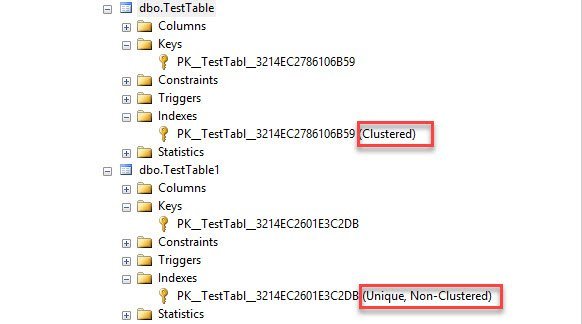
You can also inspect the catalog rather than relying on Object Explorer. unique_index_id connects each constraint to its backing index:
SELECT t.name AS TableName,
       kc.name AS PrimaryKeyName,
       i.name AS BackingIndexName,
       i.type_desc AS IndexType
FROM sys.key_constraints AS kc
JOIN sys.tables AS t
  ON t.object_id = kc.parent_object_id
JOIN sys.indexes AS i
  ON i.object_id = kc.parent_object_id
 AND i.index_id = kc.unique_index_id
WHERE kc.type = 'PK'
  AND t.name IN (N'TestTable', N'TestTable1');
The answer is no: SQL Server does not keep a primary-key constraint with no backing index. A clustered index is not mandatory, but some unique index is. DROP INDEX cannot separately remove an index created to enforce a primary-key constraint. Dropping the constraint removes its index too.
That distinction is why I like this interview question. A candidate who says “make it nonclustered” has changed the index type, not removed the index. What other wording would you use to test the same idea?
Published by Pinal Dave on SQLAuthority. More of my work at pinaldave.com.
Discover more from SQL Authority with Pinal Dave
Subscribe to get the latest posts sent to your email.




1 Comment. Leave new
It might be worth reminding people that not all products use indexes. For example, Teradata is based on hashing. The advantage of a hash is that no matter how big the table gets, a key can be located in at most two probes, with over 99% of them being found in only one probe. Tree structured indexes, on the other hand, require traveling down levels of indexes, to get to the leaf notes.