
Business intelligence comes with a lot of vocabulary, and most of it clicks once you see where each word fits. Here are the important terms and definitions I would learn first as a SQL Server person, grouped by the path data takes from the source system to the report on a manager’s screen.
Business intelligence, or BI, is the set of tools and practices a company uses to collect its data, store it in a shape that is easy to analyze, and turn it into reports and answers that support better decisions.
Where the data starts and how it moves
- OLTP (online transaction processing): the everyday systems that take orders, record payments and update stock, one small transaction at a time.
- ETL (extract, transform, load): pulls data out of source systems, cleans and reshapes it, and loads it into the warehouse.
- Staging area: a work space where data waits while ETL cleans it up.
- Data warehouse: a central store of cleaned, combined history from many systems, built for reporting, not daily transactions.
- Data mart: a smaller, focused store for one subject or one department, such as sales or finance.
How the warehouse is shaped and used
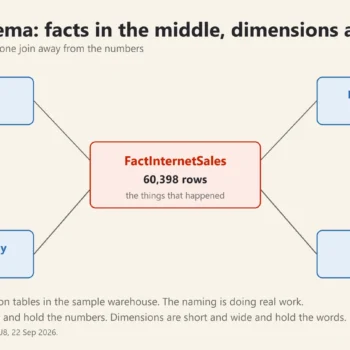
- Fact table: holds the numbers you measure, such as quantity or sales amount, plus keys that point to the dimensions.
- Dimension table: holds the descriptive details, such as customer, product or date, that you use to filter and group the facts.
- Measure: a numeric value in a fact table that you add up, count or average.
- Star schema: one fact table in the middle with the dimension tables around it, like the points of a star.
- Cube: a multidimensional structure, often with totals already calculated, so a total like sales by product by month comes back quickly.
- OLAP (online analytical processing): tools that let you explore a cube interactively, slicing it by any dimension and drilling down from a yearly total to monthly detail.
- Dashboard and KPI: a dashboard shows key performance indicators on one screen, usually comparing each one with a target.
In SQL Server, these ideas map to its own tools: Integration Services handles ETL, Analysis Services builds and serves cubes, and Reporting Services delivers the reports. My longer article has a much bigger glossary and a sample business scenario. Learn the short list above first, and the next BI meeting will sound a lot less like a foreign language.
Published by Pinal Dave on SQLAuthority. More of my work at pinaldave.com.
Discover more from SQL Authority with Pinal Dave
Subscribe to get the latest posts sent to your email.


5 Comments. Leave new
Is is possible to get the link for the complete article?
Thanks.
Dave, post the link please :)
Tiago Salgado,
Thanks for pointing out. Link is posted :
Thanks.
Thanks