I treat bit conversion as normalization, not input validation. SQL Server converts a nonzero numeric value to one. That can hide an unexpected number unless the original value remains visible.

Read the original number beside the flag
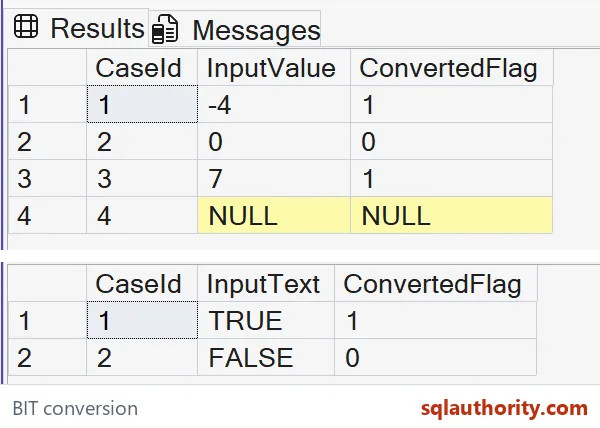
The first query includes negative four, zero, seven and NULL. Its expected flags are one, zero, one and NULL. Negative four doesn’t remain negative, and seven doesn’t remain seven.
I keep the original integer column next to the bit result. Without that column, both unexpected numbers look like an ordinary true flag. The output is useful for learning conversion behavior, but it isn’t proof that the input followed a zero-or-one rule.
WITH Numbers AS
(
 SELECT CaseId, CAST(InputValue AS int) AS InputValue
 FROM (VALUES (1,-4),(2,0),(3,7),(4,CAST(NULL AS int))) v(CaseId,InputValue)
)
SELECT CaseId, InputValue, CAST(InputValue AS bit) AS ConvertedFlag
FROM Numbers
ORDER BY CaseId;

WITH Words AS
(
 SELECT CaseId, CAST(InputText AS nvarchar(5)) AS InputText
 FROM (VALUES (1,N'TRUE'),(2,N'FALSE')) v(CaseId,InputText)
)
SELECT CaseId, InputText, CAST(InputText AS bit) AS ConvertedFlag
FROM Words
ORDER BY CaseId;
Define the allowed input separately
A feed that allows only zero and one has a stricter contract than numeric conversion to bit. The conversion accepts other nonzero numbers by reducing them to one. That difference matters before data enters a flag column.
I’d check the original domain before converting it. Otherwise, an incorrect status code can lose its identity during normalization. Retaining rejected input separately also gives a reviewer something concrete to investigate instead of a flag that looks perfectly ordinary.
Keep NULL distinct from false
The fourth numeric row preserves a missing value as NULL. It doesn’t become zero through this cast. That distinction belongs in the application contract if missing and false represent different business states.
I wouldn’t fill every NULL with zero just to simplify a display. That would turn an unanswered question into a negative answer. If the business requires a default, name that rule explicitly and apply it at a clearly identified boundary.
Recognize the supported Boolean words
The second query converts the text TRUE and FALSE. SQL Server converts those two strings to bit. Their expected results are one and zero, and the input column has an explicit Unicode type.
This doesn’t establish a general vocabulary for every source system. A feed using Y, N or custom status words needs its own mapping. I’d retain the raw label and reject unknown words rather than guessing a meaning from their appearance.

Keep the output type explicit
Both queries return a bit column named ConvertedFlag. Client tools can display bit values as Boolean true and false or numeric one and zero. NULL remains a missing value. Those are different representations of the same declared type.
A consumer can choose a suitable display without changing the underlying contract. I’d verify its treatment of NULL as well as true and false. A serializer that silently omits missing flags can make an incomplete record harder to recognize.
Review aggregation needs before widening
SUM and MAX over a bit column fail with Msg 8117, an operand data type error. To count true flags, CAST the bit to int first and then sum it.
Casting a bit to int for a later calculation doesn’t restore the original numeric input. The normalization has already discarded that distinction. I’d retain source values when they matter, even if the stored flag remains convenient for ordinary filtering.
Test normalization and validation independently
The example performs no updates and defines no table constraint. It reports the conversion behavior on small typed inputs. All original values remain readable, so the full result can be compared without hidden setup.
I’d keep a separate test for the allowed-input rule in a real pipeline. A successful cast answers whether conversion succeeded. It doesn’t answer whether the source was allowed, whether its label was understood, or whether a missing flag was acceptable.
Check what comes in, then let the cast do its quiet work.
A successful bit conversion is not validation, it is normalization that can discard an unexpected number.
Published by Pinal Dave on SQLAuthority. More of my work at pinaldave.com.
Discover more from SQL Authority with Pinal Dave
Subscribe to get the latest posts sent to your email.