
This post answers nine SQL Server interview questions, including cursor and join questions. It is the second part of my series on interview questions and answers.

What Is a Cursor?
A cursor is a database object that applications use to work with data one row at a time. The usual SQL commands work on all the rows in a set at once.
To work with a cursor, you perform these steps in this order:
- Declare the cursor
- Open the cursor
- Fetch a row from the cursor
- Process the fetched row
- Close the cursor
- Deallocate the cursor (read more here)
What Is Collation?
Collation is a set of rules that decides how data is sorted and compared. Character data is sorted by rules that define the correct character order. The options cover case sensitivity, accent marks, kana character types and character width (read more here).
What Is the Difference Between a Function and a Stored Procedure?
You can use a user-defined function (UDF) anywhere in the WHERE, HAVING or SELECT part of a SQL statement. You can’t do that with a stored procedure.
A UDF that returns a table works like another rowset. You can use it in joins with other tables. An inline UDF is like a view that takes parameters. You can use it in joins and other rowset operations.
What Is a Subquery, and What Are Its Properties?
A subquery is a SELECT statement nested inside another T-SQL statement. It is also called a sub-select. You write it inside a set of parentheses.
Subqueries usually return a single row as one value. You can also compare a value against multiple rows with the IN keyword.
A subquery can stand alone. If you run it by itself, it returns a result set, so it doesn’t depend on the statement around it. It can return any number of values. You can find it in the column list of a SELECT. It also works in FROM, GROUP BY, HAVING and ORDER BY clauses. You can also use it as a parameter to a function call. In short, you can use a subquery anywhere you can use an expression (read more here).

What Are the Different Types of Join?
Cross Join
A cross join with no WHERE clause produces the Cartesian product of the tables. The result has as many rows as the first table’s row count times the second table’s row count. A common example is a company that combines each product with a pricing table. That shows each product at each price.
Inner Join
An inner join shows only the rows that have a match in both tables. It is the default join type in the Query and View Designer.
Outer Join
An outer join includes rows even when they have no related rows in the joined table. You can create three kinds of outer join to decide which unmatched rows to include:
- Left Outer Join: includes all rows of the first-named table, the “left” table that appears leftmost in the JOIN clause. Unmatched rows in the right table don’t appear.
- Right Outer Join: includes all rows of the second-named table, the “right” table that appears rightmost in the JOIN clause. Unmatched rows in the left table aren’t included.
- Full Outer Join: includes all rows of all joined tables, whether they match or not.
Self Join
A self join is a case where a table joins to itself, with one or two aliases to avoid confusion. It can be of any type, as long as the joined tables are the same. It is unusual because it involves a relationship with only one table.
A common example is a company with a reporting structure, where one member of staff reports to another. A self join can be an outer join or an inner join (read more here).
What Are Primary Keys and Foreign Keys?
Primary keys are the unique identifiers for each row. They must contain unique values and can’t be null. They are the most fundamental of all keys and constraints, because they matter so much in relational databases. A table can have only one primary key.
Foreign keys ensure data integrity, and they show the relationship between tables.
What Are User-Defined Functions, and What Kinds Can You Create?
User-defined functions let you write your own T-SQL functions. They accept zero or more parameters, and they return a single scalar value or a table.
Scalar User-Defined Function
A scalar function returns one of the scalar data types. The text, ntext, image and timestamp types aren’t supported. This is the kind most developers know from other programming languages. You pass in zero to many parameters and you get a return value.
Inline Table-Valued User-Defined Function
An inline table-valued function returns a table and is a good alternative to a view. It can pass parameters into a T-SQL SELECT. In effect, it gives you a parameterized, non-updateable view of the underlying tables.
Multi-Statement Table-Valued User-Defined Function
A multi-statement table-valued function also returns a table, and it is also a good alternative to a view. It can support multiple T-SQL statements to build the final result, while a view is limited to a single SELECT. It also takes parameters, so it gives you a parameterized, non-updateable view of the underlying tables.
Inside the CREATE FUNCTION command, you define the structure of the table that is returned. You can use this type in the FROM clause of a T-SQL command. A stored procedure, which can also return record sets, can’t be used that way (read here for an example).
What Is Identity?
Identity, also called AutoNumber, is a column that generates numeric values on its own. You can set a start value and an increment, but most DBAs leave both at 1.
A GUID column holds 16-byte unique values instead of numbers, usually from NEWID(). You can’t control the value it generates. SQL Server doesn’t index either one automatically, so add an index when you search or join on them.
What Is Data Warehousing?
A data warehouse is a database with these four traits:
- Subject-oriented: the data is organized so that all elements about the same real-world event or object are linked together.
- Time-variant: changes to the data are tracked and recorded, so you can produce reports that show changes over time.
- Non-volatile: once committed, the data is never overwritten or deleted. It is static and read-only, and it is kept for future reporting.
- Integrated: the database holds data from most or all of an organization’s operational applications, and the data is made consistent.
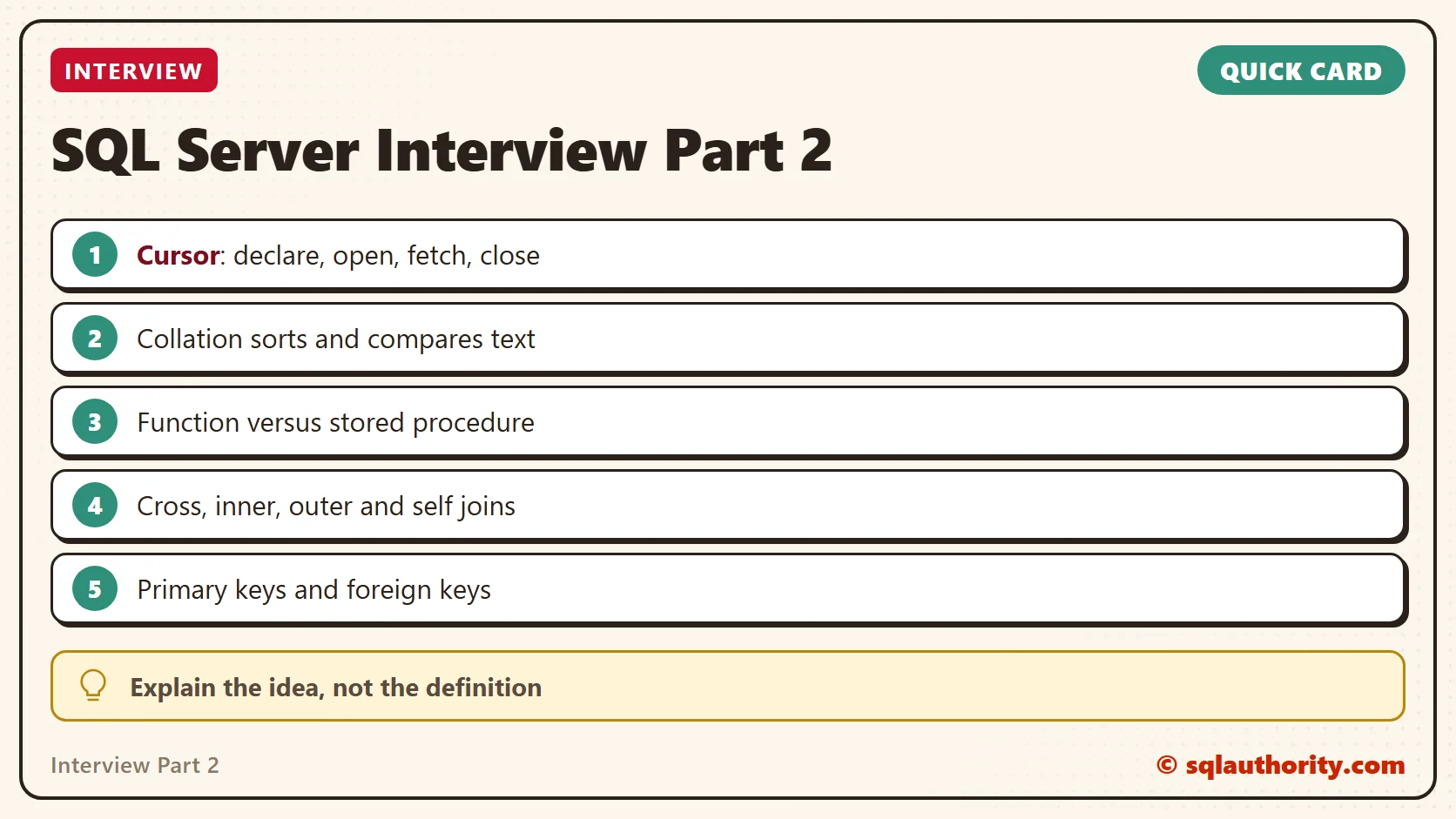
An interview answer is not a definition to recite, it is an idea you can explain.
Published by Pinal Dave on SQLAuthority. More of my work at pinaldave.com.
Discover more from SQL Authority with Pinal Dave
Subscribe to get the latest posts sent to your email.



37 Comments. Leave new
Hi Sir,
I am your fan,Great work !!
hi sir,
i am working with sqlserver2008
i got one problem
in joins
select *from EMPP
select *from Dept
——————————-
select EMPP.Eno,EMPP.Ename,Dept.DeptNo
from EMPP innor join Dept
on EMPP.Eno=Dept.DNo
—————————————————
Msg 4104, Level 16, State 1, Line 4
The multi-part identifier “EMPP.Eno” could not be bound.
Msg 4104, Level 16, State 1, Line 2
The multi-part identifier “EMPP.Eno” could not be bound.
Msg 4104, Level 16, State 1, Line 2
The multi-part identifier “EMPP.Ename” could not be bound.
Plz Help me, how to avoid this Error
Use a different alias
select t1.Eno,t1.Ename,t2.DeptNo
from EMPP as t1 innor join Dept as t2
on t1.Eno=t2.DNo
Hi
IN the question for difference between stored procedure and functions. Do user defined functions compile and has a plan. if not then is it wise to say that, we can use functions also in places where the SQL engine does not need to store the plan and where a logic needs to be called 1000 times but there is no need to store the plan and take procedure cache space.
hello sir,
really it is a good site to all type of exp person could u send me some of the important questions for my further interview
Looking forward for your replay sir
thanking you
nikesh
Thanks sir,
i am very much interested to learn sql server can u send complex queries, questions,please help any professionals
The best resources one can ever find related to SQL Server.
Thank you so much for sharing the valuable information. Keep doing the good deeds.
Hi Pinal
I am Deepthi..This is really a very informative site..It gives good knowledge of sql server…
I have a small doubt..Can you just tell me whats the difference between a view and user defined function..in which situations each of them will be used…
Hi Pinal,
Thanks for everything. I appreciate your effort to provide us everything simple and accurate.
I have two questions about cursor.
Mostly we are asked to avoid cursors, is there any situation when we must have to use a cursor? and what is the most important benifit using a cursor?
hi pinal thanks for your support…
Hi Pinal,
I am working in an mnc. and my main role release Engineer and i need to do website and ssrs script deployements. Can u pls suggest me what all concepts i need to study for upcoming interviews for the same role.
Thanks
Regards,
Sneha
NICE
Hello sir,
Thank u for the amazing SQL resource.. i am a big fan of u sir..
Regards
kirtika