
You can read the current date and time in SQL Server in eight ways. They differ in precision and in time zone. Pick the wrong one and your timestamps lose detail, or lose their meaning.

Current Date and Time in SQL Server: Eight Ways to Ask
Three of the eight are the same function under different names. GETDATE() is the T-SQL spelling. CURRENT_TIMESTAMP is the ANSI standard spelling. {fn NOW()} is an ODBC escape that SQL Server accepts. All three return a datetime. The rest add precision, a time zone offset, UTC, or the date alone.
The first script creates a small database for the examples. The second asks every function for its value in one query. SQL_VARIANT_PROPERTY reports the data type and scale of each value, so you can see what you get back.
IF DB_ID(N'DateTimeDemo') IS NULL CREATE DATABASE DateTimeDemo;
GO
USE DateTimeDemo;
SELECT f.FunctionName,
       CONVERT(nvarchar(40), f.Result, 121)       AS ReturnedValue,
       SQL_VARIANT_PROPERTY(f.Result, 'BaseType') AS DataType,
       SQL_VARIANT_PROPERTY(f.Result, 'Scale')    AS Scale
FROM (VALUES
    (N'GETDATE()',           CAST(GETDATE() AS sql_variant)),
    (N'CURRENT_TIMESTAMP',   CAST(CURRENT_TIMESTAMP AS sql_variant)),
    (N'{fn NOW()}',          CAST({fn NOW()} AS sql_variant)),
    (N'SYSDATETIME()',       CAST(SYSDATETIME() AS sql_variant)),
    (N'SYSDATETIMEOFFSET()', CAST(SYSDATETIMEOFFSET() AS sql_variant)),
    (N'GETUTCDATE()',        CAST(GETUTCDATE() AS sql_variant)),
    (N'SYSUTCDATETIME()',    CAST(SYSUTCDATETIME() AS sql_variant)),
    (N'CURRENT_DATE',        CAST(CURRENT_DATE AS sql_variant))
) AS f(FunctionName, Result);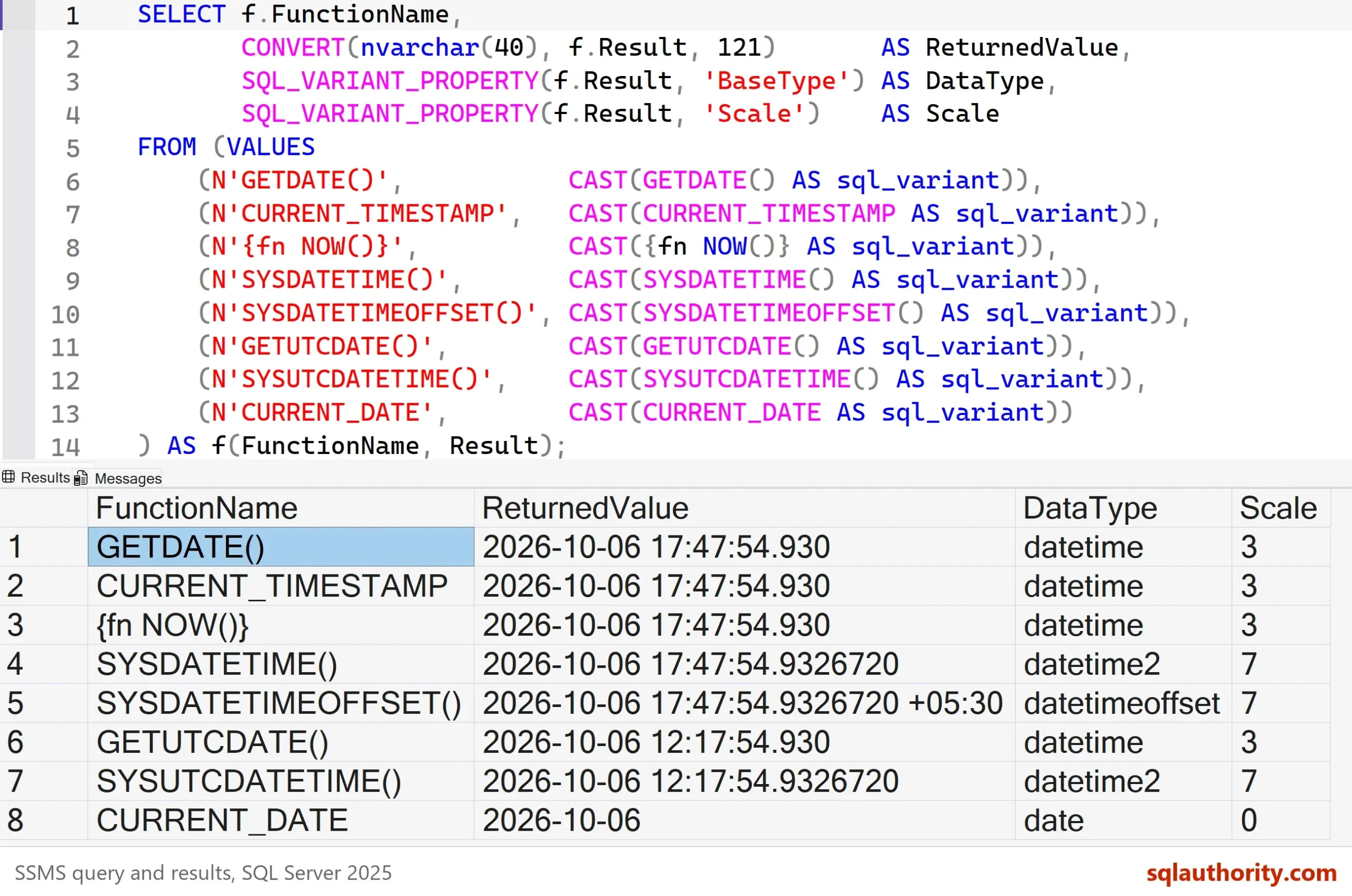
| FunctionName | ReturnedValue | DataType | Scale |
|---|---|---|---|
| GETDATE() | 2026-10-06 17:23:04.033 | datetime | 3 |
| CURRENT_TIMESTAMP | 2026-10-06 17:23:04.033 | datetime | 3 |
| {fn NOW()} | 2026-10-06 17:23:04.033 | datetime | 3 |
| SYSDATETIME() | 2026-10-06 17:23:04.0342668 | datetime2 | 7 |
| SYSDATETIMEOFFSET() | 2026-10-06 17:23:04.0342668 +05:30 | datetimeoffset | 7 |
| GETUTCDATE() | 2026-10-06 11:53:04.030 | datetime | 3 |
| SYSUTCDATETIME() | 2026-10-06 11:53:04.0342668 | datetime2 | 7 |
| CURRENT_DATE | 2026-10-06 | date | 0 |
Your values will differ, because they come from your clock. My server runs five and a half hours ahead of UTC, so the local and UTC rows are 5:30 apart. CURRENT_DATE runs on SQL Server 2025. The cast form shown later works on SQL Server 2008 and later. It’s the safer choice when code must run on several versions.
datetime and datetime2 Are Not the Same
A datetime keeps time in steps of 1/300 of a second. That’s why the milliseconds always end in 0, 3 or 7. A datetime2(7) holds 100 nanoseconds. For a report header, nobody cares about the difference.
For an event log, the difference matters. Two events inside the same few milliseconds can get identical datetime stamps. Then you can’t tell which came first. Use SYSDATETIME() or SYSUTCDATETIME() for anything you will sort or compare.
Once Per Statement, Not Once Per Row
These functions don’t tick while a query runs. Each function reads the clock once per statement and reuses that value for every row. The next query reads 100,000 rows and counts the distinct values for two of them.
SELECT COUNT(*)                       AS RowsRead,
       COUNT(DISTINCT t.NowValue)     AS DistinctGetdate,
       COUNT(DISTINCT t.PreciseValue) AS DistinctSysdatetime
FROM (SELECT TOP (100000) GETDATE() AS NowValue, SYSDATETIME() AS PreciseValue
FROM sys.all_columns AS a CROSS JOIN sys.all_columns AS b) AS t;| RowsRead | DistinctGetdate | DistinctSysdatetime |
|---|---|---|
| 100000 | 1 | 1 |
Every row got the same value from each function. Two different functions in one statement can still differ by a few milliseconds. The GETDATE, GETUTCDATE and SYSDATETIME rows in the first table show it. A new statement reads the clock again, even inside one batch. This script waits one second between two reads and measures the gap.
DECLARE @first datetime2(7) = SYSDATETIME();
WAITFOR DELAY '00:00:01';
DECLARE @second datetime2(7) = SYSDATETIME();
SELECT DATEDIFF(millisecond, @first, @second) AS MillisecondsApart;
| MillisecondsApart |
|---|
| 1012 |
The practical lesson: one INSERT stamps every row it adds with the same time. Don’t use the timestamp to order rows from the same statement. Use an identity column for that.
Defaults and Audit Columns
The best place to capture the current date and time is a DEFAULT constraint on the table. The application never has to remember to send a time, and every row gets one. My habit is a UTC datetime2 for the audit column. I add an offset column when local meaning matters, and a plain date for the order date.
DROP TABLE IF EXISTS dbo.OrderLog;
CREATE TABLE dbo.OrderLog (
    OrderID       int               IDENTITY(1,1) PRIMARY KEY,
    Item          nvarchar(60)      NOT NULL,
    OrderDate     date              NOT NULL CONSTRAINT DF_OrderLog_OrderDate DEFAULT CAST(SYSDATETIME() AS date),
    CreatedUtc    datetime2(3)      NOT NULL CONSTRAINT DF_OrderLog_CreatedUtc DEFAULT SYSUTCDATETIME(),
    CreatedOffset datetimeoffset(0) NOT NULL CONSTRAINT DF_OrderLog_CreatedOffset DEFAULT SYSDATETIMEOFFSET()
);
INSERT INTO dbo.OrderLog (Item) VALUES (N'Tomato seedlings'), (N'Herb planter');
SELECT OrderID, Item, OrderDate, CreatedUtc, CreatedOffset FROM dbo.OrderLog;| OrderID | Item | OrderDate | CreatedUtc | CreatedOffset |
|---|---|---|---|---|
| 1 | Tomato seedlings | 2026-10-06 | 2026-10-06 11:53:05.141 | 2026-10-06 17:23:05 +05:30 |
| 2 | Herb planter | 2026-10-06 | 2026-10-06 11:53:05.141 | 2026-10-06 17:23:05 +05:30 |
A default fires only on INSERT, and only when you leave the column out. An UPDATE never refreshes it. Both rows came from one INSERT, so both carry the same stamp. The UTC column and the offset column describe the same moment. Only the offset column says where the server was when it happened.
UTC and Time Zones
A plain datetime doesn’t record its time zone. A stored 14:00 can’t be placed once the server moves or a second one joins. Store UTC and convert when you display it. AT TIME ZONE does the conversion by zone name and applies daylight saving for you. It needs SQL Server 2016 or later.
SELECT SYSDATETIMEOFFSET() AT TIME ZONE 'Pacific Standard Time'                 AS Pacific,
SYSUTCDATETIME() AT TIME ZONE 'UTC' AT TIME ZONE 'Eastern Standard Time' AS Eastern;| Pacific | Eastern |
|---|---|
| 2026-10-06 04:53:05.1432071 -07:00 | 2026-10-06 07:53:05.1483501 -04:00 |
The zone is named Pacific Standard Time, yet the result shows -07:00. On this date, daylight saving applies, and SQL Server handled it. The second column shows the two-step form. The first AT TIME ZONE 'UTC' says what the value already is. The second says what you want. Leave the first off and SQL Server treats the UTC reading as Eastern time. The offset is right, but the hour is wrong.
Just the Date, and Other Formats
The old way to drop the time used DATEADD and DATEDIFF. Today, a cast to date says what it means. For a “today” filter, use a range. Start at the beginning of today and stop before the beginning of tomorrow. An index on the column can still help.
SELECT COUNT(*) AS OrdersTodayUtc
FROM dbo.OrderLog
WHERE CreatedUtc >= CAST(SYSUTCDATETIME() AS date)
  AND CreatedUtc <  DATEADD(day, 1, CAST(SYSUTCDATETIME() AS date));
It returns 2, the two rows inserted above. This counts UTC days. For a local day, filter on CreatedOffset or convert with AT TIME ZONE first. Display formats such as 09-02-2008 come up constantly. Convert only when you show the value, and keep the stored value a date type.
SELECT CONVERT(char(10), SYSDATETIME(), 110)  AS UsStyle,
       CONVERT(char(10), SYSDATETIME(), 23)   AS IsoStyle,
       CONVERT(varchar(11), SYSDATETIME(), 106) AS MonthName,
       CONVERT(char(8), SYSDATETIME(), 108)   AS TimeOnly,
       FORMAT(SYSDATETIME(), 'hh:mm tt')      AS AmPm,
FORMAT(SYSDATETIME(), 'dd-MM-yyyy') AS DayFirst;| UsStyle | IsoStyle | MonthName | TimeOnly | AmPm | DayFirst |
|---|---|---|---|---|---|
| 10-06-2026 | 2026-10-06 | 06 Oct 2026 | 17:23:05 | 05:23 PM | 06-10-2026 |
FORMAT is handy for one value but slow over many rows, so prefer CONVERT in big queries.
You could argue that GETDATE() is good enough, because most old code uses it and it works. For a report header, that's true. It stops being true when two servers share data. It also fails when you need to know which of two events came first.
Which One Should You Use?
The right source for the current date and time in SQL Server depends on the column. For audit and log columns, use SYSUTCDATETIME(). It's precise, and it leaves no time zone question. When the local clock matters to the reader, such as a store's closing time, use SYSDATETIMEOFFSET(). For a printed report header, GETDATE() is fine.
CURRENT_TIMESTAMP is the portable choice when the same SQL must run on other database systems. Pick one spelling for each purpose and keep it across the codebase. Then a search finds every use, and nobody wonders whether two spellings differ.
What to Remember
Whenever you need the current date and time in SQL Server, ask two questions. Does the order of events matter, and does anyone read the value in another time zone? Two yeses mean a UTC datetime2, or a datetimeoffset.
Remember that each function reads the clock once per statement. Filter by range, convert time zones by name, and format only on display. Run the cleanup script below when you finish.
USE master;
GO
IF DB_ID(N'DateTimeDemo') IS NOT NULL
BEGIN
    ALTER DATABASE DateTimeDemo SET SINGLE_USER WITH ROLLBACK IMMEDIATE;
    DROP DATABASE DateTimeDemo;
END;
A timestamp is not a clock reading, it is a promise about when something happened.
Published by Pinal Dave on SQLAuthority. More of my work at pinaldave.com.
Discover more from SQL Authority with Pinal Dave
Subscribe to get the latest posts sent to your email.




458 Comments. Leave new
This is a very helpful article…Thanks PinalDave
how to find currenttime in australia
Thanks yet again… PinalDave, I have used your teachings many times and well, never offered a thank you. So… Thank you. Anytime I do a query for SQL help, I check your links first! You have been most helpful so many times – so thanks for this one, and all of them!
hi, how to get yyyymmddhhmmss ??? without space and : between hour minutes and seconds
Thanx
This is formation issues that should be handled by your application. However here is the answer for sql
select convert(char(8),getdate(),112)+replace(convert(char(10),getdate(),108),’:’,”)
Hi Sir,
I m facing a problem that is:
I have two columns as CreateDate and ExpiryDate in ASPNETDB.MDF file, I want to put days between two date in DaysLeft Column.
I m using Visual Web developer 2005 express Edition. I m using the function
Datediff(Day,convert(datetime,CreateDate),Convert(Datetime,ExpiryDate)) in computed column specification
but failed. Please reply
I am creating an SSIS to export queried data to excel. I want to pull records from yesterdays date. Seems like the following should work but I get no return
SELECT * FROM TableName
WHERE dateTimeMix = dateadd(dd, -1, getdate())
It should be
SELECT * FROM TableName
WHERE dateTimeMix >= dateadd(day, datediff(day,-1, getdate())),0) and
dateTimeMix < dateadd(day, datediff(day,0, getdate())),0)
Hi Sir, can you please assist me I am trying to insert the current time in a timestamp field.
like
create table x ( a timestamp not null)
INSERT INTO x
VALUES CAST(current_timestamp AS TIMESTAMP)
This alone works
SELECT CAST(current_timestamp AS TIMESTAMP) but if I want to insert it into a table it does not work . I am aware that it converts it to binary on the table when it was successful
I am trying to convert to Month/Day/Year formant,
from Day/Month/Year format.
Will this statement work, or should it be 101 rather than 103 ???
SELECT WorkOrderID, Convert(varchar(12),ModifiedDate,103) FROM Production.Workorder
Hi All,
I wanted a query which will get records between current date and 20 days before also if i can group them to each day. Can any body help?
Regards,
Sachin
Hello, It is a very helpful page. Can anyone tell me how to retrieve only TIME part and DATE/TIME of Database of 2011 from database MS SQL Server 2000. If there is no field of TIME in the table, even then if someone is able to retrieve Time of data storing?
I want to
Create a table having fields are as follows
Create table emp
(
Empname varchar(50),
joining SystemDate,
sal int
)
Plz help me whats the actual Query to get systemdate in this table
Hello ,
i want to search txt file like as 13.03.2014_15.59. txt (current date and time ).
**********************************
bulk insert TmpStList
from ‘C:\PATH\ currentdate_time.txt ‘
with (fieldterminator = ‘,’, rowterminator = ‘\n’)
*************************************************** is what i want to do.
why i get this error:
“The conversion of a varchar data type to a datetime data type resulted in an out-of-range value.
The statement has been terminated.”
i want to insert datetime.now into sql where the type is also datetime
but somtimes its not working.. i get above error..
how can i insert datetime.now as datetime in sql… i want to check the datetime stored in sql with current datetime (it must be of the form dd/mm/yyyy hh:mm:ss am/pm or mm/dd/yyyy hh:mm:ss am/pm)
pls help me with the above problem…
You need to use unambiguous datetime format YYYYMMDD HH:MM:SS
The time is not server time but the time of the machine running the SQL (e.g. if you run the query on a SQL Management studio in one country and it connects to a server on another country – the time will be of the local machine – not the remote)
Hi! Congratulations for your blog is awsome!
One question:
if i want to setup the date of the database with a configuration file… how can i achieve this?
So for example if the configuration file says it is 12/12/12 getdate() retrieves that date…
thank youuu
Thanks for this!
Hello.. need your help.
i have SP like this:
Crearte PROC [dbo].[SP_CONVERT_DAY_TO_DATE_2] @DAY_CODE AS CHAR(2),@TARGET_DATE AS DATETIME OUTPUT
AS
SET DATEFIRST 1
DECLARE @TRX_DATE AS DATE
SET NOCOUNT ON
SELECT @TRX_DATE = TRX_DATE FROM MASTER_CALENDAR
WHERE D_CODE = @DAY_CODE
AND TRX_DATE BETWEEN GETDATE()-25 AND GETDATE()
SET @TARGET_DATE = ISNULL(@TRX_DATE,’01-01-1900′)
—-
PRINT @TARGET_DATE
but, the result always : ” Jan 01 1900 12:00AM”, whats wrong??
when i exec this SP like this: exec [SP_CONVERT_DAY_TO_DATE_2] 02,’2015-01-02′
the result always ” Jan 01 1900 12:00AM, but when 02 change to 31 the result is right, “Dec 31 2014 12:00AM”
may be MASTER_CALENDAR table doesn’t have entry for ’2015-01-02′
Thanks for the articel,actualyy it’s giving half and hour late to the current time
i see Select GetDate() as CurrentTime query running from app server to my database, and it is blocking other queries.
and it never released the lock unless i kill the session. could you please sugget why is that.
Never heard about such blocking. What is the wait resource?