
With mirroring gone as deprecated feature, I have tried to keep away from exploring into what has been happening in this space. But what can I do when customers still use them? The challenges for consulting is pushing the boundaries of my comfort zone here. This made me revisit some of my learnings again. As part of this exercise, I learnt a minute or two which I personally felt was worth a share as part of this blog post. Here is a story for Mirroring Error 1412.
SQL SERVER – The Need for Data Tier Elasticity in Cloud Computing
Many application workloads are characterized by resource use that varies over time. Usage peaks can vary depending on the time of the day, week, or month, and outside events. Even a big sport game or an online sale can bring usage spikes. With traditional, on-premises technologies, IT departments typically provisioned enough capacity to manage worst-case scenarios. This approach to scalability can leave a significant amount of underutilized resources in the data centers, most of the time—and inefficiency that can impact overall costs. Cloud computing promises answers to such inefficiencies. In the cloud, you can balance costs and performance by deploying new resources when needed and shrinking them during slack periods. This elastic approach matches demand and capacity.
SQL SERVER – Installing SQL Server Management Studio 2016 – Step by Step
New versions bring new learning. To keep myself up-to-date, I have downloaded RC0 (release candidate zero) for SQL Server 2016 and while installing SQL Server I was surprised to see the feature list. Installing these bits were something I was wanting to do as we are getting closer to the release date. But something got me by surprise though, check the screenshot shown below, there is no mention of SQL Server Management Studio 2016:
Interview Question of the Week #062 – How to Find Table Without Clustered Index (Heap)?
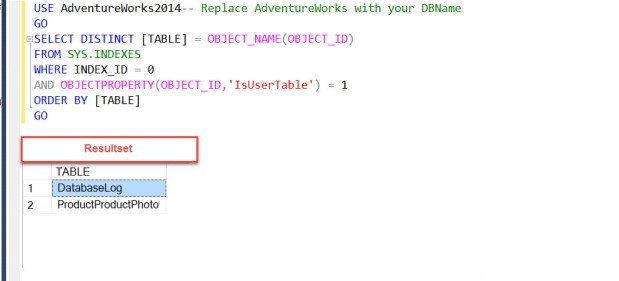
Question: How to Find Table Without Clustered Index (heap)?
Answer: In SQL Server, when we create a primary key it automatically creates clustered index on the table, unless we explicitly mentioned not to create one. Due to this reason, the most of the table where there is a primary key, there are good chances it is also a clustered index key.
Comparison – Understanding Tables Between Oracle and SQL Server
Oracle has a Heap-organized table which SQL Server calls “Heap”
Oracle’s “Clustered” tables are called “Indexed Views” in SQL Server
Both Oracle and SQL Server have “Partition” & “Temporary” tables
Oracle’s “External” tables are called “Linked Servers” in SQL Server.
Oracle’s “Object” table is called “Table Type” in SQL Server.
Oracle’s “Index-organized” tables are referred to as a “Clustered index” in SQL Server.
Oracle does not have an equivalent/term for SQL Server’s In-Memory OLTP table
And Oracle’s “Hybrid columnar” compressed tables are called “Column store clustered index” in SQL Server.
SQL SERVER – The NOLOCK Question – Notes from the Field #117
[Note from Pinal]: This is a 117th episode of Notes from the Field series. Everytime I go to do performance tuning consultancy, one thing annoys me and makes me angry. The usage of NOLOCK hint. I think without any argument, this is one of the most abused query hint in the SQL Server universe. Lots of people treat NOLOCK as a silver bullet of performance tuning and that is unfortunate. There is a special purpose of how NOLOCK should be used and what is the end goal of it.
In this episode of the Notes from the Field series database expert Stuart Ainsworth explains about NOLOCK and its best practices. Trust me, you do not want to overuse NOLOCK hint as it can just impact your database integrity negatively.






Is your SQL Server running slow and you want to speed it up without sharing server credentials? In my Comprehensive Database Performance Health Check, we can work together remotely and resolve your biggest performance troublemakers in less than 4 hours.
Once you learn my business secrets, you will fix the majority of problems in the future.

Have you ever opened any PowerPoint deck when you face SQL Server Performance Tuning emergencies? SQL Server Performance Tuning Practical Workshop is my MOST popular training with no PowerPoint presentations and 100% practical demonstrations.
Essentially I share my business secrets to optimize SQL Server performance.