
Question: Who changed a SQL login’s password? An audit record captured at the time can identify the principal and target login. Without suitable retained evidence, SQL Server cannot reliably reconstruct the actor after the event.

This came from a real client during an internal audit. Their sa password appeared to change unexpectedly, and they wanted to identify who was doing it before the external audit. I first checked whether the default trace had captured the needed event.
-- Read-only: inspect captured default-trace event classes if enabled.
DECLARE @TraceID int;
SELECT @TraceID=id FROM sys.traces WHERE is_default=1;
IF @TraceID IS NOT NULL
 SELECT DISTINCT e.trace_event_id,e.name
 FROM sys.fn_trace_geteventinfo(@TraceID) AS t
 JOIN sys.trace_events AS e ON e.trace_event_id=t.eventid
 WHERE e.name LIKE '%Audit%';
ELSE SELECT 'Default trace is not enabled' AS Information;

-- Historical unsupported investigation, templates only, NOT an audit trail:
-- USE master;
-- SELECT [Transaction SID],SUSER_SNAME([Transaction SID]) AS [Login Name]
-- FROM sys.fn_dblog(NULL,NULL) WHERE [Transaction Name]='ALTER LOGIN';
-- SELECT [Lock Information] FROM sys.fn_dblog(NULL,NULL)
-- WHERE [Lock Information] LIKE '%SERVER_PRINCIPAL%';
-- SELECT name FROM sys.server_principals WHERE principal_id=270;

-- Read an EXISTING approved file audit, using its actual path and permissions:
-- SELECT event_time,action_id,succeeded,server_principal_name,
--        target_server_principal_name
-- FROM sys.fn_get_audit_file(N'D:\SqlAudit\*.sqlaudit',DEFAULT,DEFAULT)
-- ORDER BY event_time DESC;
Check what was actually captured
The original trace inventory included Audit Login Change Property, not Audit Login Change Password. Those are different event classes. A current inventory can also be empty if the default trace is disabled, and its files roll over. Do not equate the absence of a retained event with proof that no password change occurred.
The historical log investigation was a clue
I explored the undocumented fn_dblog route in master. The original images showed an ALTER LOGIN transaction SID resolving to PinalDave, a SERVER_PRINCIPAL lock with principal_id 270, and that ID resolving to SQLLogin1.
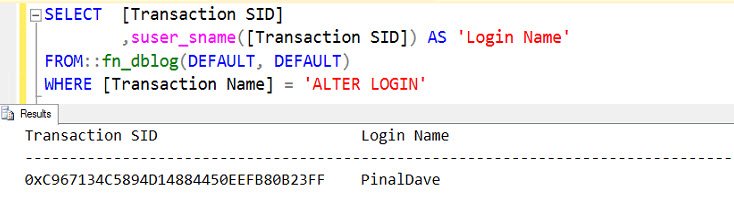

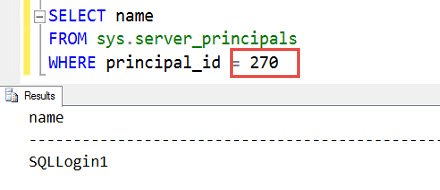
These clues are not sufficient to correlate every ALTER LOGIN record with every principal-lock record, and an ALTER LOGIN need not be a password change. In SIMPLE recovery, checkpoint can make inactive log space reusable; it does not instantly erase every older byte. The available clues depend on retention and reuse. Do not promise this unsupported method will answer the question.
Capture the next event deliberately
For ongoing monitoring, configure an approved SQL Server Audit with LOGIN_CHANGE_PASSWORD_GROUP and protect its target and retention. It records password changes through ALTER LOGIN or sp_password. Test both a successful and a failed change against a disposable login, and verify actor and target fields under the real access model before relying on it.
The file-reading template above reads an existing audit only. It does not enable auditing or create a login. I have omitted the old demonstration’s hard-coded passwords and disabled password policy; neither is needed to preserve the lesson.
Microsoft’s audit action groups identify the password-change group. The audit-file reference documents the actor and target fields.
Published by Pinal Dave on SQLAuthority. More of my work at pinaldave.com.
Discover more from SQL Authority with Pinal Dave
Subscribe to get the latest posts sent to your email.




11 Comments. Leave new
Hi, Just wanted to say THANK YOU for all of your posts over the years.
Very informative! Quite useful!
Questions such this are for me a great form of a self-test, helping me stay sharp. Thanks!
Hi Pinal, thank you for this very interesting posting. I did give the scripts a try but came up a different result in the query of finding out who changed the password. The Login Name is Null instead of my name. I was using Windows Authentication login. Would that be the cause of the problem?
Thanks again!
Yvonne
how about the sp_MSforeachdb undocumented procedure? This one is sooooo useful!
hello sir , im having a problem while installing a sql native client10, the system cannnot ope the device or file specified
I ran this query SELECT [Transaction SID]
,suser_sname([Transaction SID]) AS ‘Login Name’
FROM::fn_dblog(DEFAULT, DEFAULT)
WHERE [Transaction Name] = ‘ALTER LOGIN’
on a test server and it is running for over 6 minutes. Any idea on why?
This is a separate thing related to performance :D
fn_dblog is to read the log and based on size it might take time. Are you sure you can on master?
Hi, I find this usefull for ALTER LOGIN, but in my case I need something like the Title: “Who Changed the Password of SQL Login”. If I change default database for that login it will be a resault of that ALTER LOGIN change.
Is there a way to get ALTER LOGIN explicitly for changing password?
Thanks Pinal. Very Helpful post..