Part nine of ten. Every data professional knows garbage in, garbage out. AI adds a twist: the garbage comes out polished, fluent and sure of itself. This is the chapter where your years of data work become the advantage.
1. Why does data quality matter more with AI?
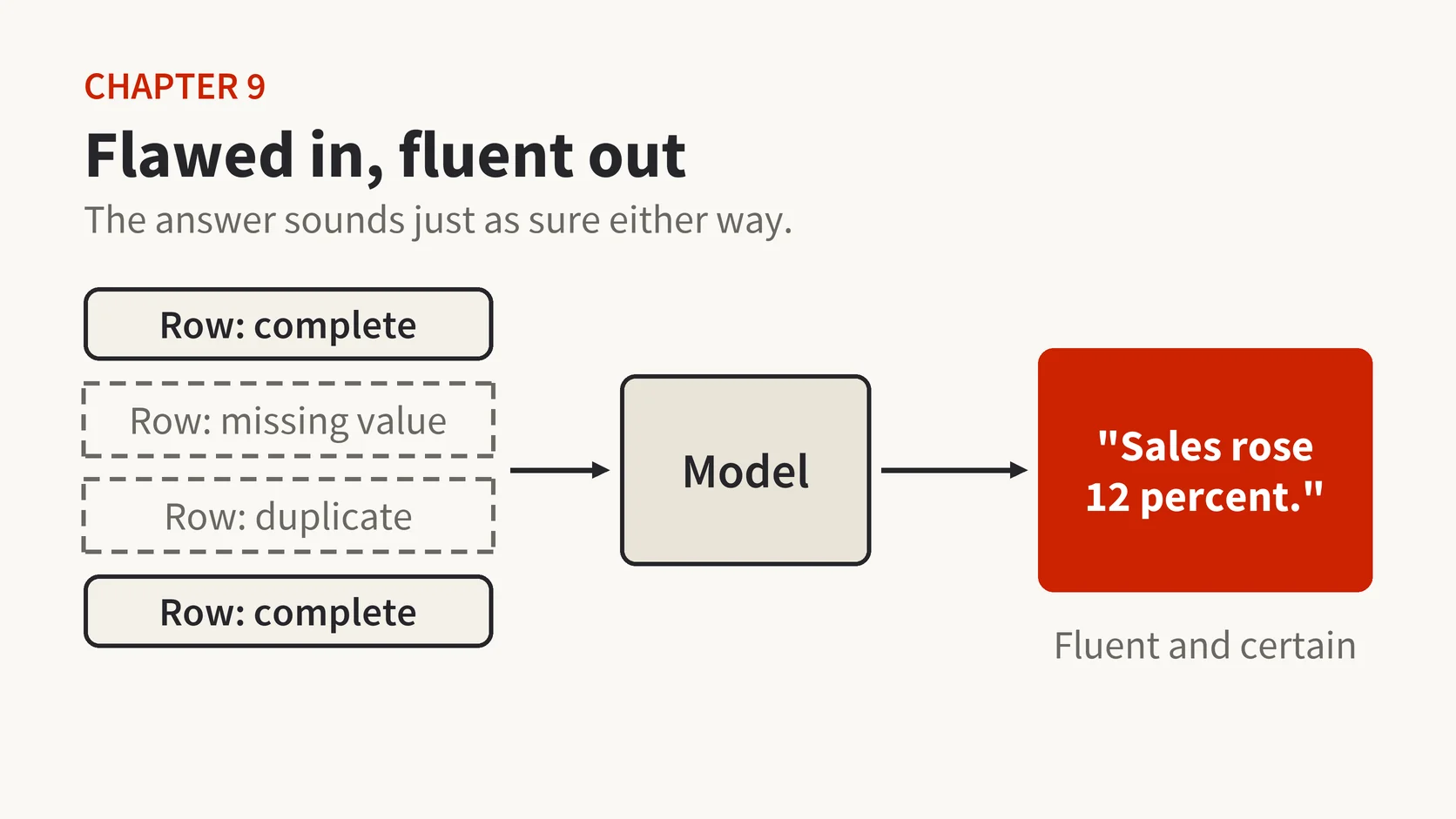
Because AI hides bad data behind good writing. A report with a wrong total looks wrong to a trained eye. A fluent AI summary built on the same wrong data sounds right to everyone.
Why it matters. AI also scales mistakes. One bad row can shape thousands of answers, recommendations or classifications before anyone notices.
Watch out. Don’t promise that a smarter model will fix messy data. It can smooth over the mess, which makes the mess harder to see.
2. How do missing values mislead AI?
A model can treat missing as meaning something, or quietly skip it. If a region’s sales are NULL because a feed failed, a summary can report that region as having no sales.
Why it matters. Missing data is rarely random. Blanks cluster in certain systems, time periods or groups, and that skews every answer built on them.
What the interviewer wants. A plan to measure missing values before use and decide per column: fill, flag or exclude. Saying “NULL isn’t zero” to a data interviewer earns a nod.
3. What is data drift?
Data drift is when production data changes from the data a model was built or tested on. New products, new customers or a changed form can all shift it. The model keeps answering as if nothing changed.
Why it matters. Drift is why an AI feature that worked in March misbehaves in September. Nobody changed the model, and the world changed under it.
Watch out. Drift isn’t only about numbers. A new product line, a renamed category or a new language in support tickets counts too.
4. How do you prepare PDFs and emails for AI?
Extract the text, clean it and add structure before embedding it. Parse PDFs and emails, run OCR on scans, and remove headers, footers and signatures. Keep metadata such as source, date and owner with every piece.
Why it matters. Most company knowledge lives in documents, not tables. A RAG system is only as good as the text it gets.
Watch out. Tables inside documents are the hardest part. Extract them as tables, not flattened text, or the numbers lose their meaning.
5. What is a data contract?
An agreement between the team that produces data and the teams that use it. It spells out the schema, meanings, quality rules and how changes will be announced. When the producer breaks it, checks fail before bad data reaches anyone downstream.
Why it matters. AI features sit downstream of many systems. A renamed column or a changed code value can quietly break a model’s inputs.
Watch out. Start small. One contract on the table your AI feature depends on most beats a company-wide programme that never ships.
Five minutes, any AI assistant
This list is small on purpose, so you can check every decision it makes:
How many unique customers are in this list? Jane Smith / JANE SMITH / J. Smith / Tom Brown / Tom Brown / N/A
What number did it give, and did it explain how it decided? Did it treat JANE SMITH and Jane Smith as one person? Did it ask whether J. Smith is Jane, or count N/A as a customer?
The list alone doesn’t tell you how many people are in it. A good answer separates distinct names from distinct people, and says so. Most first answers pick a number and move on.
That is the whole chapter in one exercise, and it’s the part of AI work you already know how to do.
Why this is worth a book
Chapter 9 has ten questions. It also covers duplicates, biased data producing biased output, and data leakage between training and testing. Then why freshness matters for RAG, and how to profile a dataset quickly.
Data leakage is the Senior one, and it’s a question a data person can answer better than most machine learning specialists. That’s worth knowing before you walk in.
100 AI Interview Questions and Answers for Data Professionals is in Kindle (also on Amazon.in), paperback and audiobook.
Part ten is the question everybody wants answered. Will AI replace your job?
Bad data is not fixed by a better model, it is only made to sound better.
Published by Pinal Dave on SQLAuthority. More of my work at pinaldave.com.
Discover more from SQL Authority with Pinal Dave
Subscribe to get the latest posts sent to your email.