
Integer division discards the fractional quotient, but the remainder can retain the unfinished part. I keep both results together when the consumer needs a complete signed decomposition.

A whole quotient does not tell the complete story
Integer division truncates the fractional part when both operands are integers. Seven divided by three therefore returns two. The remaining one still matters in a decomposition. It can be obtained through the remainder operator.
Negative inputs make the chosen quotient rule especially important. Truncation toward zero differs from a mathematical floor. A quotient of negative two for negative seven divided by three follows truncation. A floor-based decomposition would use another quotient and remainder.
I’d state that convention before exchanging quotient and remainder values with another system. Languages can use different signed division rules. Matching a positive example doesn’t establish matching negative behavior. Both signs need to be included in the comparison.
Retain both operands and both results
The script supplies positive and negative combinations of seven and three. It also includes exact division, zero and a missing dividend. Every divisor is nonzero. That keeps division-by-zero policy outside this particular demonstration.
The output shows the quotient, remainder and reconstructed dividend. Reconstruction multiplies the quotient by the divisor and then adds the remainder. It uses the same original divisor. Changing the divisor sign afterward would no longer describe the same decomposition.
Negative seven with divisor three yields quotient negative two and remainder negative one. Positive seven with divisor negative three yields quotient negative two and remainder positive one. The raw remainder follows the dividend’s sign in these selected cases.
WITH Inputs AS
(
    SELECT Id, Dividend, Divisor
    FROM (VALUES (1, 7, 3), (2, -7, 3), (3, 7, -3),
                 (4, -7, -3), (5, 6, 3), (6, 0, 3), (7, NULL, 3))
        AS v(Id, Dividend, Divisor)
)
SELECT i.Id, i.Dividend, i.Divisor, a.Quotient, a.Remainder,
       a.Quotient * i.Divisor + a.Remainder AS ReconstructedDividend
FROM Inputs AS i
CROSS APPLY (VALUES (i.Dividend / i.Divisor,
    i.Dividend % i.Divisor)) AS a(Quotient, Remainder)
ORDER BY i.Id;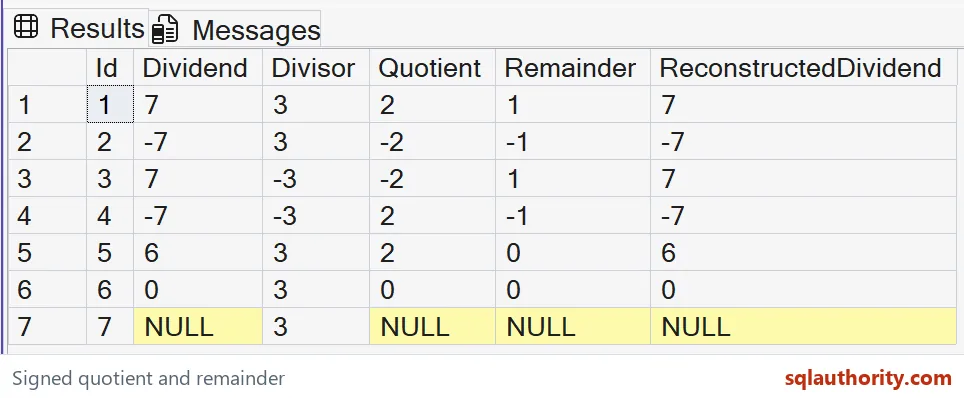

Separate truncation from floor-based grouping
A positive bucket calculation may normalize a signed remainder into another interval. That transformation changes the decomposition contract. It needs a corresponding quotient adjustment if reconstruction must still work. Don’t replace only one half while claiming the same identity.
I can justify floor-based division for some interval or calendar calculations. That would require an expression implementing the chosen rule. The ordinary integer division operator doesn’t infer it from a negative input. Keeping the raw pair visible prevents that accidental assumption.
A missing dividend produces missing arithmetic outputs. It is different from a zero dividend, whose quotient and remainder are both zero. No default is applied. The original operands retain enough context to understand each result.
Keep range and type limits explicit
The selected small integers keep all intermediate operations within int range. Other inputs can overflow division or the reconstruction multiplication. This example doesn’t claim a universal overflow-safe decomposition. Choose a suitable type and permitted input range before generalizing it.
The full script is a CTE and one read-only SELECT. It creates no objects and changes no settings. ORDER BY fixes the seven-row case sequence. Both signed combinations and the exact multiple remain in the output.
Compare every complete integer tuple with its original signed input. Check reconstructed values against their originals. Matching reconstruction alone doesn’t identify the quotient convention. Check the actual quotient and remainder too.
Keep the pair together, and the signs stay honest.
A quotient is not a full decomposition, it is half of a pair.
Published by Pinal Dave on SQLAuthority. More of my work at pinaldave.com.
Discover more from SQL Authority with Pinal Dave
Subscribe to get the latest posts sent to your email.


