
Question: How do I retrieve the second, or Nth, highest employee salary? First decide whether you mean the Nth distinct salary or the Nth employee after sorting. The original query answers the distinct-salary question and returns every employee tied at that level.

Some interview questions never seem to get old. I keep seeing this one when helping hire developers and DBAs. A candidate who asks what to do with equal salaries is already asking the right question.
DECLARE @Employee TABLE(EmployeeID int,Salary decimal(12,2));
INSERT @Employee VALUES(1,90000),(2,75000),(3,75000),(4,60000),(5,NULL);
DECLARE @N int=2;
-- Original correlated approach: count distinct salaries above this salary.
SELECT E1.EmployeeID,E1.Salary
FROM @Employee AS E1
WHERE E1.Salary IS NOT NULL
AND @N-1=(SELECT COUNT(DISTINCT E2.Salary)
          FROM @Employee AS E2 WHERE E2.Salary>E1.Salary)
ORDER BY E1.EmployeeID;

-- Equivalent distinct-salary ranking, retaining employees tied at that rank.
WITH Ranked AS
(
 SELECT EmployeeID,Salary,DENSE_RANK() OVER(ORDER BY Salary DESC) AS SalaryRank
 FROM @Employee WHERE Salary IS NOT NULL
)
SELECT EmployeeID,Salary FROM Ranked
WHERE SalaryRank=@N ORDER BY EmployeeID;
Both queries return employees 2 and 3, each earning 75000.00. There is one distinct salary above them: 90000. Ties do not consume additional salary levels.
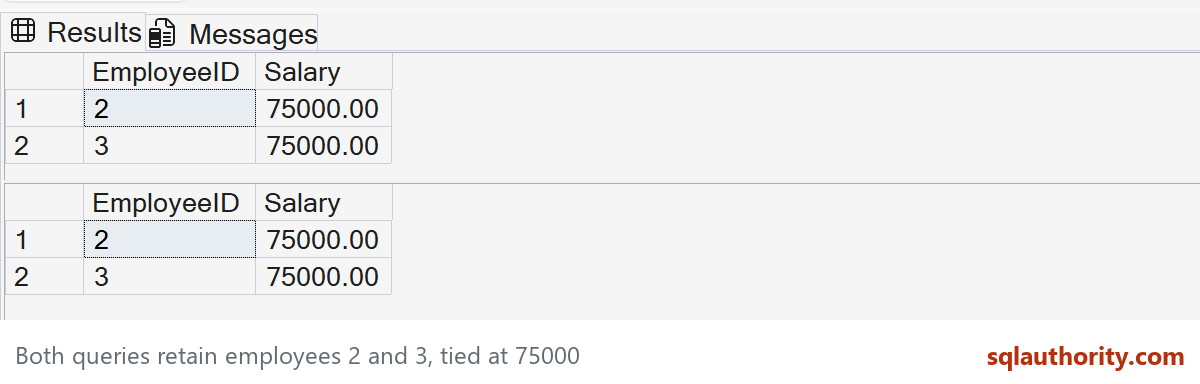
Finding the second highest salary with a correlated query
For a candidate amount, count the distinct higher salaries. Exactly N minus one higher levels means this is the Nth level. The reference to E1.Salary makes the subquery logically correlated; it does not require SQL Server physically to execute a separate subquery once per employee. Read the plan rather than assuming that implementation.
The NULL filter matters. With N=1, the original unfiltered query could also admit employees whose salary was unknown because no comparison is true for their NULL salary. An unknown value is not the highest known salary.
Ranking makes the tie policy visible
DENSE_RANK gives equal amounts the same rank without gaps. ROW_NUMBER instead chooses employee positions and needs a deterministic tie-breaker such as EmployeeID. RANK leaves gaps after ties, so its third rank is not necessarily the third distinct salary.
Use a positive N. When the table has fewer distinct known amounts than requested, these queries return no rows. Neither spelling is automatically faster for every table; data distribution, indexing and the plan decide the work.
Published by Pinal Dave on SQLAuthority. More of my work at pinaldave.com.
Discover more from SQL Authority with Pinal Dave
Subscribe to get the latest posts sent to your email.

10 Comments. Leave new
Do You think that ranking (dense_rank) could be a better way for similar queries in terms of clarity and execution cost ? Like:
WITH SalaryRanking_CTE AS
(
SELECT *,
DENSE_RANK() OVER (ORDER BY Salary DESC) as Ranking
FROM Salary
)
SELECT *
FROM SalaryRanking_CTE
WHERE Ranking = n
Sure. That would also work.
Hi Pinal, I’ve tried the script on SQL2012 and it does not recognized N in the Where clause. The error reads: Msg 207, Level 16, State 1, Line 4
Invalid column name ‘N’.
Do I miss something here? Thank you!
N is a variable.. declare @N int =2 .. then replace N with @N and this give you the second highest
Thanks for adding a comment.
Yvonne, if you’d like to run his query, replace “N” with either a constant (e.g. “2” to get the second highest salary) or declare a variable “@N” and set it to “2” (or whatever number you’d like).
— Using ROW_NUMBER()
SELECT *
FROM
(
SELECT ROW_NUMBER() OVER(ORDER BY Salary DESC) as rownum ,*
FROM Employee
) AS Employee
WHERE rownum = 2
WE can also use Offset and Fetch to get 2nd highest value
–Sample For Adventure works 2012
SELECT *
FROM HumanResources.EmployeePayHistory
ORDER BY Rate DESC
OFFSET 1 ROW FETCH NEXT 1 ROW ONLY
Offset can be used now to get value of any level
–For adventure works 2012
SELECT *
FROM HumanResources.EmployeePayHistory
ORDER BY Rate DESC
OFFSET 1 ROW FETCH NEXT 1 ROW ONLY
Simple query: select top 1 * from(select top 2 * from employee order by salary desc) order by salary asc