The job that was never there is the hardest one to explain. After the last post, my inbox filled up for four days. The hardest messages were not from people who had lost a job. They were from people who had gone outside, sat down, looked back, and realised they had never quite had one.

A few weeks ago I published an interview with somebody who finished their company’s AI development plan and was let go eleven days later.
I expected messages about the training. Those came.
The other kind I did not expect. There were more of them. They were worse. And every one of them circled the same thing without naming it, so I am going to name it here.
Losing the building was not the painful part.
That came about six weeks later, from a distance, when they finally looked back and saw what had actually been filling each day.
The usual note, and this time it matters more. Everything here is blended across many messages, reshaped so that no person, company, industry or system is identifiable. Titles, numbers and details are changed. And nobody in this piece is a fraud. I want that on the record before you read a word of it, not after.
The Number

I will start with the one I cannot put down.
Somebody wrote to me whose job, for six years, was a weekly number. It went out every Monday to a list of about forty people.
It took most of Thursday and all of Friday morning, because the sources disagreed and reconciling them required knowing exactly where every body was buried.
They knew.
They were good at it. By every measure that existed inside that company, they were excellent at it.
Two months after they were let go, they asked a former colleague to check something. They could not fully explain to me why.
Nobody had asked for the number.
Not once. Eight Mondays. Forty people on that list, and not one had noticed the email had stopped. Or they had noticed, and it had not been worth a message.
They said they sat with the laptop open for a long time.
They said the strange thing was that they were not angry. They were embarrassed, which they knew made no sense. And underneath the embarrassment was something worse.
It was relief.
They did not want to talk about the relief. I understand why. Relief means part of you already knew, and that part has been sitting quietly at the back of every Monday for six years, waiting to be proved right.
Eleven Leads and One Thing Being Led
Another message opened with a sentence I have thought about every day since.
I was the Regional Lead.
They wrote it the way you write something you are proud of. They should have been. It took eleven years.
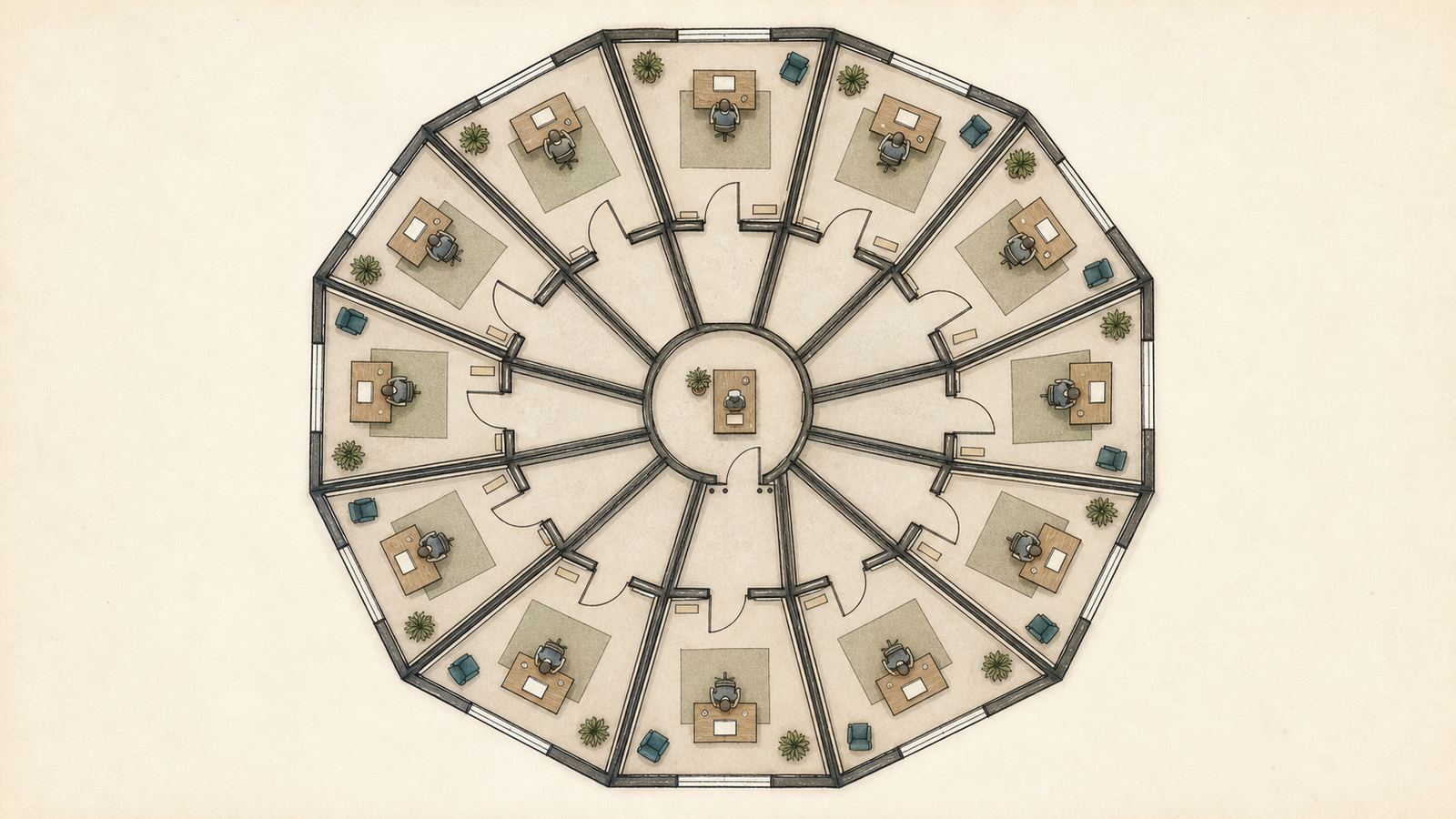
Two paragraphs later, almost in passing, they listed the other people who sat in the same weekly meeting.
The Global Lead. The Product Lead. The Platform Lead. The Security Lead. The Delivery Lead. The Data Lead. The Governance Lead. The Transformation Lead. The Value Realisation Lead. A Regional Lead for a different region. A Chief of Staff belonging to one of the above.
Eleven job titles. One thing being led.
They wrote: “I counted them on the train home. Then I counted them again, because I assumed I had made a mistake.”
Now here is the part that should worry you, and it is not the part you are expecting.
Every one of those eleven was real. Every one worked hard. Every one of them could have explained to you, in detail, with evidence, exactly why their role existed and precisely how it differed from the other ten.
And they would all have been right.
Because each of those functions was invented on a Tuesday, by somebody sensible, solving a genuine problem that genuinely existed at the time.
Nobody has ever been given the job of removing one.
So they accumulate. A ring of invented functions forms around one real one, the way a pearl forms, slowly and without anybody’s permission, and after fifteen years nobody in the room can tell you which one was the grain of sand.
Which Brings Me to the Uncomfortable Bit
I have gone back and forth on this and landed somewhere I did not expect.
The people were innocent. The ecosystem was not.
You did not invent your title. You applied for it. Somebody described it to you across a table, and you believed them, because why on earth would you not.
You did the work you were handed. You were measured against objectives you did not write, by a person who did not write them either, using a framework nobody in the building could name the origin of.
You are not guilty of anything.
But you were standing inside something that had stopped being honest with itself long before you arrived, and it needed you to keep standing there in order to keep going.
That is not guilt. It is not innocence either.
There is no word for it, and I think the absence of that word is a large part of why none of these people could say any of this out loud until a stranger wrote a blog post.
The Tuesday You Already Knew
Here is something almost every one of them mentioned, and not one of them mentioned first.
They already knew.
Not fully. Not in a way you could act on. But there was a Tuesday, three or four or nine years ago, in the middle of something ordinary, when a thought arrived fully formed and completely unwelcome.
What am I actually doing.
And you pushed it back down. Instantly. Expertly. The way you push down a thought about your own death, because you had a mortgage and a review coming up and two people at home who needed you to be fine.
You did not lie to yourself.
You simply declined to finish a sentence.
You did not lie to yourself. You just chose, every day for years, not to finish one sentence.
I think almost everybody reading this has had that Tuesday. I suspect some of you had it recently.
And I think you did exactly what they did, which is the only sane thing available at the time, which is nothing at all.
Twenty Two Meetings and Four Sentences
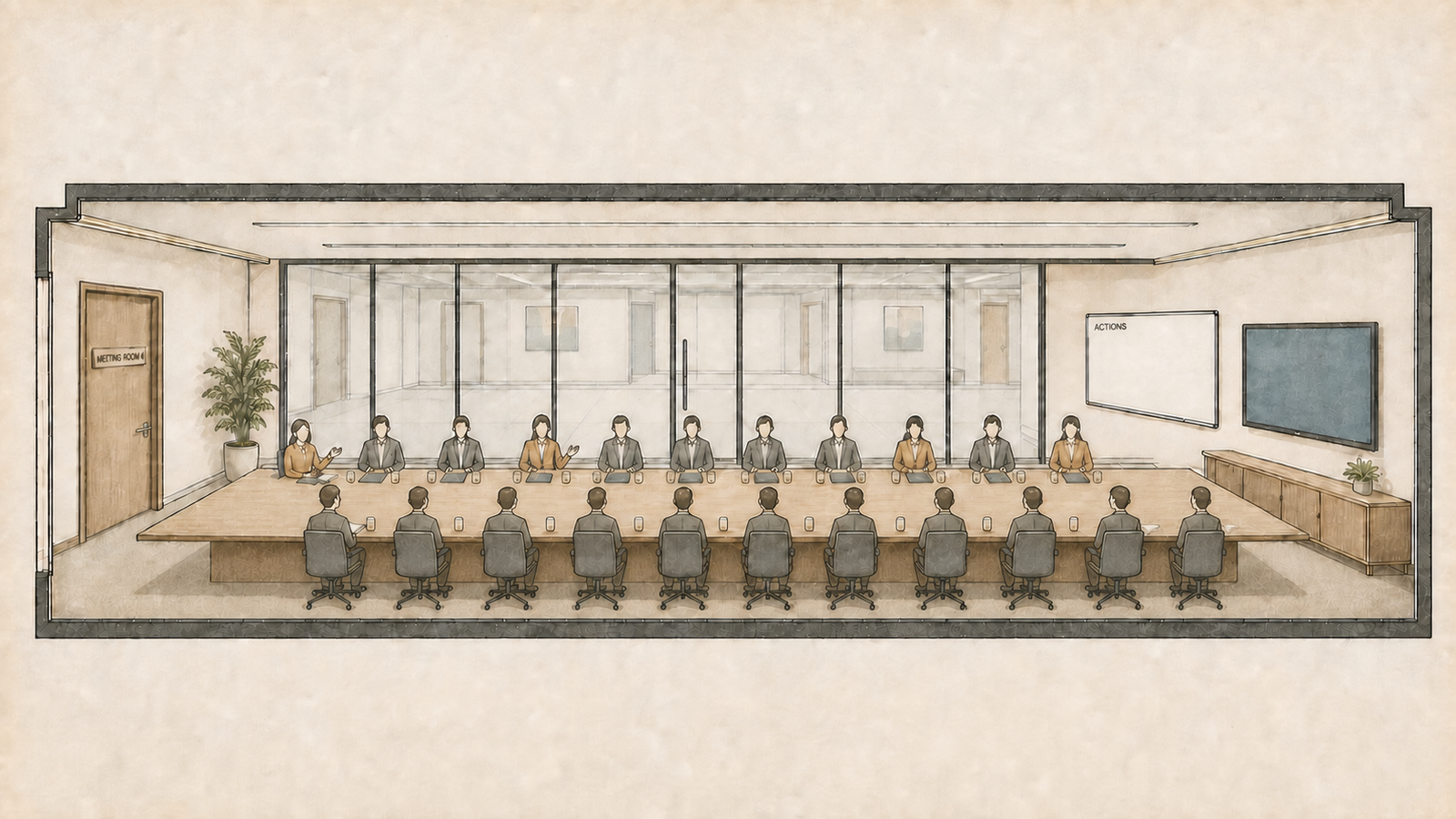
Somebody who had been a Senior Manager for Operational Excellence, a real title held by real people in a great many companies, which I have never once heard defined twice the same way.
In their final month, out of an instinct they could not name, they exported their own calendar.
Twenty two recurring meetings. Governance forums. Alignment calls. Steering committees. Working groups.
They went through them one at a time and asked the most dangerous question in corporate life.
In how many of these have I ever actually said anything?
Four.
In the other eighteen they were, in their own word, coverage. Their name on the invite meant the function was represented. The representation justified the function. The function justified the headcount. The headcount justified somebody more senior.
Nobody designed that. I need you to hear that clearly.
It accreted. Like coral. Beautiful, structural, and entirely made of things that used to be alive.
The Deck That Became a Department

Years ago, somebody noticed a real problem. A good observation, made by a person paying attention.
They wrote it up with evidence. It was well received, because it was correct.
They were asked to propose a solution. So they wrote a strategy document. Also well received.
Then came headcount. Two people. Then five. Then a Head of. Then a function on the org chart with a mission statement, quarterly objectives, and a shared inbox.
Somewhere in year three, the original problem was quietly solved by a platform migration that had nothing to do with any of them.
The function ran for another four years.
“I built a department out of being right once, and then spent four years protecting a thing whose reason had already gone. At the time it felt like leadership.”
It does not sound like failure to me. It sounds like almost every organisation I have ever walked into.
Eleven Months of Green

So many people wrote about status reporting that I could have stacked the messages.
A programme reports green. Then green. Then green.
Eleven consecutive months of green, on a dashboard seen by important people.
In month twelve it is cancelled.
Everybody knew by month three.
What none of them could do was be the first to write amber. Amber is not a colour in those meetings. It is an accusation. It points at a specific person’s judgment, and the room hears it that way however carefully you word it.
One of them told me about a colleague who did go amber. Early, honestly, with a plan attached.
That colleague was not punished. That would have been easier to describe.
They were offered support. There was a warm conversation about whether they were overloaded. Somebody senior was added to help them. Their scope reduced quietly over the following two quarters.
Everybody watched. Everybody learned. Nobody ever discussed it.
Green is not a measurement. Green is a social act.
The Boarding Pass
Somebody sent me a photograph of a boarding pass. It took me a moment to understand why, and then I found it almost unbearable.
They had been flown to another country for a two day alignment workshop. Sixteen people. Four flown in. A facilitator. Breakout groups. Sticky notes, first physical, then carefully transcribed onto a digital board so the outputs would be preserved.
They looked that board up recently.
Still there. Read only. Last opened four days after the workshop.
By them.
They were careful to tell me it was not a waste, and I believe them. They met people they went on to work well with for years. Two decisions came out of it that stuck.
Then they wrote this, and it is the line I keep returning to.
“If somebody had told me to stay home and just send an email, I would have argued. I would have argued hard. That is the part I have to sit with.”
The Award
Somebody won an internal award. A real one. Ceremony, photograph, their manager visibly proud in a way they told me they still think about, years later.
It was for delivering a migration ahead of schedule.
They know now, with the terrible clarity that only arrives from outside the building, that they migrated a system almost nobody used onto a platform almost nobody would use. On time. Under budget. Beautifully.
They still have it. They cannot throw it away and they cannot look at it.
So it lives in a box, which seems to me like exactly the right place for most of what this piece is about.
The One That Actually Hurts
Four separate people wrote to me about this, and every single one of them apologised for bringing it up.
You onboarded somebody.
A bright young person, three or four years ago. Genuinely talented. Delighted to be there. Nervous on the first morning in the way that is lovely to see.
And you taught them.
You explained which forum things get raised in. You showed them how to write a status update that is honest and survivable at the same time. You told them, kindly, patiently, with total sincerity, who has to be told before the meeting rather than during it.
You were a good mentor.
That is the terrible part. You were an excellent mentor. Several people have probably told you so.
You handed a twenty six year old the complete operating manual for a machine you had not yet noticed was hollow.
One of them wrote: “They are still there. They are doing my old job now. They are very good at it.”
I could not get that sentence out of my head for a week, and I am not sure I have managed it yet.
What Is Actually Happening Here
The cheap version of this argument is that these people were passengers and the market simply corrected.
That version is lazy, and it is cruel to people who worked extremely hard for a very long time.
Here is what I think is really going on.
Past a certain size, an organisation loses the ability to see value directly. It genuinely cannot tell, from the centre, whether the work at the edges produces anything.
So it measures what it can see. Attendance. Reports. Status. Delivery against a plan it wrote itself.
Activity.
And people, being reasonable, supply activity. Not cynically. Not as a scheme. They supply it because it is what gets noticed, and being noticed is how you keep a job, and keeping a job is how you feed the people in your house.
Every individual behaved rationally. The result was a building full of intelligent, sincere, hard working people producing artefacts for one another.
Manufactured work is not fraud. It is what grows in the gap between what an organisation values and what it is able to measure.
That gap has been widening for twenty years. And now something has arrived that produces artefacts instantly, for free, in unlimited quantity.
The gap is no longer possible to look away from.
The Cruel Part Nobody Warns You About
Several of them worked this out alone, in different countries, at different times. Each thought it was a private discovery.
The skills that kept you employed there do not exist anywhere else.
Knowing which forum to raise something in. Knowing who has to be told before the meeting rather than during it. Writing a status update that is honest and survivable at the same time. Knowing whose sign off is real and whose is decorative.
Those are genuine skills. They are hard won. Several of the people who wrote to me were world class at them.
None of it transfers. Not one item.
It is all local knowledge about one building, and the building is gone.
Which produces the specific cruelty in all of this. The people who were best at surviving that system are the ones it left with the least, and they cannot even name the problem in an interview, because the honest sentence is:
“I was extremely good at something I can no longer describe.”
The Sentence You Lost
And here is a thing that never comes up in a redundancy conversation, because there is no box for it on the form.
You did not only lose a job.
You lost a sentence.
Regional Lead was not a title. It was the sentence your parents used when their friends asked what you did. It was the answer you gave at your cousin’s wedding when somebody asked. It was on a lanyard that your child once wore around the house for an entire afternoon because they thought it was hilarious.
That sentence is gone. There is nothing to put in its place yet.
And you still have to attend things. People still ask.
Nobody prepares you for how much of your identity was living inside a sentence you did not even write.
The Message That Was Not From Somebody Laid Off
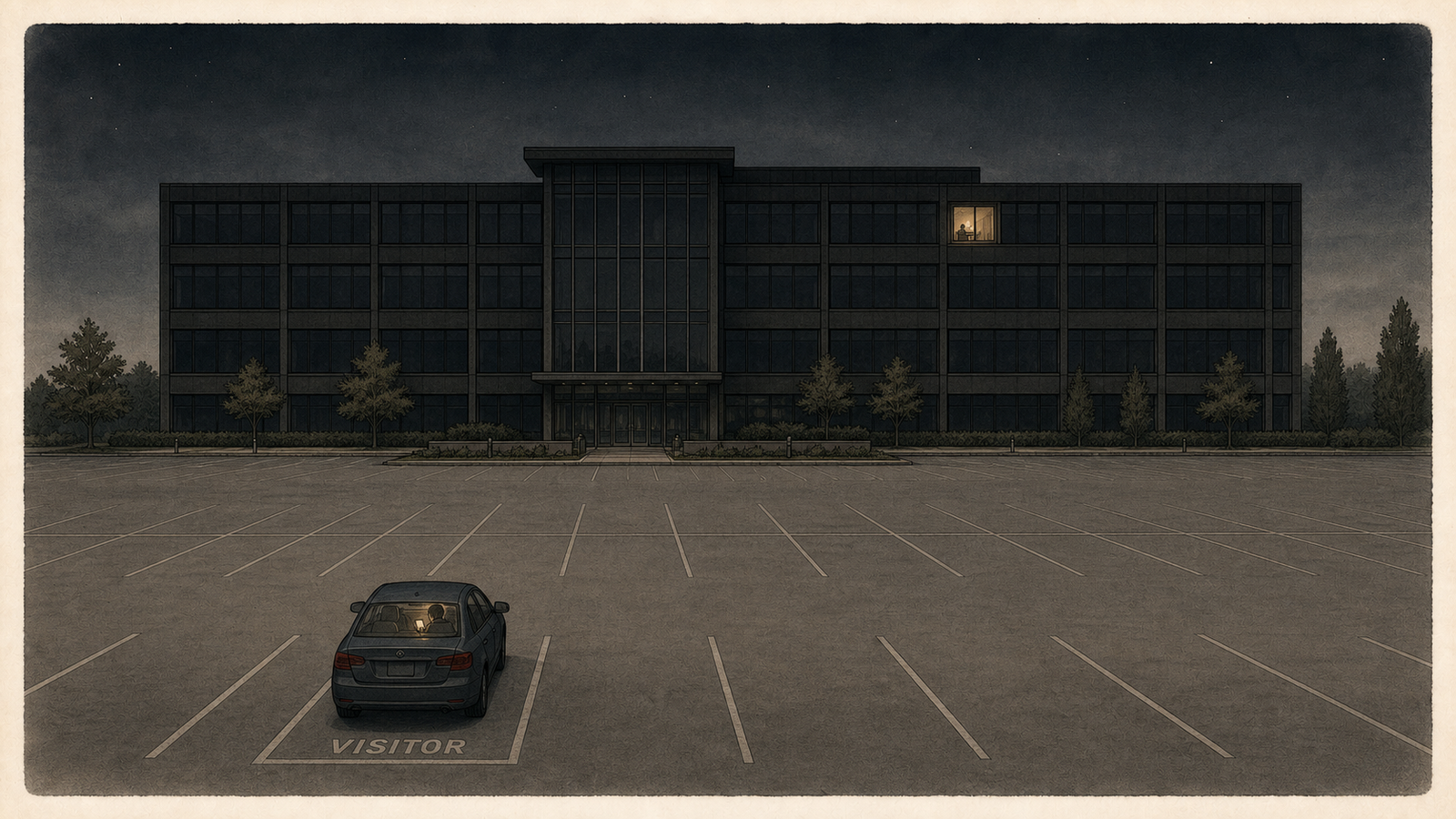
One of them still had their job.
It arrived at eleven at night. It was four lines long.
They had read the piece at their desk, twice, and then sat in their car in the car park for a while before driving home. They wanted me to know that. They asked me not to reply, which I have honoured until now.
The last line was this.
“I am not laid off. I am worse. I know.”
If that is you, reading this at your desk right now with the door open behind you, I do not have anything clever. I have only this. Knowing is the hard part and you have already done it. Everything after knowing is just decisions, and decisions are survivable.
The Question I Have Started Asking
I am not going to hand you a framework. Every person in this piece is cleverer than a framework.
But there is one question I now ask clients, and it is rude, and I ask it anyway.
If this person went on leave tomorrow and nobody backfilled them, what breaks, and how long before anybody outside this team notices?
The point is not to be indispensable. Indispensable people are a risk, and usually an unhappy one.
The point is that somebody should know the answer. In most places I visit, nobody has ever asked.
And the version for you, on a Monday, is smaller and harder.
Open last week’s calendar. Find the one thing you did that would still have been worth doing if the company had not existed.
If you find it, protect it. That is the part that travels with you.
If you cannot find one, you have not learned something shameful about yourself. You have learned something about the shape of the room you are standing in.
And it is very much better to learn that on a Monday morning with a coffee than eight weeks after somebody takes your laptop.
The Thing They All Did Without Noticing

I want to end somewhere kinder, and I can, because there is something in these messages that surprised me and not one of them saw themselves doing it.
Every single person, at some point in their email, stopped talking about the work.
And started talking about a person.
The colleague who quietly covered for them the fortnight their parent was ill. The one who always made two teas without being asked. The one who explained the same thing four times and never once let them feel stupid about it. The Friday messages.
Not one of those was invented. Not one was manufactured. Nobody was ever inserted into a meeting to justify headcount and accidentally produced eleven years of friendship.
The building was hollow. The people standing in it were not.
If you take one thing from all of this, take that one.
The work may or may not have been real. That question is worth asking and you should ask it.
But the person who noticed you were having a bad day and said nothing about it and simply put a coffee on your desk was completely real. They are still real. Nothing that happened to your company changed that.
And you can message them tonight.
This is the question underneath all thirty essays in my book AI: Nobody’s in There. But we’re still in here. All thirty are free to read at pinaldave.com, and the book is available in paperback, Kindle and audiobook on Amazon.
One last message, and then I will stop.
It came at the end of a very long email describing a career I would have been proud of, containing real achievements that I could see clearly and the writer could not see at all.
The final line was this.
“I keep telling people I lost my job. I do not think that is what happened. I think I found out.”
This is not a story about people who were not needed, it is a story about a building that could not tell the difference and quietly asked them to prove it every single day.
Published by Pinal Dave on SQLAuthority. More of my work at pinaldave.com.
Discover more from SQL Authority with Pinal Dave
Subscribe to get the latest posts sent to your email.