
Two query lines are on the page. One looks longer. Look once, make a choice, and then look again.
I have spent years looking at execution plans. The lines, boxes and arrows can make an expensive operation look important before I have read a single number. That is useful when the picture points me to a place worth investigating. It is less useful when I start treating the size of a drawing as evidence.
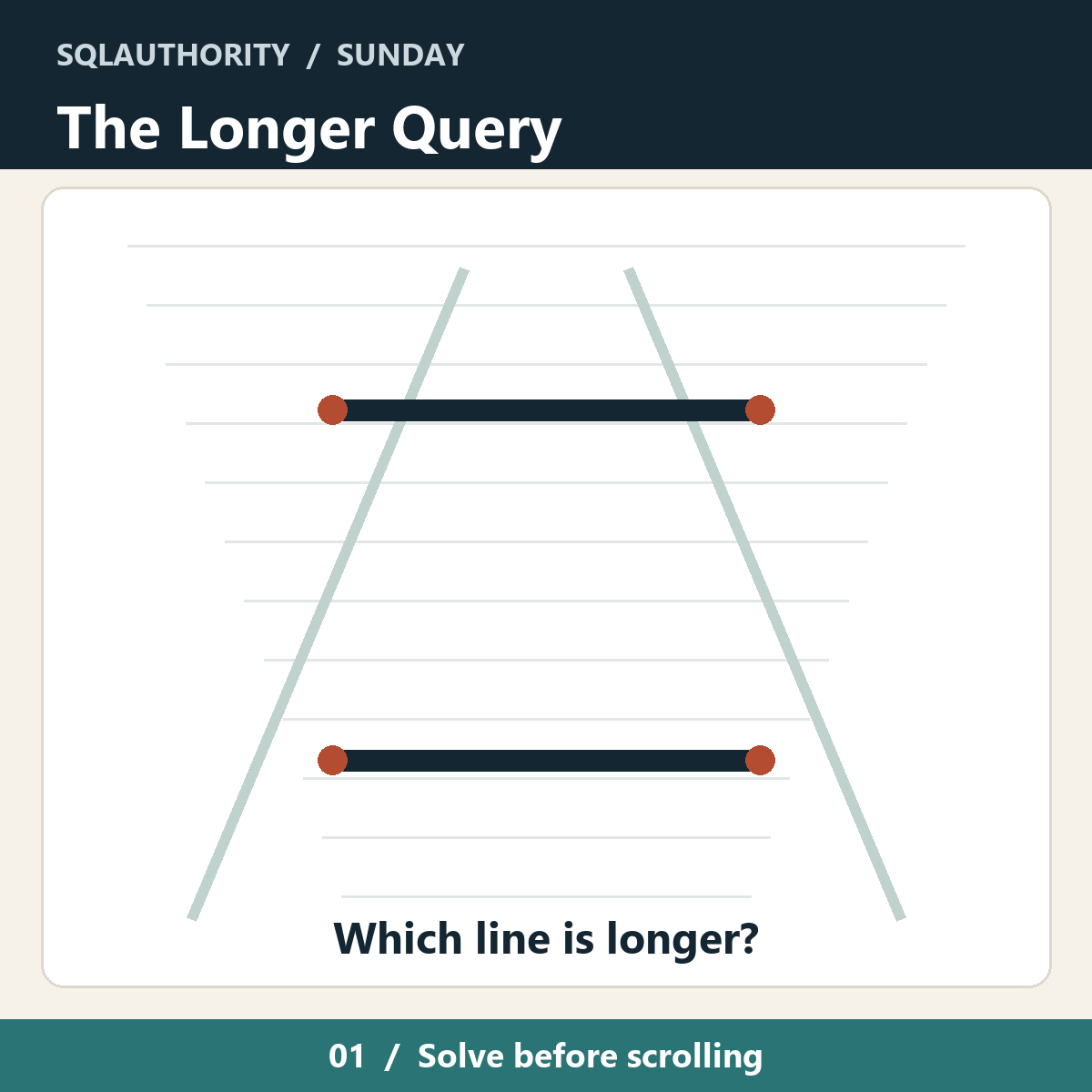
For today's Sunday puzzle, look at the two dark horizontal lines in the picture. The upper one sits near the narrow end of a server aisle. The lower one sits near the wide end. Do not measure them yet. Which line looks longer to you? If someone else is nearby, ask them before you scroll. It is more fun when two people are confidently wrong in different directions.
The illustration was drawn to a fixed grid. There is no animation and nothing changes when you look away. Give your eyes five seconds, then read the answer.
The Longer Query Answer
The lines are exactly the same length. Each starts at the same horizontal position and ends at the same horizontal position. The corridor lines around them converge, so your brain reads the upper line as farther away and adjusts its apparent size. The bar did not grow; the scene changed the way you judged it.
You can check without trusting me. Cover the aisle with two strips of paper or place a ruler on your screen. The end dots line up. In the source drawing both bars run from x = 365 to x = 835, a length of 470 pixels. I kept the coordinates identical because a good puzzle should have an answer you can verify.
This is not a lesson that pictures are bad. Pictures help us notice patterns quickly. It is a reminder to let the picture start a question rather than finish an investigation. When a query seems much heavier than its neighbour, I still want elapsed time, reads and the actual plan before I decide what to fix.
Next time a chart or a plan seems obvious at a glance, take one more glance at its scale. Sunday is a good day to practise that small pause.
Published by Pinal Dave on SQLAuthority. More of my work at pinaldave.com.
